
Yamaha patent points to a roadgoing electric sportbike
A new patent shows a street-oriented electric motorcycle related in design to Yamaha’s Proto BEV, with Type 2 charging and an unusual braking layout.

3 min read
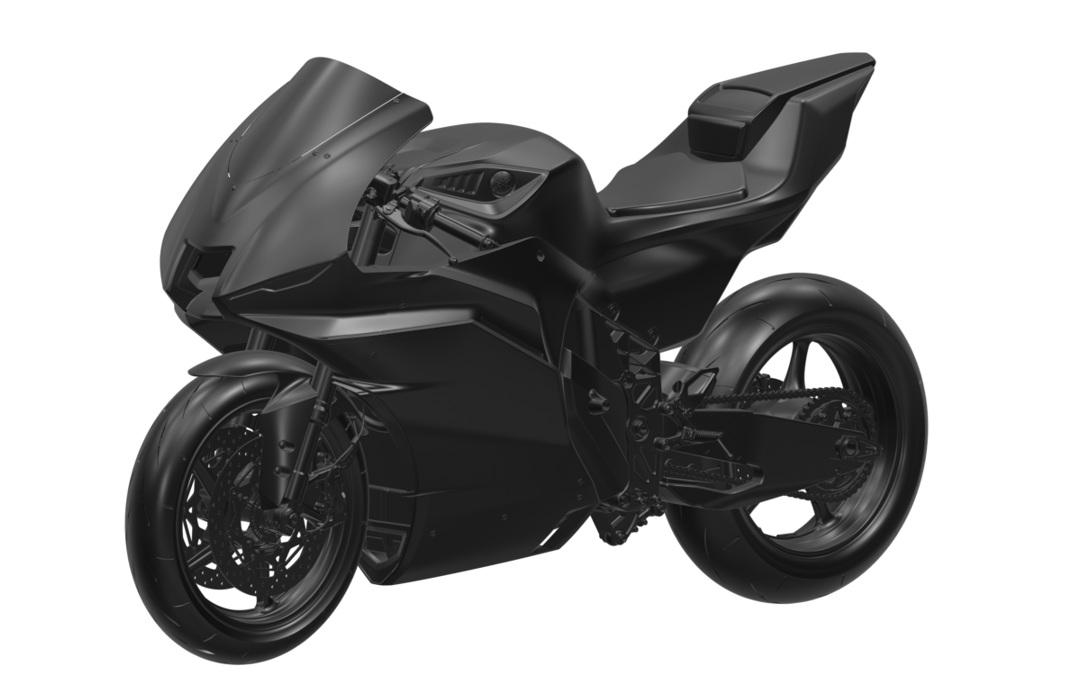
Yamaha appears to be continuing development of a roadgoing electric sportbike, according to a newly published patent. The filing does not confirm a production model, launch date or final specification sheet, but its illustrations show a street-oriented motorcycle that shares the general design language of the track-only Proto BEV project displayed at the previous year’s Tokyo Mobility Show.
Yamaha has offered electric models—technically scooters—in Asian and European showrooms for more than two decades. Electric motorcycles, however, have not entered the mainstream as quickly as early adopters predicted, while combustion-powered machines remain dominant in sales charts. Manufacturers continue to develop the technology nonetheless, and this patent suggests Yamaha’s work is moving beyond a display or track-focused concept.
A sportbike layout built around the battery
The patented motorcycle uses a beam-style frame arranged around a large battery pack. Its apparent dimensions are similar to those of Yamaha’s YZF-R7, although no production measurements are provided. The battery case is made from die-cast aluminium and also serves as structural support for components mounted to it. A motor controller sits in the belly pan immediately ahead of the motor, while the charge controller is mounted above the large, rectangular battery pack.
Rear brake on the left handlebar
Most of the patent concerns the braking system. The design removes the conventional foot-operated rear brake pedal and places the rear-brake control on a lever on the left handlebar, where a clutch lever would ordinarily be found.
Yamaha is also seeking protection for the position of the ABS hydraulic control unit. It is bolted immediately behind the steering head rather than being located beneath the seat. According to the patent, this arrangement shortens the hydraulic hoses connecting the unit with the front and rear master cylinders, potentially improving the antilock system’s response time. Whether Yamaha can secure meaningful protection for that placement remains uncertain, since other manufacturers have used similar ABS locations.
Type 2 charging and a possible Honda rival
The patent refers to an AC fast-charging system using a Mennekes/Type 2 connector, the same type identified with Honda’s WN7 and widely used for single-phase and three-phase charging in European markets. The motorcycle is described as compatible with 7.4 kW single-phase chargers and 22 kW three-phase chargers—substantially faster than a household socket. Only a small number of current electric motorcycles are described as offering a comparable setup, including some Zero models, Can-Am’s Pulse and Origin, and Honda’s WN7.
That charging hardware may indicate a battery and performance target above those of many current electric motorcycles, but the patent provides no battery capacity, range, power output, price or confirmed performance figures. Yamaha’s development could eventually form the basis of a rival to Honda’s WN7, described here as the first large, high-performance, mass-produced electric motorcycle from one of Japan’s Big Four manufacturers. Any suggestion that Yamaha could be first with a direct competitor also depends on the WN7 becoming a sales success. For now, the filing is evidence of continued development—not an announcement of a ready-to-launch motorcycle.
THE EVIDENCE BEHIND THE STORY
Sources
Spotted something that needs correcting? Contact the editorial team ↗