
Honda’s V3R pairs a 900cc V3 engine with electric supercharging
Honda describes the V3R as the first production four-stroke V3 motorcycle, using an electric supercharger to target 1200cc-equivalent performance from an approximately 900cc engine.

4 min read
Honda’s V3R is described as the world’s first production four-stroke V3 motorcycle, built around a 75-degree V3 engine of approximately 900cc. Its defining feature is an electric supercharger, which Honda says is intended to deliver performance equivalent to a 1200cc engine. The claimed objective is not simply more output: the system is presented as a route to 1200cc-level performance from a smaller package that should also be more fuel-efficient and emissions-friendly than a 1200cc engine.
Boost when it is needed
The additional technical detail has emerged through a group of patent applications rather than a Honda press release. Their key implication is that the electric compressor can reach full pressure whenever required, without waiting for engine speed or exhaust-gas velocity to build boost progressively as a conventional turbocharger does. It also does not depend on a mechanical drive from the engine in the way a conventional mechanically driven supercharger does.
The supercharger is designed to operate only part of the time. When the riding conditions call for extra performance, its electric motor can activate it on demand. When boost is unnecessary, the V3R can bypass the compressor and function as a naturally aspirated engine. Honda’s stated intention is to avoid consuming engine performance when the added pressure is not required, while also avoiding the need for a large battery to store the energy needed to run the system. A smaller and lighter electric-supercharger installation is the proposed result, although no battery capacity, power, torque or weight figures have been disclosed in the available evidence.
How the intake system is packaged
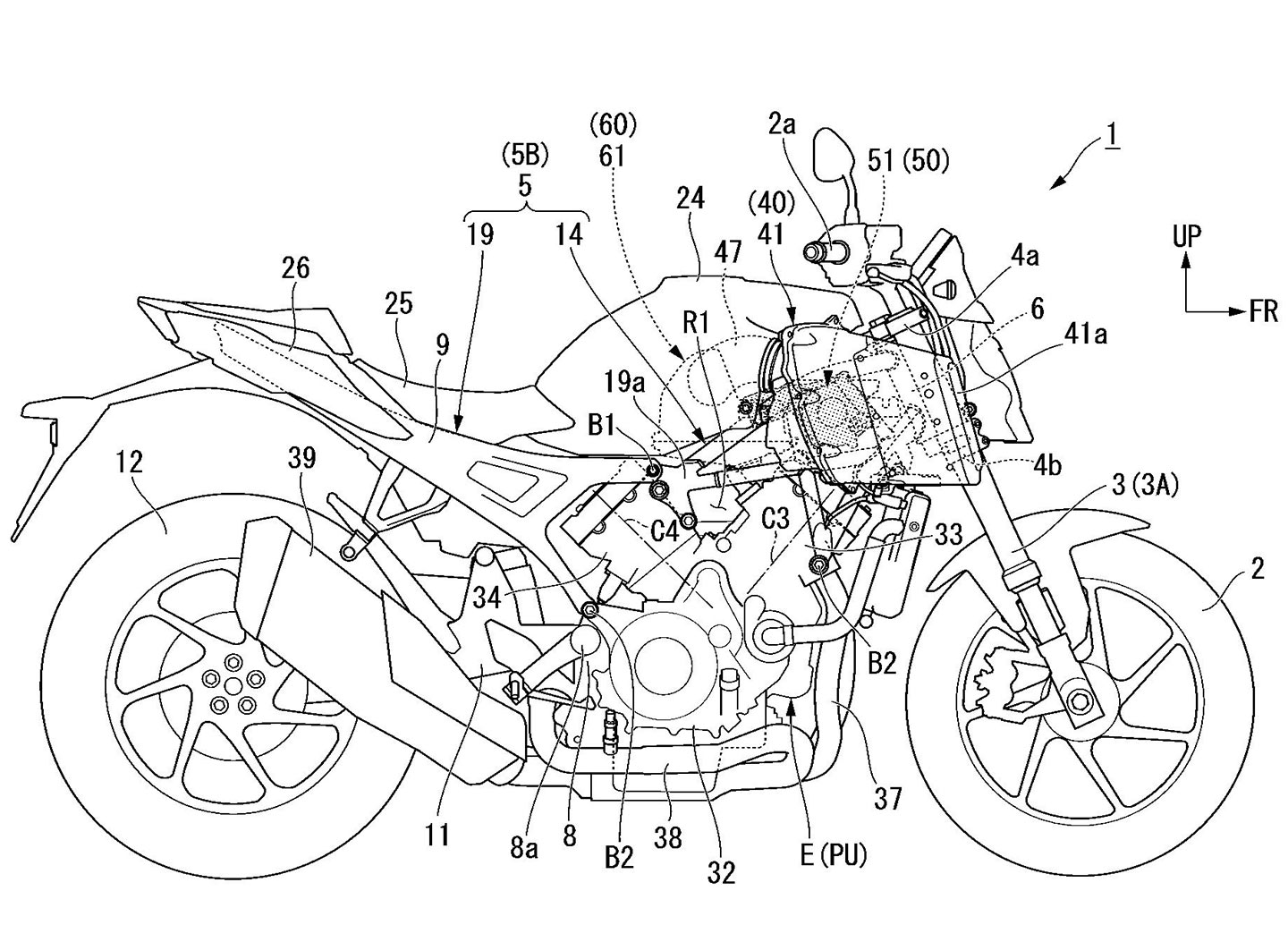
The prototype engine was first displayed in a placeholder chassis in 2024. In that layout, the electric supercharger and its motor sit between the frame rails, immediately behind the steering head. This places the heavier compressor hardware near the motorcycle’s centre, while shortening the duct that carries pressurised air to the intake plenum.
The plenum sits above the engine’s three throttle bodies, inside the V formed by the cylinders. Its role is to equalise intake-air pressure before the air reaches the throttle bodies. The compressor and plenum occupy the space normally taken by an airbox on a naturally aspirated motorcycle, so Honda places the V3R’s filter housing and intake on the motorcycle’s right-hand side instead.
That arrangement produced an asymmetrical design on the near-finished prototype displayed the following year. The appearance may take some getting used to, but the airbox and intake are relatively light compared with the compressor and motor. Moving the lighter hardware away from the centre is therefore presented as a logical packaging solution, while the more substantial components remain centralised. The evidence supports this mass and packaging explanation, not a measured handling advantage.
After air passes through the filter, it can take one of two routes. One duct leads to the supercharger inlet. A second curves from the rear of the filter housing to the plenum above the throttle bodies, allowing the air to bypass the compressor. When the supercharger is pressurising the plenum, an electronic valve closes the bypass so that pressurised air cannot escape back into the airbox. When the compressor is inactive, the valve opens and the engine operates naturally aspirated.
A V3R, or a wider engine family?
The V3R is identified in the patent material as the initial application of the electric-supercharger system. The same documents indicate that Honda may apply it to other motorcycle models and engine configurations, including V-twin, V-4, V-5 and V-6 layouts. They specifically describe a V-5 with three cylinders in the front bank and two in the rear.
That detail could indicate that Honda is considering such an engine, although the patent may also be covering possible applications broadly. The V3R’s suggested 300cc cylinders could theoretically form layouts ranging from a 600cc V-twin to an 1800cc V-6, with electric supercharging applied to each. The article estimates that the system could add approximately one-third more performance than the same engines would produce without it; this remains a projection rather than an independently verified test result.
If the concept develops beyond the V3R, supercharged V-layout engines would give Honda a distinctive technical direction in an increasingly homogeneous motorcycle market. Honda has historically been regarded as one of the industry’s more innovative manufacturers, while its big-bike innovation has slowed as the company focused on emerging markets. The V3R and its potential derivatives are presented as a possible return to that earlier approach. The publication’s editorial staff says it is eager to ride the V3R when it is released.
THE EVIDENCE BEHIND THE STORY
Sources
Spotted something that needs correcting? Contact the editorial team ↗