
Aegis Rider puts spatially anchored HUD inside a motorcycle helmet
The helmet-mounted system projects navigation, speed and warnings ahead of the motorcycle, while cameras and sensors keep the image aligned with the bike.

4 min read
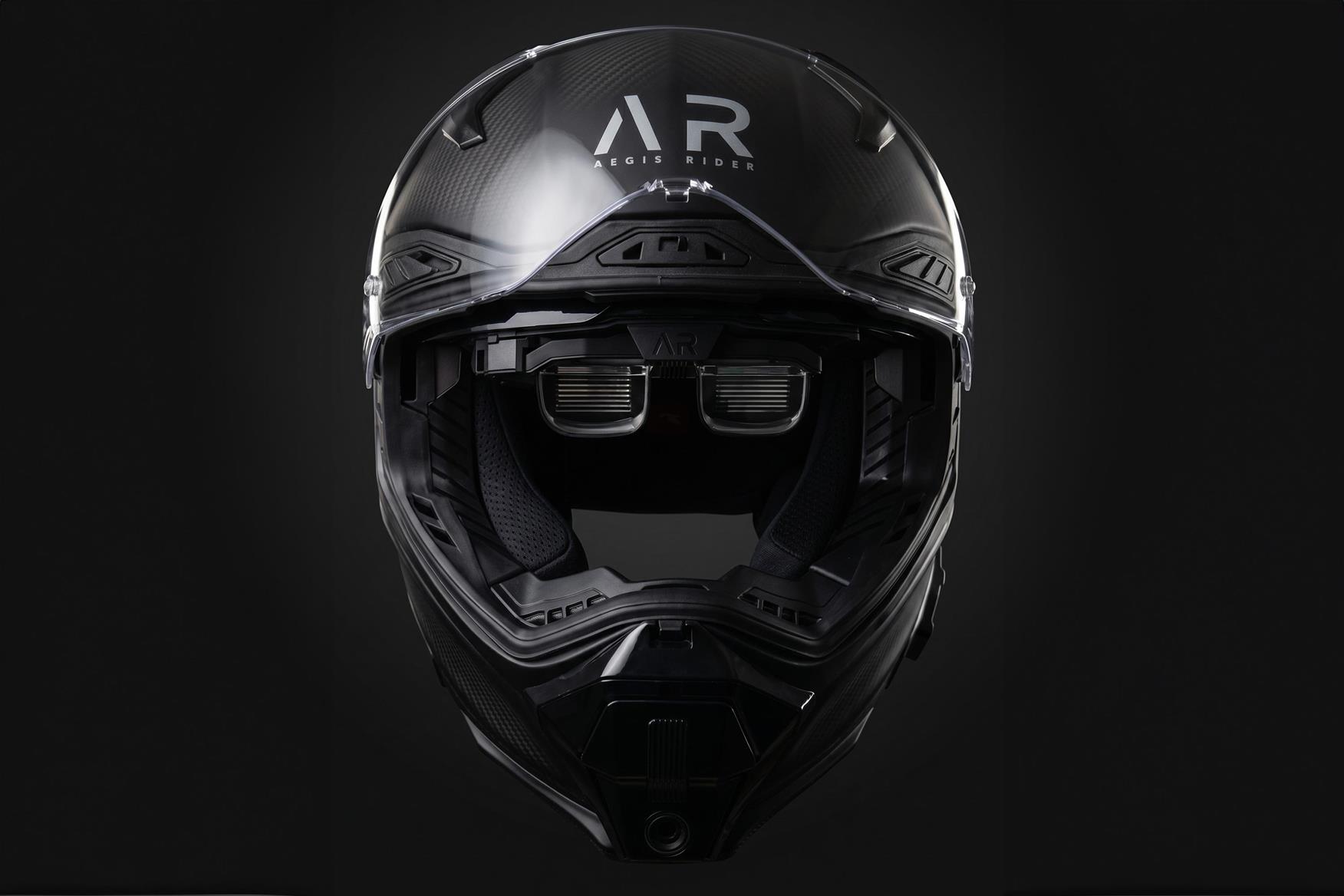
Aegis Rider has released a helmet-mounted heads-up display designed to place navigation instructions, speed information and warnings in the rider’s forward view. The system uses a spectacle-like display mounted behind the visor, but its most significant feature is that the graphics are anchored to the motorcycle rather than tracking the rider’s eyes. Turn your head to check a junction and the display remains positioned ahead of the bike instead of moving across the rider’s field of view.
The system can show three-dimensional arrows at the junction where a turn is required, with a simpler presentation available for riders who prefer less prominent graphics. Simon Hecker, Aegis Rider’s founder and CEO, describes the fixed relationship between the display and the motorcycle as the core of the technology. In his view, keeping information attached to the vehicle frame can be less distracting than requiring the rider to look down, while the company’s stated aim is not to interfere with the riding experience.
How the image stays in place
A small camera positioned in the helmet’s chin area uses image recognition and algorithms to measure the helmet’s position relative to the motorcycle. Inertial sensors add data covering three axes of movement and three axes of rotation. The motorcycle’s own position is supplied in one of two ways: through a smartphone secured in a fixed mount, or through Aegis Rider’s separate Pro-Box.
Each motorcycle must be calibrated before it is added to the app’s AR Vision Garage. The process takes 10 minutes and includes five left turns, five right turns and 45 seconds of straight riding at a constant speed. It must also include more than five minutes of riding at 12mph. During this procedure, the helmet camera learns where the front of the motorcycle is, allowing the system to place the graphics on the road in the correct direction. The Garage can hold up to five motorcycles, so riders can switch between them in the app.
Calibration is tied to the position of the phone mount or Pro-Box. Moving either one to another location on the motorcycle means the procedure has to be repeated. That requirement is important to the system’s operation: the display is not simply showing an arrow in the rider’s general direction, but attempting to maintain a stable relationship with the bike as both helmet and motorcycle move.
Cameras, recording and helmet equipment
A front action camera records at 1080p and 30fps. Its 128GB storage is said to accommodate up to 20 hours of riding footage, while recorded clips can be retrieved over Wi-Fi through the app. A second camera at the rear is intended to identify objects in the rider’s blind spot and provide a warning. That function is still in development and is planned as a future software update rather than a feature that is already active.
The electronics are integrated into a Nexx X.WST3 helmet, with the electrical installation carried out at Nexx’s factory in Portugal. The helmet has a carbon-fibre shell and is supplied with clear and dark visors plus a Pinlock insert. With the Aegis Rider hardware installed, the complete helmet weighs around 2kg, which makes it heavier than an average helmet. Prescription-lens wearers can use their glasses with the system, and the display also works with the helmet’s drop-down tinted sun visor. A dedicated night mode is included.
An intercom system is built into the helmet, including speakers and a microphone. Bluetooth 5.2 connects it to a phone for navigation notifications, music and calls. The helmet meets ECE 22.06 certification requirements, while the added Aegis Rider equipment is tested under the UA, or Universal Accessories, classification. A two-year warranty is included. Prices start at £1399, and the finish currently listed is matte carbon.
Hecker says Aegis Rider originally began with a safety focus and investigated a curve-warning system. The problem was how to communicate a warning without making the rider look down at an indicator. That thinking led to the heads-up display now used for navigation and other information. The rear blind-spot function remains part of the company’s future development, but the helmet already combines the anchored display, recording camera and communications equipment in one unit.
THE EVIDENCE BEHIND THE STORY
Sources
Spotted something that needs correcting? Contact the editorial team ↗