
WMC Mono RR channels air through the motorcycle
White Motorcycle Concepts has built a running Krämer-based demonstrator with a supercharged single, a central duct and ambitious aerodynamic targets.

6 min read
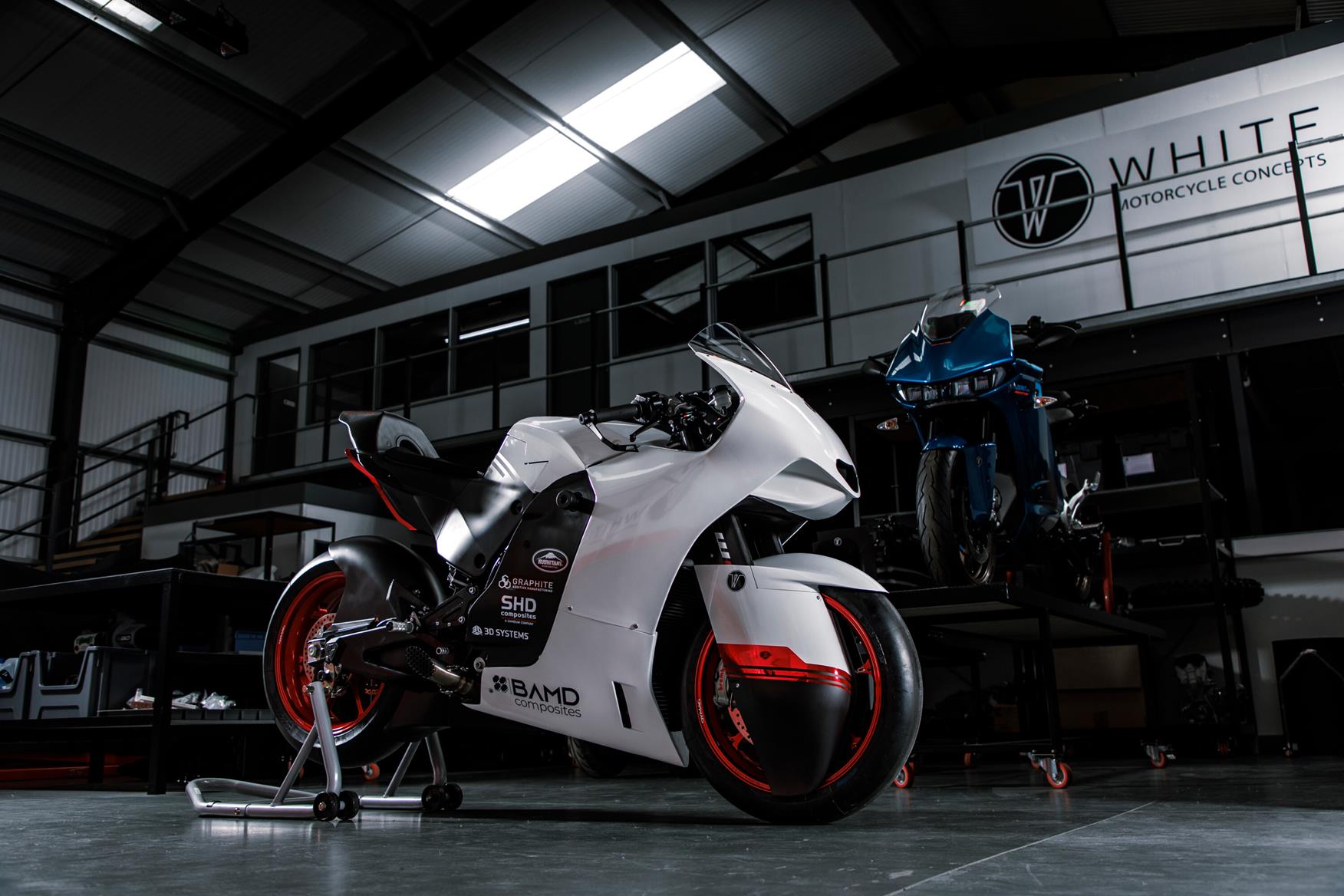
White Motorcycle Concepts has built the WMC Mono RR, a one-off running demonstrator that treats a motorcycle’s engine, chassis, rider and airflow as one engineering problem. Based on the Krämer EVO2 690R, the machine replaces the track bike’s conventional packaging with a large duct running through its centre. Air enters beneath the nose fairing and exits below the rider’s seat, rather than being forced entirely around the outside of the motorcycle.
The purpose is broader than adding aerodynamic winglets or reshaping a fairing in isolation. WMC wants to demonstrate that aerodynamic efficiency can be designed into a motorcycle from the beginning while preserving the familiar sports-bike riding position. The project is intended to improve performance and efficiency without simply relying on a larger engine or abandoning internal-combustion power.
The result is a substantial re-engineering exercise rather than a cosmetic bodywork change. The existing chassis, suspension and brakes have been retained, but the area normally occupied by several engine and fuel-system components has been reorganised around the duct. WMC says the work was carried out over 18 months, and the finished motorcycle now functions as a technology demonstrator rather than a production proposal.
A smaller single with forced induction
The Krämer’s original KTM-derived 693cc single-cylinder engine had to make way for a 449cc single derived from Yamaha’s YZ450F motocross motorcycle. Its reverse-cylinder-head layout places the intake at the front and the exhaust at the rear. That arrangement helps separate the cooler intake flow from hot exhaust gases, while also creating the space needed for the central aerodynamic passage.
The smaller engine is not being used in standard form. WMC has added a crank-driven Rotrex C15-20 supercharger, an intercooler and revised fuel-injection hardware. The supercharger is mounted on the right side of the engine and sends air towards the intercooler through a narrow pipe that runs around the outside of the duct. A specially shaped plenum passes through the central area above the cylinder head before feeding the combustion chamber.
The installation required more than forced-induction hardware. The engine internals were reworked with, among other changes, a new piston and crank. WMC also had to package the supercharger’s traction fluid and other external components while keeping the new engine inside the standard trellis frame. The stated objective is to approach the performance of the larger engine used by the original Krämer rather than accept the output normally associated with the smaller single.
Initial power development is aimed at approximately 75hp, close to the 76hp figure associated with the standard Krämer. WMC’s longer-term target is to move towards 100hp. Neither number is presented as a completed measured output from the Mono RR. Weight is also a target: the donor bike is listed at 125kg, while the project aims eventually to reach 100kg. That reduction remains part of the development plan.
The duct shapes the whole motorcycle
The central passage begins with an intake in the front fairing. Two additional openings in the bodywork direct air towards the intercooler, while the main flow continues through the motorcycle and leaves beneath the seat. Because the air is guided more cleanly through the centre, the side fairings have gained carbon extensions that shield the rider’s legs and knees from the altered airflow.
WMC has also modified the front mudguard, fork shrouds and fairing. A carbon-fibre shroud covers the front brake disc, the rear hugger is larger and made from carbon, and extra surfaces beneath the belly pan and swingarm are intended to reduce turbulence around the rear wheel. These details show that the aerodynamic concept is not limited to the visible opening in the nose: the motorcycle has been treated as a connected flow-management system.
The rear section of the duct combines Kevlar-reinforced carbon fibre with an aluminium core. It is fused with the fuel tank area, which sits in front of the rider beneath a cover instead of occupying the rear of the seat as on the conventional Krämer layout. Both the fuel-tank arrangement and the duct section contribute to the motorcycle’s structural and packaging strategy.
WMC’s computational fluid-dynamics work indicates a 16.4 per cent reduction in CdA compared with the standard motorcycle. The company also projects a 16 per cent improvement in thermal management, a 7 per cent improvement in fuel efficiency and a 3 per cent increase in top speed. Its modelling gives a 111 per cent improvement in the lift-to-drag ratio. These are simulation results and development projections, not a substitute for a completed wind-tunnel or track validation programme.
The new side extensions are aimed specifically at the wake around the rider. Robert White, WMC’s founder and chief executive, explained that the cleaner central flow remains attached to the motorcycle and can otherwise run into the rider’s knees. With the extensions fitted, the team says rider drag has been reduced by 30.4 newtons compared with the base machine. The claim illustrates why WMC has treated the rider as part of the aerodynamic design instead of measuring only the bare motorcycle.
A running prototype, not a showroom model
The Mono RR is already operational. Its right-side exhaust produces the sound expected from a high-performance combustion engine, accompanied by the distinctive mechanical noise of the supercharger. That running status matters because the project is intended to retain the character associated with an engine, gearbox, clutch and vibration while exploring lower aerodynamic and fuel demands.
White says a future development direction could involve synthetic or carbon-neutral fuel, but the current motorcycle is presented as a demonstration of engineering possibilities rather than as such a finished fuel solution. The company’s stated aim is to show that a lighter, more efficient and better-performing combustion motorcycle need not automatically sacrifice noise, mechanical involvement or the conventional riding experience.
Before the physical parts were produced, WMC used computer-aided design to examine multiple duct and bodywork concepts. Three-dimensional scans of a rider were incorporated into simulations covering acceleration, braking and cornering. The next development stage is wind-tunnel and track testing, which will compare the aerodynamic predictions with measurements and with the motorcycle’s behaviour in operation.
That testing will determine how much of the projected benefit survives outside the computer model. For now, the Mono RR’s importance lies in its method: the central duct, compact supercharged engine, fuel placement, rider shielding and retained chassis have been developed as parts of one package. The donor motorcycle keeps its seat height, riding position, wheelbase and chassis geometry, showing the route WMC believes could allow similar principles to be applied to existing motorcycle platforms without automatically designing an entirely new chassis.
White Motorcycle Concepts is an engineering and technology company, not a motorcycle manufacturer, and the Mono RR is not intended for series production. The project is instead meant to demonstrate technology that could eventually be licensed to established road or racing motorcycle manufacturers. Its immediate value is therefore as a full-scale, running test bed for integrating aerodynamics with combustion power, rather than as a new Krämer variant that buyers can order.
THE EVIDENCE BEHIND THE STORY
Sources
Spotted something that needs correcting? Contact the editorial team ↗