
CFMoto’s V4 reveals its engineering ambitions
Eleven patents point to variable intake hardware, a stressed engine and possible turbocharging without confirming a production version.

3 min read
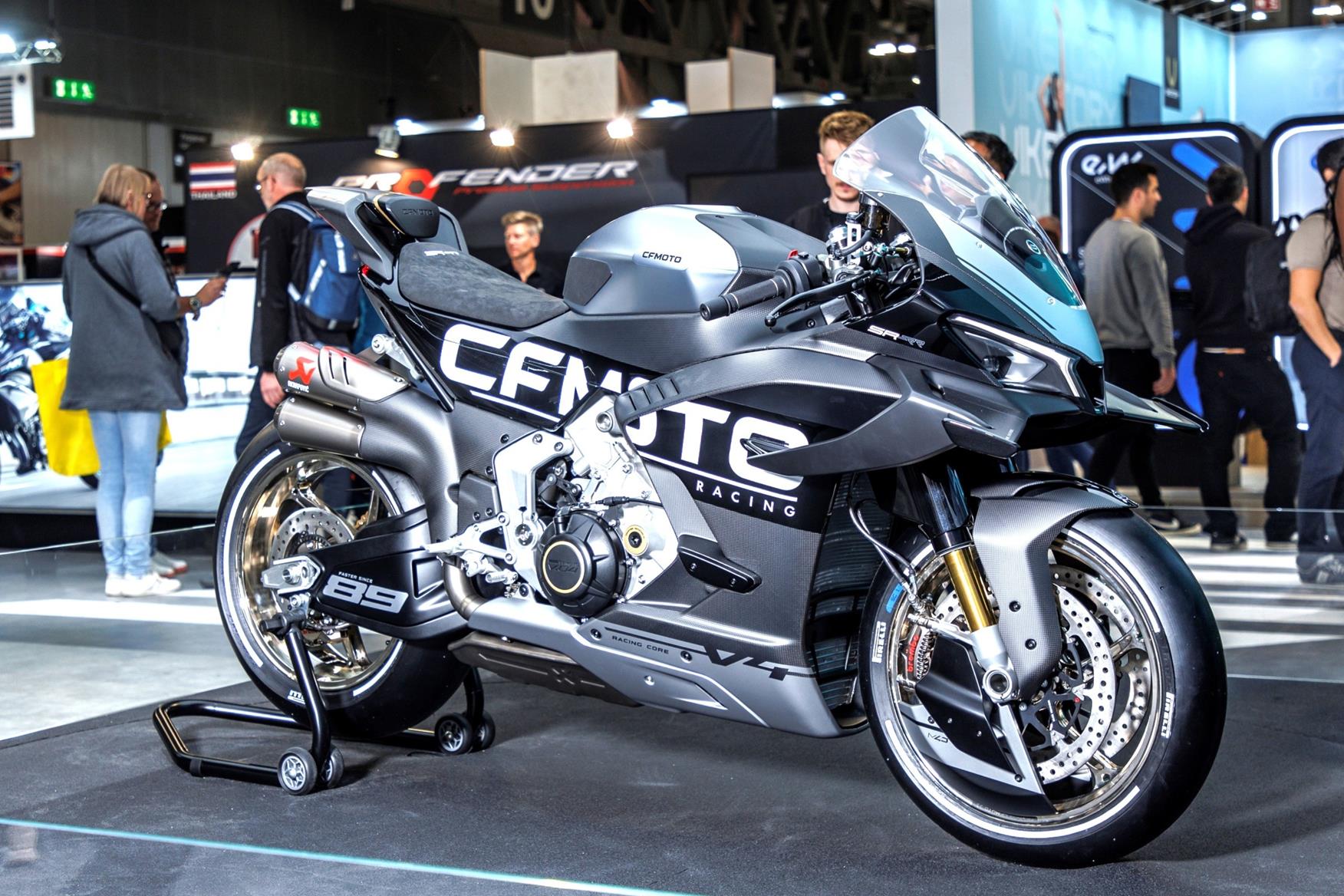
CFMoto’s new V4 is revealing considerably more than a headline power figure. Eleven patent applications filed in China provide a detailed look at the engine’s packaging, from its variable-length intake to the arrangement of its cam drive. Some descriptions also account for turbocharging, although they do not confirm that a forced-induction production motorcycle is planned.
The basic engine is a 997cc 90-degree V4 with an 81mm bore and a 48.4mm stroke. CFMoto has claimed at least 207bhp, a 14,500rpm redline and 84.1lb.ft of torque. The engine is listed at a suggested 61.5kg. Its contra-rotating crankshaft is intended to reduce gyroscopic forces and help the motorcycle change direction more quickly.
The prototype engine was shown at EICMA in 2024, followed a year later by the complete motorcycle. CFMoto has also released footage of Moto2 rider David Alonso riding a development machine in China. That progression places the V4 beyond a static engineering exercise and into the development of a working motorcycle.
An intake system with two operating profiles
The patent drawings describe a variable-length intake system built around two-piece trumpets. The lower sections remain fixed, while shorter upper sections sit on a frame moved by a small electric motor. The arrangement changes the effective intake geometry as engine speed rises, rather than relying on one fixed trumpet length across the rev range.
At lower speeds, the upper sections lift, allowing air to enter around their edges as well as through the trumpets. The stated objective is stronger torque in that part of the operating range. At higher revs, the upper sections drop onto the fixed portions and create a longer intake path, a configuration associated in the technical description with improved peak power.
A stressed V4 with compact cam drive
The engine is also a fully structural part of the motorcycle. A short cast-aluminium front frame bolts to the cylinder heads, while intake air travels through the steering head and into the airbox to use the ram-air effect. The layout concentrates the chassis and engine interfaces around a compact power unit.
The cam-drive system follows the same packaging-first approach. The front cylinder bank is driven by a chain on the left-hand side and the rear bank by a chain on the right. Those chains drive the intake camshafts, with gears then transferring drive to the exhaust camshafts. The gears sit between the camshaft sections rather than at their outer ends, allowing shorter chains that can be tensioned more easily while keeping the engine compact.
The cylinder heads are similarly concentrated. The throttle bodies bolt directly to the heads without a separate manifold, and the valve train uses finger followers. This differs from the shim-and-bucket arrangement associated with Aprilia’s V4 engines and from Ducati’s desmodromic system, placing CFMoto’s design among the distinct solutions used in high-performance V4s.
What the turbo reference does—and does not—mean
Several patents describe a turbocharged configuration in which the turbocharger is mounted at the cylinder head. For the naturally aspirated version, the exhaust gases instead leave through a conventional exhaust-manifold arrangement. That wording indicates that the underlying architecture may have been prepared for more than one application, but it is not confirmation of a production turbocharged motorcycle. For now, the project remains centred on a naturally aspirated V4 whose claimed figures place it firmly in serious superbike territory.
THE EVIDENCE BEHIND THE STORY
Sources
Spotted something that needs correcting? Contact the editorial team ↗