
2026.5 Harley-Davidson FXD Super Glide revisits the factory-custom idea
Harley-Davidson’s numbered FXD Super Glide combines the visual language of the 1971 original with a Softail chassis, Milwaukee-Eight 117 power and modern brakes—but not its controversial boattail.

9 min read
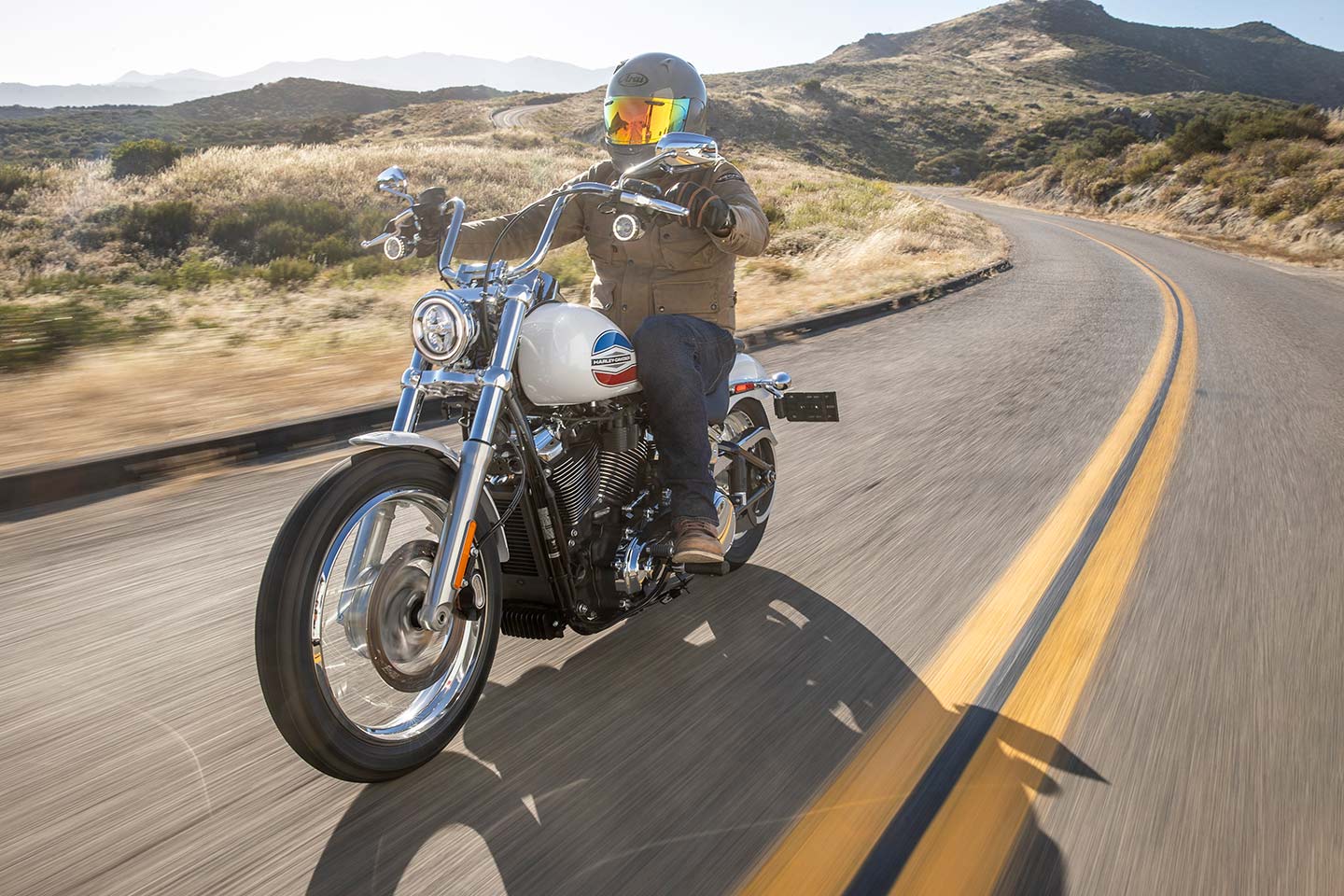
Harley-Davidson has brought back the Super Glide as the 2026.5 FXD Super Glide, a numbered Special Edition limited to 2,500 units for the United States and Canada. It is the first Super Glide built on the company’s Softail platform, and it combines a modern Milwaukee-Eight 117 with styling cues that look back to the motorcycle that helped define the factory-custom category in 1971. The listed MSRP is $15,999.
This is not a literal reconstruction of the original FX. The new motorcycle leaves out the boattail bodywork that quickly disappeared from the original model, and its exhaust is not an exact copy of the 1971 system. Instead, Harley-Davidson is presenting the FXD as a contemporary interpretation of a motorcycle whose importance went well beyond its specification sheet.
Why the 1971 FX mattered
In 1970, Harley-Davidson’s heavyweight range consisted mainly of touring motorcycles and the Sportster, while lightweight models came from Aermacchi. The company’s heavyweight tourers were increasingly dated rather than simply old-fashioned. The Sportster had served as an American sporting alternative to British motorcycles since 1957, but Honda’s 1969 CB750 and Kawasaki’s subsequent Z1 made its position as America’s superbike increasingly difficult to defend.
The FX was Willie G. Davidson’s first complete motorcycle design after he joined Harley-Davidson in 1963. Before that, he had interned in industrial design at Brooks Stevens. The concept combined the 74-cubic-inch FL touring chassis and Big Twin engine with the lighter front end of the Sportster, including its distinctive headlight eyebrow. Harley-Davidson also stripped away touring equipment, including the electric starter, leaving a kick-start-only motorcycle.
In practical terms, the Super Glide was an Electra Glide transformed through the FX idea: a touring-based Big Twin with less equipment, a slimmer front end and a different visual attitude. Harley-Davidson design chief Björn Shuster describes Davidson’s insight as an understanding of what custom builders were already doing—changing components to alter a motorcycle’s character. Removing touring hardware and fitting the Sportster-style front end changed the motorcycle’s proportions and appearance substantially.
That shift was important culturally as well as mechanically. The 1971 Super Glide helped Harley-Davidson connect with customers and motorcycle culture in a new way. The article presents it as a catalyst for the expansion of the cruiser market and argues that it may have helped the company through a period of change and increasing competition. Shuster regards it as the birth of a segment that has shaped American motorcycling and the cruiser category for roughly 55 years.
The boattail problem—and the modern solution
The first Super Glide’s boattail rear bodywork was intended to distinguish the motorcycle visually from an FL and to reflect contemporary custom influences. It did not find favor with buyers, however, and Harley-Davidson removed it for the 1972 model. The new FXD does not attempt to revive it. That is a significant design decision: the boattail is one of the most recognizable details associated with the first FX, but it is also the element whose market reception was weakest.
Instead, the new model establishes its identity through a larger teardrop-shaped fuel tank, a centrally mounted gauge, laced wheels, extensive chrome and White Onyx Pearl paint. Red and blue graphics on the tank and fenders draw on the original Super Glide. Harley-Davidson’s CMF&G team—responsible for color, material, finish and graphics—also contributes to the deliberate period reference. The supplied design commentary specifically praises the depth of the chrome and paint finishes.
The styling is selective rather than archival. The reviewer whose impressions are presented considered the bobbed rear fender and mini-ape handlebars closer in character to a Street Bob than to the original Super Glide. Even so, that review judged the motorcycle effective at evoking the original’s character for modern customers. A different handlebar and a Sportster-style headlight eyebrow were among the changes the reviewer said they would consider, which also underlines that the new motorcycle is an interpretation rather than an exact replica.
Softail proportions, modern hardware
The choice of platform is central to the new motorcycle’s design. The original FX used a solid-mounted Big Twin. The Dyna that followed in 1991 introduced a new platform with a rubber-mounted engine. In the design discussion behind the new Super Glide, Harley-Davidson did not use its current twin-shock, rubber-engine-mount touring platform. Shuster says the contemporary Softail offers a stance and set of proportions closer to the original FX than the alternative considered.
The engine is an oil- and air-cooled, counterbalanced Milwaukee-Eight 117 V-twin with four valves per cylinder. Displacement is 117 cubic inches, or 1,923cc, from a 103.5mm bore and 114.3mm stroke. Compression ratio is 10.3:1. Harley-Davidson claims 98 hp at 4,500 rpm and 120 lb-ft of torque at 2,800 rpm. Power reaches the rear wheel through a six-speed transmission and belt final drive. The fuel system is electronic sequential port fuel injection, while the wet multiplate clutch is cable-operated.
The chassis is tubular steel. Suspension consists of a 49mm Dual Bending Valve telescopic fork with 5 inches of travel and a cam-style preload-adjustable coilover monoshock offering 3.4 inches. Braking is handled by a single 300mm front disc with a Brembo four-piston caliper and ABS, plus a 292mm rear disc with a floating two-piston caliper and ABS. The spoked wheels are chromed aluminum and carry bias-ply Dunlop Harley-Davidson Series tires: 100/90-19 at the front and 150/80-16 at the rear.
Geometry includes a 30-degree rake and 6.2 inches of trail. The listed wheelbase is 64.2, although the supplied specifications do not identify the unit. Ground clearance is 4.9 inches and seat height is 26.2 inches. Fuel capacity is 5.0 gallons, listed average fuel economy is 41 mpg, and claimed wet weight is 656 pounds.
What the road test found
The road impressions describe a motorcycle with a stiff chassis and taut damping. The reviewer reported that the single 300mm Brembo front disc and 292mm rear disc brought the Super Glide down effectively from high speed, with no perceptible brake fade. That is a marked contrast with Cook Neilson’s period account of the 74-cubic-inch Shovelhead Super Glide, which he described as fast and capable of handling but criticized for a front brake that stopped poorly and faded severely.
At lower speeds on winding roads, the narrow wheels and chassis give the FXD notable agility. The suspension, 30-degree rake and 6.2-inch trail also provide stability, including at high lean angles made possible by the mid-mounted foot controls. The reviewer considered the motorcycle adequate at 75 mph, but better suited to around 65 mph on winding back roads.
The mini-ape bars fit the motorcycle’s intended attitude, but they also demand a sustained pull-up posture that becomes tiring during extended interstate riding. The reviewer, who is 6 feet 2 inches tall, also noted that riders with shorter arms may find full-lock turns challenging because of the reach. Those observations make the ergonomics a matter of fit rather than an uncomplicated claim of all-day comfort.
Rain, Road and Sport ride modes alter engine response. There is no TFT touchscreen: information appears in a small LCD window beneath an analog speedometer. A USB-C connector is located on the left side of the steering head.
The new 2-into-1 exhaust is another historical reference with limits. On two-cylinder Softail engines, greater combined muffler volume in a two-into-one-style arrangement typically helps Harley-Davidson meet noise and tailpipe-emissions tests. The FXD’s system is not an exact copy of the original FX exhaust, but the article links its appearance more closely to the system used on the 1977 FXS Low Rider. That model is described as a Super Glide offspring and a major sales success when introduced.
Recent 117-cubic-inch engines tested on the publication’s in-house Dynojet 250i dyno produced 94 hp and 118 lb-ft of torque. Those figures are close to Harley-Davidson’s claimed 98 hp and 120 lb-ft for the Super Glide, but they are not presented as a dyno result specifically for this motorcycle and should not be treated as one.
A limited model carrying a larger legacy
Harley-Davidson had already revived the Super Glide in 2006. That return included a memorable link to the model’s history: Cook Neilson rode the revived motorcycle from New England to Milwaukee to meet Willie G. Davidson. Neilson had written Cycle magazine’s first Super Glide road test, whose cover called the motorcycle Harley-Davidson’s “Outrageous Super Glide.”
The broader legacy of the FX is less about a single body panel than about Harley-Davidson discovering what its motorcycles could mean to customers. The article describes the 1971 model as a major change in the company’s cultural and spiritual position, helping it recognize that riding experience and intangible cultural value could matter alongside specifications. Shuster portrays Willie G. Davidson as someone who evolved with the company and helped shape it during a critical period, absorbing the motorcycle culture of the late 1960s as his own appearance and design outlook changed.
That influence helped build generational loyalty around the Big Twin’s 45-degree architecture, sound and feel. The article also connects the Super Glide’s impact to Harley-Davidson’s transition to the Evolution Big Twin in 1984: technical progress continued, but in measured steps that supported rather than erased the brand’s emotional appeal.
The 2026.5 FXD Super Glide therefore works best as a limited reinterpretation, not as a museum replica. It keeps the factory-custom formula—Big Twin presence, a lighter-looking front end, selected chrome and a strong graphic identity—while replacing the original’s kick-start simplicity and period hardware with a 1,923cc engine, ride modes, ABS and a contemporary Softail chassis. Its 2,500-unit production run gives the model a collectible position, while the road-test impressions suggest a motorcycle that remains usable on winding roads but makes clear compromises in long-distance ergonomics. The boattail is gone; the Super Glide idea remains.
THE EVIDENCE BEHIND THE STORY
Sources
Spotted something that needs correcting? Contact the editorial team ↗