
2026 Triumph Trident 800 bridges the gap with 113.4 hp
A larger triple, adjustable suspension and approachable ergonomics give Triumph’s Trident 800 a broader road-focused remit than the 660 without the sharper character of the Street Triple.

8 min read
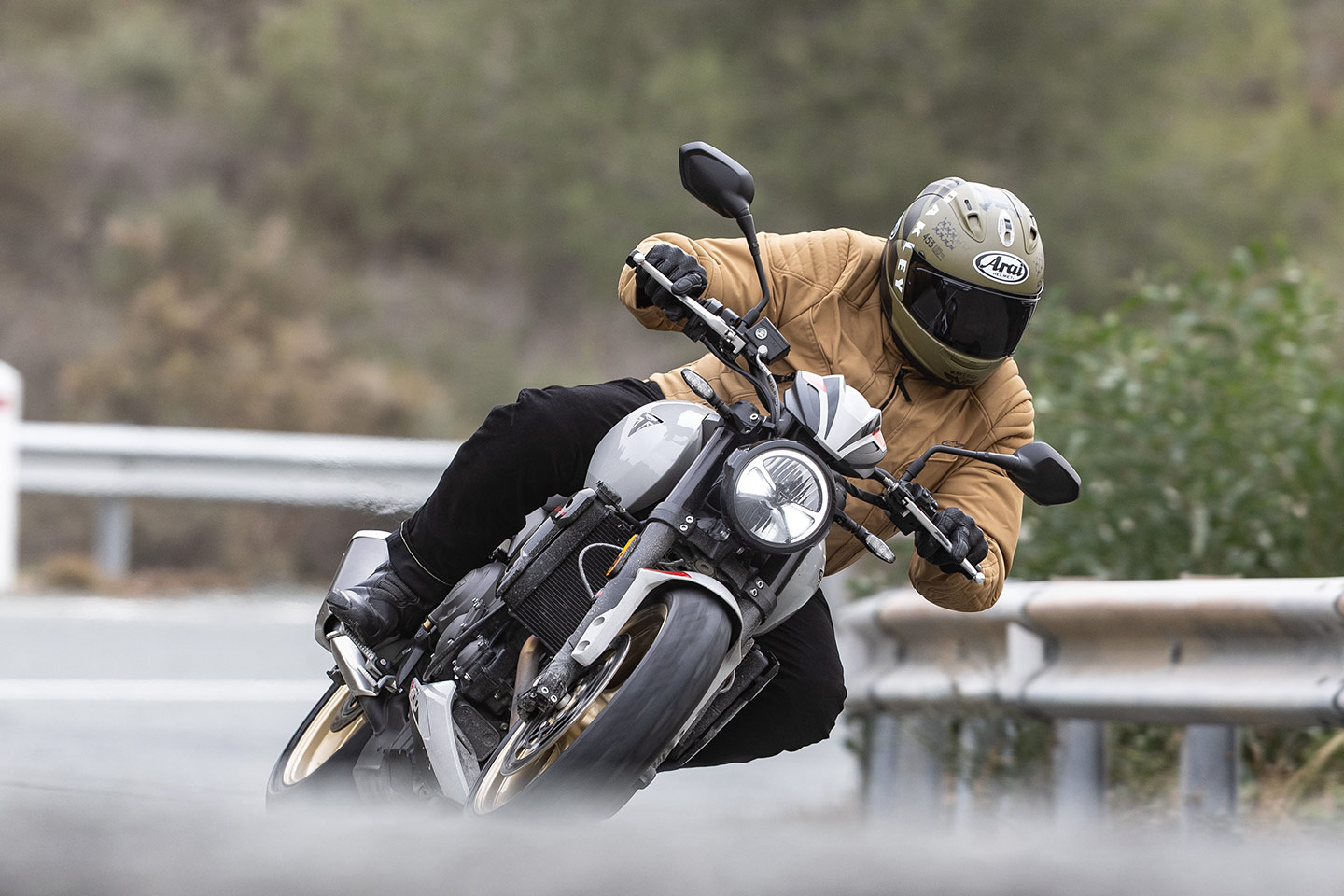
The 2026 Triumph Trident 800 is designed to occupy the space between the Trident 660 and Street Triple 765. Its 798cc three-cylinder engine produces a claimed 113.4 hp at 10,750 rpm and 61.9 ft.-lb. of torque at 8,500 rpm, with Triumph’s stated priority being stronger midrange performance for road riding rather than the more aggressive character associated with the Street Triple. Cycle World evaluated the motorcycle on a first ride in Cyprus, during a winter storm that brought rain, cold temperatures and snow at higher elevations.
The result, according to the Cycle World reviewer, is a versatile naked roadster that combines the Trident 660’s everyday friendliness with substantially more performance and equipment. It is not presented as a replacement for the sharper Street Triple, nor as a near-supersport-style naked bike. Instead, the Trident 800 aims to provide usable performance, relaxed ergonomics and a relatively accessible price relationship.
A larger version of the Trident triple
The Trident 800’s engine is described as a bored-and-stroked development of the 660’s powerplant. Bore grows by 4mm and stroke by 4.6mm, reaching 78.0mm and 55.7mm respectively. The liquid-cooled, DOHC four-stroke inline-three uses four valves per cylinder, a 120-degree crankshaft and a 13.2:1 compression ratio. Three 42mm ride-by-wire throttle bodies feed the engine, while Bosch multipoint sequential electronic fuel injection operates with electronic throttle control.
The engine retains a six-speed gearbox and uses a cable-operated wet multi-plate slip-and-assist clutch. Triumph Shift Assist provides bidirectional quickshifting. Cycle World found the clutch smooth, light and communicative, while describing the gearbox as slick and precise and the quickshifter as effective.
The reviewer heard the characteristic three-cylinder sound develop from a low-end growl into a top-end wail, along with burbling and popping from the exhaust on deceleration. Unlike the Trident 660, which uses an underslung muffler, the 800 has a conventional silencer on the right side.
Triumph Chief Engineer Stuart Wood explained that the compact 660-based engine helps preserve a low standover height. Using the larger Tiger 900 engine with three throttle bodies would not have been possible in this application, he said. The 800 therefore increases output while keeping the basic packaging and accessible proportions central to the Trident concept.
Three modes for changing conditions
The Trident 800 has Rain, Road and Sport riding modes. All three provide the full claimed 113 hp; they change the engine’s response rather than reducing the motorcycle’s stated peak output. Rain mode offers the softest throttle response, while Sport mode is the sharpest. Road mode was described as giving a connected relationship between throttle input and power delivery and as a suitable setting for commuting and urban riding.
The electronics also include lean-sensitive traction control and cornering ABS. Traction control incorporates wheelie control, and the reviewer tested Sport mode with both systems switched off. In the wet, however, Rain mode was used for nearly half the test day. On mountain sections affected by snow and sleet, the reviewer reported that the motorcycle maintained traction during acceleration and braking.
The cornering ABS was triggered during a sharp braking event on a wet corner that may have contained diesel fuel. The system prevented the front tire from locking while the motorcycle was leaned over, and the reviewer felt only a brief pulse at the front lever. Cycle World described the calibration as accurate and not excessively conservative.
Adjustable suspension, with an important setup caveat
The Trident 800 uses a tubular-steel perimeter frame, matching the basic frame approach of the Trident 660. The Street Triple and Speed Triple use twin-spar aluminum frames instead. At the front is a 41mm Showa Separate Function Big Piston inverted fork with compression- and rebound-damping adjustment and 4.7 inches of travel. The rear uses a Showa monoshock with spring-preload and rebound-damping adjustment; it does not have compression-damping adjustment. Rear-wheel travel is 5.1 inches.
That adjustability is a significant equipment upgrade over the Trident 660, but the test motorcycle initially required attention. Cycle World reported that it benefited from more rear-shock spring preload and three additional clicks of rebound damping. In the original setup, the rear sat too low, and the front end pushed on corner exits even under mild throttle. The reviewer’s 230-pound weight used much of the available rear travel while stationary, and the shock bottomed too easily.
After the adjustments, handling became substantially sharper. Turn-in was easy without making the motorcycle nervous, and midcorner stability was described as very strong. Corner exits were predictable and precise with throttle application. Changing line while leaned over required some effort, but the motorcycle responded willingly. The overall assessment was less razor-sharp than a Street Triple, yet consistent, composed and predictable.
The motorcycle is fitted with Michelin Road 6 tires as original equipment. The reviewer considered them well suited to the test conditions and reported excellent grip. Cast-aluminum alloy five-spoke wheels carry a 120/70-R17 front tire and a 180/55-R17 rear tire.
Brakes and everyday ergonomics
Front braking comes from two 310mm floating discs and Triumph-branded J.Juan four-piston radial-mount calipers. The rear brake uses a 220mm disc and a single-piston sliding caliper. Cornering ABS operates at both ends. Overall front-braking performance was considered strong, although the initial lever bite felt soft and nearly vague. The reviewer said additional feedback at the beginning of lever travel would improve more aggressive corner-entry riding.
The rear brake was described as consistent, adequately communicative and unobtrusive in operation. That balance suits the motorcycle’s broader remit: the Trident 800 is intended for riders who want more performance than the 660 offers without adopting near-supersport ergonomics.
The seat is 31.6 inches high. The reviewer, who is 5 feet 10 inches tall, reported an easy reach to the ground and a roomy cockpit. A tall-ish handlebar allows a comfortable reach with relaxed elbow bend, while the distance between the seat and footpegs was considered suitable for all-day comfort without eliminating some sportiness. The rounded fuel tank and spacious seat also contribute to everyday usability.
Cycle World characterized the motorcycle as comfortable for all-day rides, capable on mountain roads and usable in cities. Those observations came during the Cyprus first ride, not a long-term evaluation.
Where the price sits
The Trident 800 has a listed MSRP of $9,995. The Yamaha XSR900 is identified as the closest match: it uses an 890cc CP3 three-cylinder engine, has similarly adjustable suspension and costs $600 more. The Yamaha is described as producing nearly the same horsepower and 7 ft.-lb. more torque.
The Suzuki GSX-8T is listed at $650 above the Trident 800. Its 776cc parallel-twin produces less horsepower and torque, and its suspension offers only rear spring-preload adjustment. The Kawasaki Z900RS costs $2,900 more, uses an inline-four engine and produces 12 ft.-lb. more torque.
On the supplied comparisons, the Trident 800’s relationship between power, equipment and price is attractive. It does not lead every rival in output, but it offers a more substantial electronics and suspension package than the Suzuki while undercutting the Yamaha and Kawasaki on the listed MSRP.
A name with several chapters
The Trident name carries nearly 60 years of Triumph history. Triumph introduced the original Trident in 1968 as a platform shared with BSA’s Rocket 3. Its inline-three engine helped make it one of the first superbikes of its era, and a Trident known as Slippery Sam won the Isle of Man TT production class from 1971 through 1975. The original generation ended production in December 1975, after the 1973 Norton-Villiers-Triumph merger; Triumph was bankrupt by 1977.
After businessman John Bloor OBE rebooted Triumph for the modern era, the name returned at the 1990 Cologne Motorshow. The modern-era Trident appeared as 750cc and 900cc three-cylinder motorcycles sold as 1991 models, positioned as sporty nakeds alongside the Trophy sport-tourers and Daytona sportbikes. That generation ended production in 1998.
The Trident 660 appeared at EICMA in 2020 and became Triumph’s popular, well-rounded entry-level naked motorcycle. Its last major revision was for the 2026 model year, while the new 800 extends the concept upward rather than abandoning it.
The 2026 Triumph Trident 800 therefore carries the name credibly without trying to recreate the pioneering superbike role of the original. Its 113.4-hp triple, adjustable suspension, quickshifter, riding modes and cornering electronics broaden the motorcycle’s capability, while the accessible seat and relaxed cockpit preserve its everyday purpose. The first ride’s caveats are meaningful—the soft initial front-brake feel and the need to correct the rear-shock setup—but after adjustment the motorcycle was reported to be stable, predictable and willing. That places it convincingly between the friendly Trident 660 and the more intense Street Triple 765.
THE EVIDENCE BEHIND THE STORY
Sources
Spotted something that needs correcting? Contact the editorial team ↗