
CFMoto V4 SR-RR reaches 315.82 km/h in prototype testing
A GPS-measured 315.82 km/h run places CFMoto’s V4 SR-RR above the usual superbike speed ceiling—but the motorcycle tested was not a final homologation example.

4 min read
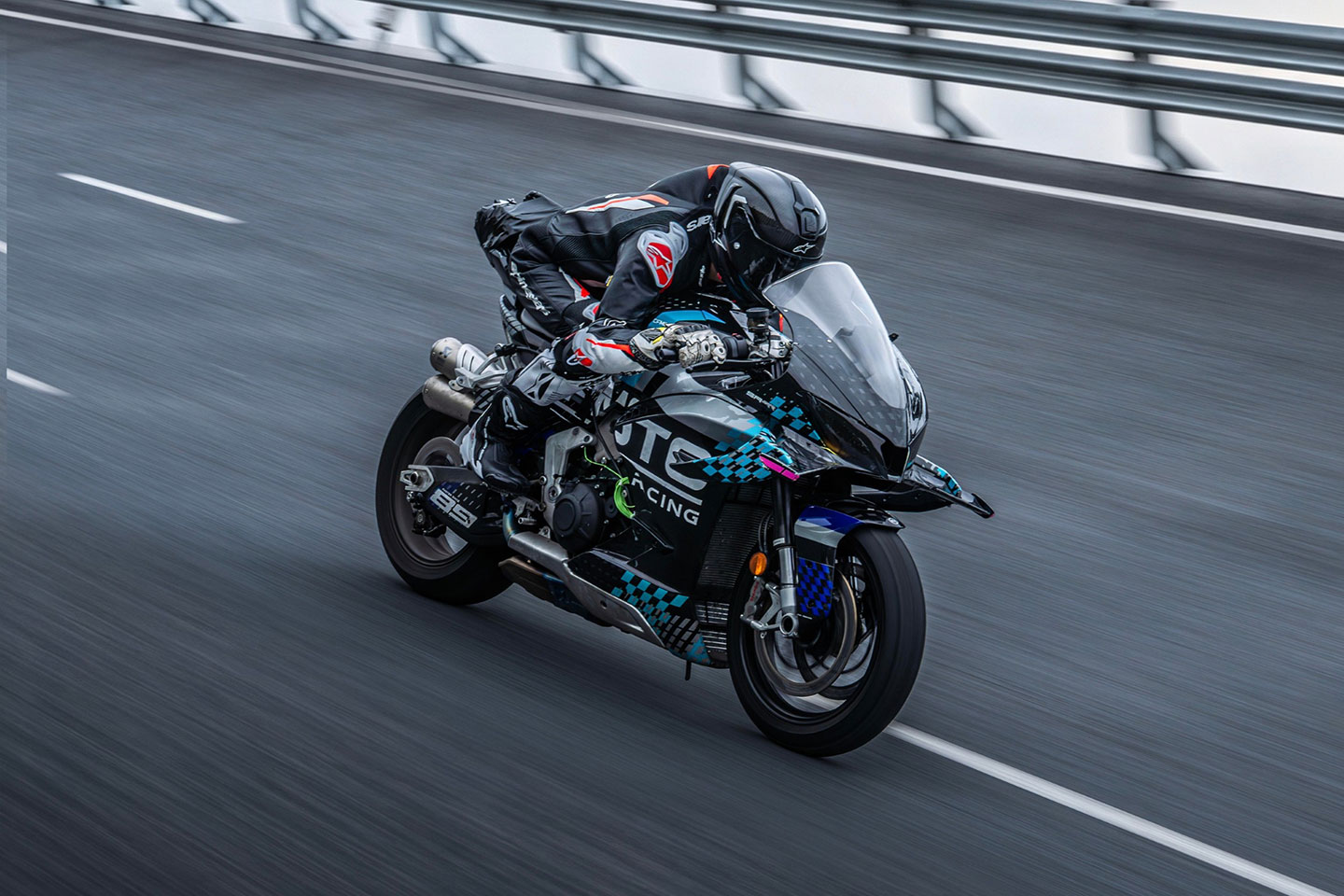
CFMoto says its V4 SR-RR reached 315.82 km/h (196.24 mph) during testing at the five-mile oval of the Shanrao Automotive Proving Ground in Jiangxi Province. Test riders Du Bang and Huang Shzhao carried out the run on a motorcycle that remains a prototype rather than a final homologation-approved production model, so the result is significant without being a guarantee of the showroom bike’s eventual performance.
The V4 SR-RR was shown in near-production prototype form at EICMA in Milan last November. CFMoto presents the speed result as evidence that its internally developed liter-class project has entered the company’s intended high-performance arena. Vice president Chen Zhiyong attributed the achievement to long-term independent research and development, together with technology developed through major racing events.
Three different speed readings
The test evidence needs careful reading. In the video, the motorcycle’s speedometer stops increasing at 299 km/h, or 185.79 mph, while the engine continues to climb through the rev range. A tank-mounted datalogger passes 316 km/h before the rider backs off. CFMoto says its evaluation of the complete dataset produced a real top speed of 315.82 km/h, measured by GPS.
The video appears to show the rider using much of the available rev range in each gear. The front wheel is in the air as the bike passes 100 mph in first gear, approximately three seconds into the run. The observed shifts come at roughly 120 mph in third, 135 mph in fourth, 150 mph in fifth and 170 mph in sixth. The video also suggests that the production motorcycle may use a speed limit of about 186 mph, although the final specification has not been confirmed.
A 15,000-rpm V4 with racing links
CFMoto claims the V4 SR-RR uses a 997cc, 90-degree V4 producing more than 210 hp and reaching 15,000 rpm. The engine has a counter-rotating crankshaft, a concept the report compares with Ducati’s V4-powered models. Claimed dry weight is 397 pounds, but CFMoto had not confirmed the final technical details when the report was published.
The planned electronics package includes a six-axis inertial measurement unit, cornering ABS, combined braking, traction control, hill-hold control, cruise control and a bidirectional quick shifter. CFMoto also says the chassis was developed using experience from its Moto3 and Moto2 competition. The company recently purchased a 51% stake in Kalex, described in the report as the dominant chassis supplier in Moto2.
Aerodynamics and the wider claim
The active aerodynamic system shown at EICMA moved its large front winglets independently. CFMoto says the system reduces drag by 12% during acceleration and increases front downforce by 45% at high speed. However, it has not disclosed the baseline values behind either percentage. The company has confirmed that the production V4 SR-RR will retain the active system.
The 315.82 km/h figure also needs context. Most current superbikes continue to follow an informal 186-mph top-speed limit, a convention associated with the Hayabusa era. BMW’s S 1000 RR is type-approved at 306 km/h, while the M 1000 RR is type-approved at 314 km/h. Ducati estimates that its latest Panigale V4 R can reach 205 mph only with restrictions removed and a race kit installed.
CFMoto says the result would make China the fourth country capable of building a motorcycle exceeding 300 km/h; the claim is presumably limited to production motorcycles, with Japan, Germany and Italy forming the other three in that comparison. Since the tested machine was not a final homologated example, direct comparisons remain provisional.
The project is backed by substantial stated investment. CFMoto says it spent more than $180 million on R&D during 2025, equal to 6.18% of total revenue, and held 2,119 active patents by the end of that year. More than 40 patents were related to the V4 engine. Chen said the result showed China moving from technology follower to strong competitor, and that CFMoto’s internally developed liter-class motorcycle had joined the ranks of the world’s top high-performance motorcycles. For an OEM to celebrate speed this openly is, at minimum, a positive sign that performance remains central to its ambitions.
THE EVIDENCE BEHIND THE STORY
Sources
Spotted something that needs correcting? Contact the editorial team ↗