
Márquez wins at Balaton Park in a race marked by a Turn 1 crash
Marc Márquez took the victory described as his 100th Grand Prix win, while Pedro Acosta finished second and Francesco Bagnaia third after a chaotic opening lap.

5 min read
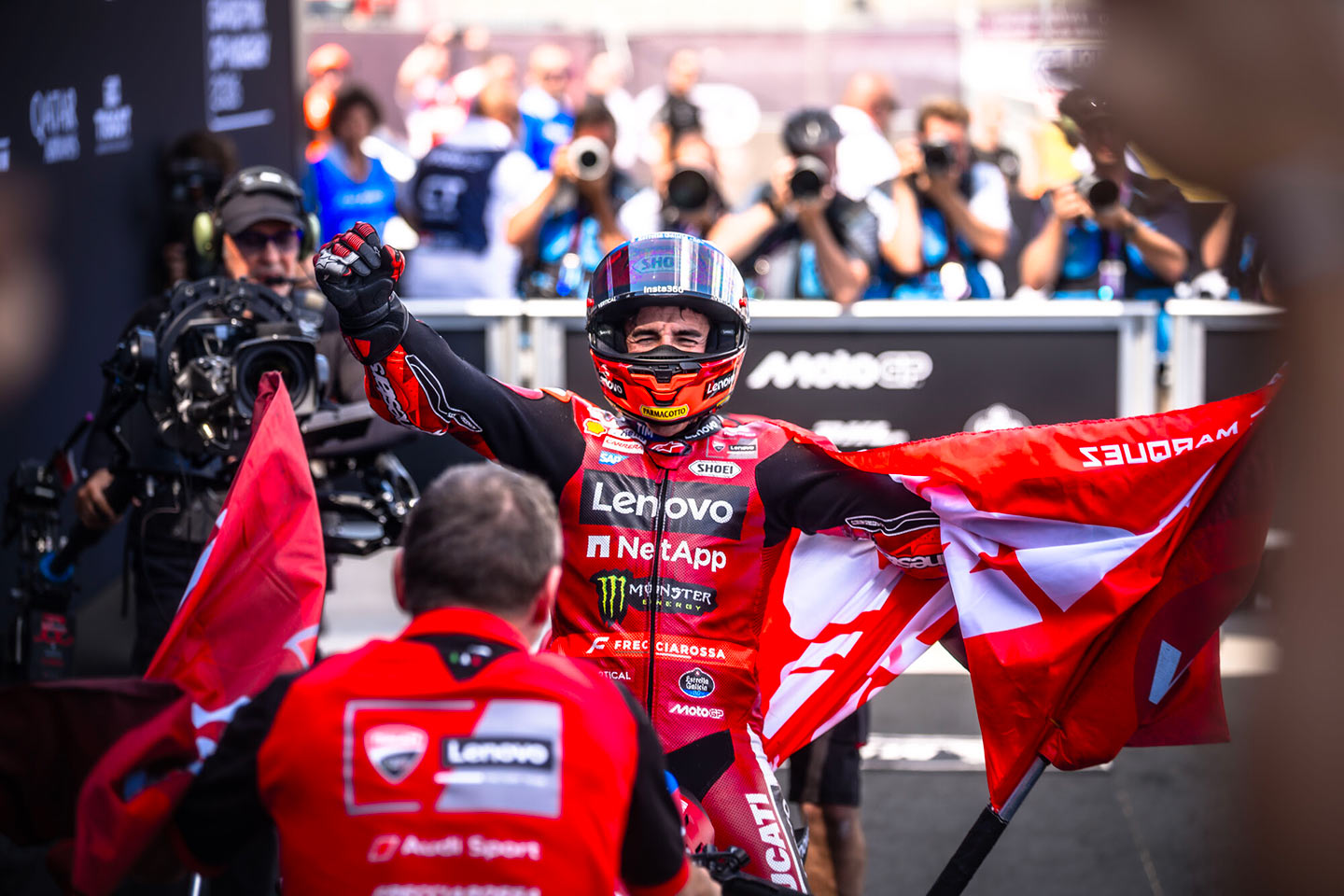
Marc Márquez won the Grand Prix at Balaton Park in a race that combined a major Turn 1 incident with a two-rider fight at the front. The victory is described in the supplied evidence as Márquez’s 100th Grand Prix win. Pedro Acosta finished second for Red Bull KTM, 1.3 seconds behind the factory Ducati rider, while Francesco Bagnaia completed the podium for Ducati, 11.6 seconds behind Márquez.
The result completed a dominant weekend for Márquez: he took pole position, won Saturday’s Sprint and then won Sunday’s Grand Prix. It also came four weeks after shoulder surgery on May 10. Márquez said the victory brought him 37 points and described it as another comeback after suffering considerably since Indonesia. He said the weekend had been physically and mentally difficult.
A chaotic first corner
The race was reshaped immediately. Jorge Martín locked the front wheel while braking for Turn 1, released the brake and then braked again before colliding with his Aprilia teammate and points leader Marco Bezzecchi. Fermin Aldeguer, riding for Gresini Ducati, Raul Fernandez of Trackhouse Aprilia and Fabio Di Giannantonio of VR46 Ducati were also taken out in the incident. The account describes five motorcycles leaving the racing line to the left, with riders tumbling and parts scattering.
The supplied evidence contains an inconsistency over the exact crash count and composition: it names Martín, Bezzecchi, Aldeguer, Fernandez and Di Giannantonio, but also states that Martín’s motorcycle was not among the five that slid away. That detail requires verification before publication as a definitive reconstruction. Martín received a double long-lap penalty, and the incident prompted discussion inside Aprilia about the value of civility.
Only Di Giannantonio remounted. He eventually finished 12th. The crash damaged championship points prospects and three motorcycles described in the account as worth three million dollars in total. None of the riders involved was reported to have been injured.
Diogo Moreira said the immediate priority after the start was simply to get through Turn 1 before beginning the race properly. The braking challenge was linked partly to the variable ride-height system. In its low position, particularly on the opening lap, the system reduces front weight transfer and prevents the front brake from delivering peak braking force. Riders compensate by using the rear brake.
That difficulty was compounded by the tyres. At the start, they had not yet reached their race-temperature distribution, making them difficult to manage. The first three laps were therefore described as a period when cold-tyre problems could catch riders out. The combination of unusual braking conditions, cold rubber and the importance of completing lap one among the top three made the opening phase especially demanding.
Márquez and Acosta choose different rear tyres
Márquez led the opening lap, but Acosta led the next 13 laps. Their rear-tyre choices were different: Acosta used a soft rear, while Márquez chose a medium. The race account presents Márquez’s decision to remain close behind as a deliberate response to that difference.
On lap 14, Márquez passed Acosta at Turn 9, only to return to second two corners later. The pair made contact during the battle. Márquez retook the lead on the following lap and began recording mid-1:38 lap times. His advantage reached 2.4 seconds on lap 21 before he finished 1.3 seconds ahead.
Márquez described Acosta as highly aggressive and said their fight involved hard braking and two or three contacts. In his account, there was sufficient space and the contest remained within the limit. He said he wants to fight in every race and practice and enjoy the competition, while also noting that the duel lasted two laps and that a longer fight might not have ended well for either rider.
Acosta had already finished second behind Márquez in the Sprint, 1.5 seconds from the winner. He said Márquez’s grip level in that race was exceptionally high. In the Sprint, Bezzecchi finished third, Fernandez fourth and Martín sixth.
Low grip shaped the Aprilia-Ducati balance
The freshly repaved Balaton Park surface was unpopular with the riders. Bagnaia said that following another rider exposed him to stones thrown from the asphalt. Bezzecchi rejected the idea that the circuit’s stop-and-go character was the main problem, instead saying that overall grip had consistently been lower and that lap times were slower than the previous year.
The Sprint suggested that the Aprilias were less strongly attached to the track at Balaton Park than they had been at Mugello. Martín attributed the difficulty in slow corners to reduced downforce, which made the motorcycles harder to turn. He said Aprilia became highly competitive in the second sector, where higher speed generated more downforce.
Di Giannantonio offered a different comparison between the bikes. He said Aprilias entered corners effectively using the front and exited them using the rear, while Ducatis relied more heavily on the rear throughout the corner. In his view, strong rear-tyre management could give a Ducati a chance. He said he had saved the rear tyre throughout the Mugello race but temporarily lost front grip about 10 times, identifying the front as the more critical area when the motorcycle was pushed to its real limit. He added that he, Bagnaia and sometimes Márquez had struggled with the front.
Bagnaia said he expected to be capable of moving from Q1 to Q2 because he had good front-end feel and could brake hard. He also said insufficient rear grip would make the following session difficult, and reported that the rear could break loose by itself when he closed the throttle and leaned into a corner. The supplied chronology does not establish whether those comments were made on Friday or on Saturday, despite the wording referring to “tomorrow [Saturday]”.
After the Balaton Park result, Márquez remained 72 points behind the championship leader, with 13 races still remaining. The weekend delivered the headline victory described as his 100th Grand Prix win, but it also showed how quickly cold tyres, ride-height behaviour, a low-grip surface and the pressure of the first corner could transform a MotoGP race.
THE EVIDENCE BEHIND THE STORY
Sources
Spotted something that needs correcting? Contact the editorial team ↗