
Honda brings the RC181 and 1960s colours back to Motegi
The RC181 returned for Honda’s 60-year premier-class celebration, while its factory MotoGP bikes adopted the red, silver and yellow look of the Hailwood and Redman era.

3 min read
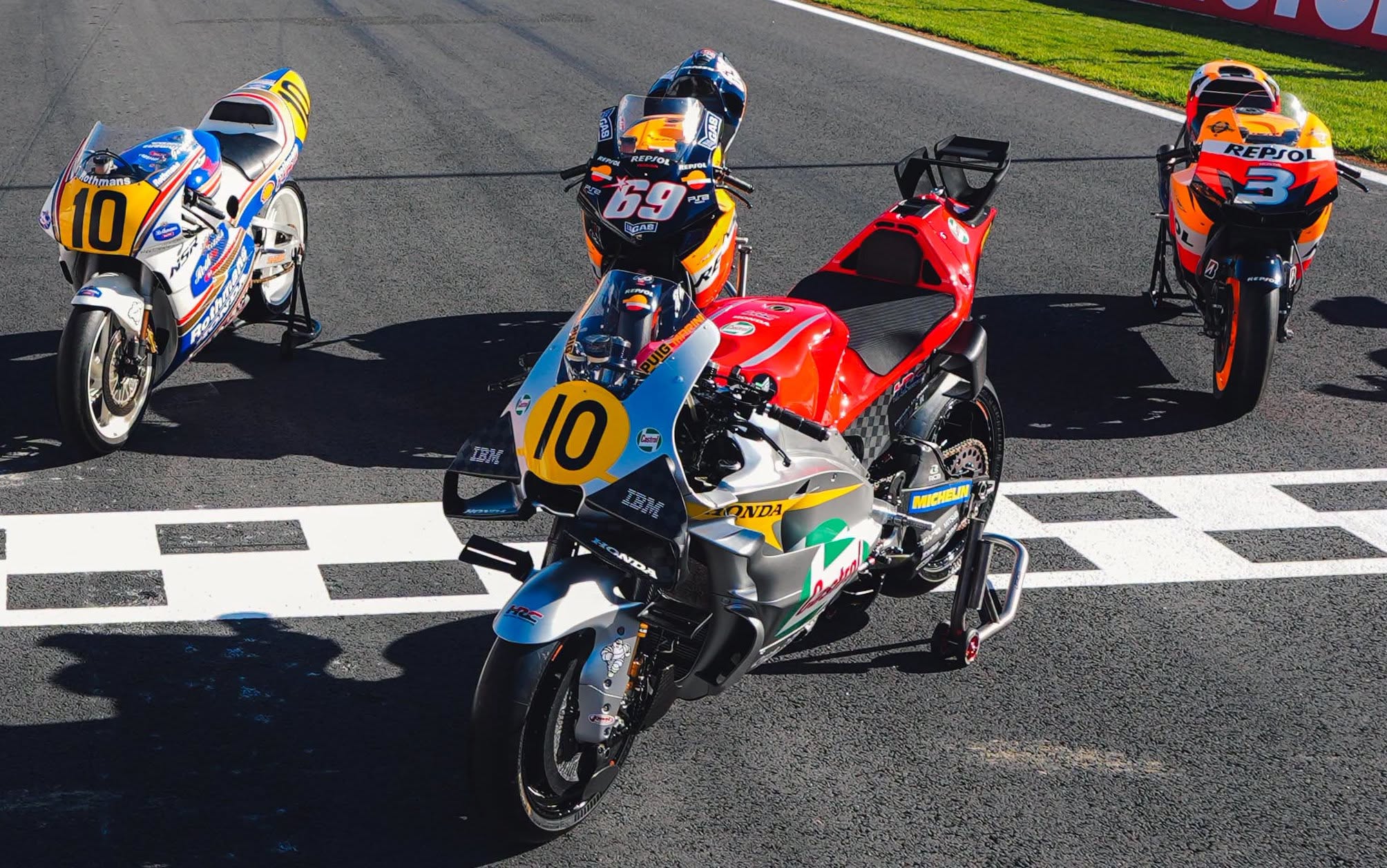
Honda used the Japanese Grand Prix at Motegi to connect its current MotoGP programme with one of the most important chapters in its racing history. The manufacturer marked 60 years in the World Championship’s premier class by displaying the historic RC181 and giving its two factory MotoGP machines a period-inspired livery. The result brought Honda’s 1960s racing identity onto the modern grid, while also marking the final Japanese Grand Prix appearance planned for the RC213V.
The RC181’s unfinished 500cc campaign
The RC181 was Honda’s official 500cc racing motorcycle and competed in the premier class for two seasons, in 1966 and 1967. It was powered by a four-cylinder engine with two overhead camshafts and 16 valves, a technically ambitious design for Honda’s first period of competition in the category. The motorcycle was associated with Mike Hailwood and Jim Redman, and its return to Motegi placed a rare and historically significant machine at the centre of Honda’s anniversary programme.
Those two seasons also brought Honda into direct competition with Giacomo Agostini and MV Agusta. In 1966, Hailwood and Agostini won three of the 12 500cc races each, with Hailwood’s total including the Tourist Trophy. In 1967, each rider recorded five victories, and together they won all ten of that year’s 500cc Grands Prix. The numbers show how closely Hailwood challenged Agostini on Sundays, but Agostini secured the 500cc championship in both seasons.
The RC181 therefore represents an important Honda campaign that ended without the premier-class title the company wanted. Honda withdrew from the World Championship in 1968 after refusing to accept new FIM regulations. Its first success in the top category came only in the 1980s, when Freddy Spencer achieved the target with a two-stroke motorcycle. Hailwood’s wider Grand Prix record adds further weight to the display: he won nine motorcycle Grand Prix world titles, matching the totals credited to Valentino Rossi, Marc Márquez and Carlo Ubbiali in the same comparison.
A Motegi tribute with a final RC213V appearance
The anniversary livery was built around a red fuel tank, a silver fairing and yellow details, echoing the colours associated with Honda’s 1960s racers. The period treatment extended to the Castrol and Michelin logos, which were styled to fit the retro theme while retaining the team’s current commercial partnerships. Honda’s factory riders wore black leather suits with white logos, another deliberate reference to the visual language of the earlier era.
Luca Marini and Somkiat Chantra represented Honda at the event, with Chantra taking the place of Joan Mir. The presentation formed the visual centrepiece of Honda’s home-race weekend, but the venue carried a second piece of significance for the current team. Motegi is Honda’s home circuit, built in 1997 as a facility combining a banked oval with a five-kilometre road course. Its Twin Ring layout was created to support IndyCar promotion as well as road racing.
The Japanese Grand Prix was also the last appearance at the event for Honda’s current RC213V. Honda is set to replace it with the RC214V for the new technical era beginning in 2027. That makes the weekend a transition point as well as a heritage celebration: the RC181 recalled the company’s early attempt to conquer the 500cc class, while the RC213V closed its Motegi chapter ahead of the next factory MotoGP machine.
THE EVIDENCE BEHIND THE STORY
Sources
Spotted something that needs correcting? Contact the editorial team ↗