
Ai Ogura converts Aprilia’s Assen pace into his first MotoGP win
Ai Ogura won the Dutch Grand Prix by about two seconds after Trackhouse Aprilia riders finished first and second in the Sprint.

7 min read
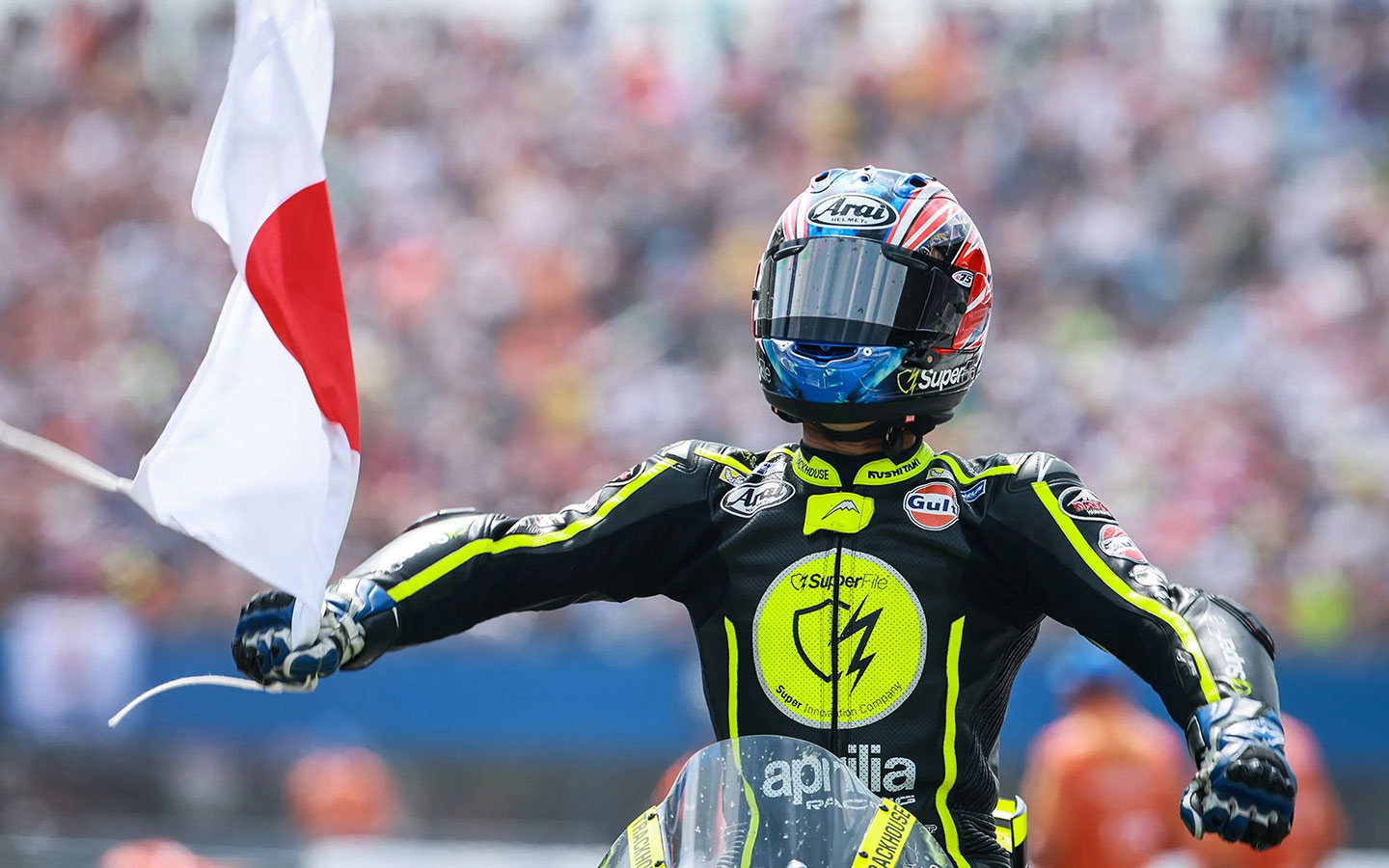
Ai Ogura secured his first MotoGP victory at Assen, completing a strong Dutch Grand Prix weekend for Aprilia. Trackhouse riders Raul Fernandez and Ogura exchanged the top step between Saturday’s Tissot Sprint and Sunday’s Grand Prix: Fernandez won the Sprint, while Ogura took the main race by approximately two seconds.
The results showed Aprilia’s strength in both race formats. Four Aprilias filled the Sprint’s top five, while Sunday produced an Aprilia one-two-three. That competitive picture also provided the setting for a race shaped by extreme heat, changing conditions, tire decisions and unresolved stability problems.
Trackhouse takes the Sprint
Fernandez and Ogura finished first and second in Saturday’s Sprint. Fabio di Giannantonio was third and the highest-placed Ducati rider. Factory Aprilia rider Marco Bezzecchi finished fourth, followed by Jorge Martín on the other factory Aprilia, giving the manufacturer four of the first five positions.
Riders described the Sprint day as exceptionally hot, with the asphalt reaching 55°C (131°F). That heat became an important part of the weekend’s wider context, affecting how teams and riders assessed the motorcycle and tires before Sunday’s race.
Ogura overcomes a ride-height-device problem
Ogura’s Grand Prix victory was not straightforward. On lap 16, while exiting Turn One, he accidentally activated the rear ride-height device. He later explained that the problem prevented him from attacking the leaders earlier and allowed the gap to increase again.
After clearing the problem, Ogura moved up to the leaders on lap 18 and took control on lap 20. He led from that point through the finish on lap 26. He said he was not rushing, judging that his pace was sufficient to pass the riders ahead and then pull away. He also managed his ride while monitoring the positions of Fernandez and Martín.
The advantage arrived quickly. Ogura extended his lead to two seconds in fewer than six laps, turning a race that had included a technical interruption into a clear win.
Bezzecchi’s Sunday had a very different outcome. He crashed in a low-side on lap two at approximately 125 mph. He survived without fractures, according to the report, but the crash cost him the championship points lead.
An unusual way of keeping the bike upright
Jorge Martín drew attention to Ogura’s cornering style. He said Ogura’s torso came very close to the pavement while the motorcycle remained relatively upright, making it appear as though he was crashing in every corner. Martín also described Ogura as difficult to follow because he could look unstable before turning and then accelerate away. Fernandez called the style unusual and different from that of the other riders.
Keeping the motorcycle more upright can affect how the tire works. With less lean angle, the rear tire’s contact patch can move toward a less-curved part of the tire profile, potentially increasing the usable footprint. That offers technical context for Ogura’s posture, but it does not establish that his riding style directly caused the victory.
The discussion also fits into a longer evolution in rider positioning. Before Marc Márquez, riders commonly moved the lower torso and inside knee into corners while keeping the upper torso more centered. Márquez’s 2013 MotoGP title-winning riding was associated with a major change: moving his whole torso inward, pulling his outside arm across the fuel tank and dragging his inside elbow. Martín later adopted dragging his inside shoulder through corners.
John Surtees provides an earlier example. While riding the MV-4 in 1956, he reportedly described losing rear-tire grip when accelerating at high lean angle. The account says that moving his body inward and downward while bringing the motorcycle more upright allowed the tire to regain grip and the motorcycle to accelerate.
A possible aerodynamic explanation for Aprilia’s form
One proposed explanation for Aprilia’s performance at Assen involves aerodynamic downforce generated by surfaces positioned close to the pavement at high lean angles. The principle is linked to the Venturi effect: faster-moving air has lower pressure, which can press the tires harder against the track.
That is different from simply adding mass. Extra mass can increase a cornering force, but it also creates an outward force that must be resisted. Aerodynamic downforce can increase the load on the tires without adding equivalent mass. Aerodynamic elements are being added near the fork, swingarm and the area between them. Positioned close to the tire contact patches, they may reduce the tendency to force the motorcycle toward a higher lean angle and may change their effect less abruptly when lean angle changes slightly.
This remains a possible explanation rather than a proven cause of Aprilia’s Assen results. The evidence supports the technical proposal, not a definitive link between a particular aerodynamic concept and the weekend’s finishing order.
Heat, tires and changing conditions
Sunday’s track temperature was reported as 43°C (109°F), cooler than the Sprint day’s reported 55°C asphalt temperature. Those figures refer to different conditions and should not be treated as directly equivalent measurements. Francesco Bagnaia attributed many crashes across the classes to the high temperatures after the Sprint, then retired from Sunday’s race with brake problems.
Enea Bastianini said the main KTM Tech3 difficulty was understanding how to adjust the motorcycle as conditions changed between cold and hot temperatures. Tire choice added another variable. Although many riders preferred the soft rear tire, all riders except the Hondas used the medium rear tire on Sunday.
Marc Márquez finished seventh, ten seconds behind Ogura. He said his target had been a top-10 finish and that he stayed in the garage after setting a Q2 lap good enough for seventh. He described Assen as very fast and narrow, with rapid changes of direction where a small mistake could have a large cost. Di Giannantonio was the highest-placed Ducati rider in the race context discussed near the end of the weekend, finishing fourth.
Pedro Acosta retired after losing his normal feeling in his right hand. While riding behind Márquez, he said he could not clearly tell whether he had the brake lever in his hand. He underwent carpal-tunnel surgery after the Assen event.
The unresolved movement problem
Motorcycle stability was a recurring subject among teams and riders. Acosta said the KTM needed greater stability, especially on entry to the fast Turns Six and Fourteen. He reported that the motorcycle shook severely in those corners and was sometimes difficult to keep travelling straight. In his view, improving stability would produce a major performance gain.
Toprak Razgatlioglu described a different but related movement in left-hand corners. He characterized it as extreme jumping rather than conventional chattering. The low-frequency movement has been compared with chatter, but it is described as slower and closer to hopping. Its exact nature remains unresolved, with each race weekend adding information rather than confirming a diagnosis.
The technical problem involves a familiar chassis compromise. Increasing lateral flexibility may improve mechanical grip but can also increase susceptibility to instability under braking. Traditionally, greater stiffness supports point-and-shoot stability while reducing grip in long, fast corners. A more flexible, corner-speed-oriented chassis can introduce another oscillator that absorbs energy from chassis movement and produces shaking.
Possible vibration-suppression devices include tuned mass dampers and inerters, although their behaviour in the event of a malfunction remains an open question. In basic terms, a spring generates force proportional to displacement, a damper generates force proportional to velocity, and an inerter generates force related to acceleration. Low-frequency movement approaching hopping or jumping therefore remains a phenomenon requiring further investigation, not a validated technical solution.
The next event named is the Sachsenring round, scheduled for July 10–12. Márquez has historically been described as the master of that circuit. At Assen, however, the defining result belonged to Ogura: his first MotoGP win, achieved after Trackhouse Aprilia riders had already exchanged the Sprint and Grand Prix victories.
THE EVIDENCE BEHIND THE STORY
Sources
Spotted something that needs correcting? Contact the editorial team ↗