
2026 Aprilia Tuono 660 Factory review: sharp chassis, serious equipment
With 105 hp, fully adjustable Öhlins suspension and a 3.8 lb-per-horsepower ratio, the Tuono 660 Factory targets sporty road riding and occasional trackdays—while retaining a few compromises.

8 min read
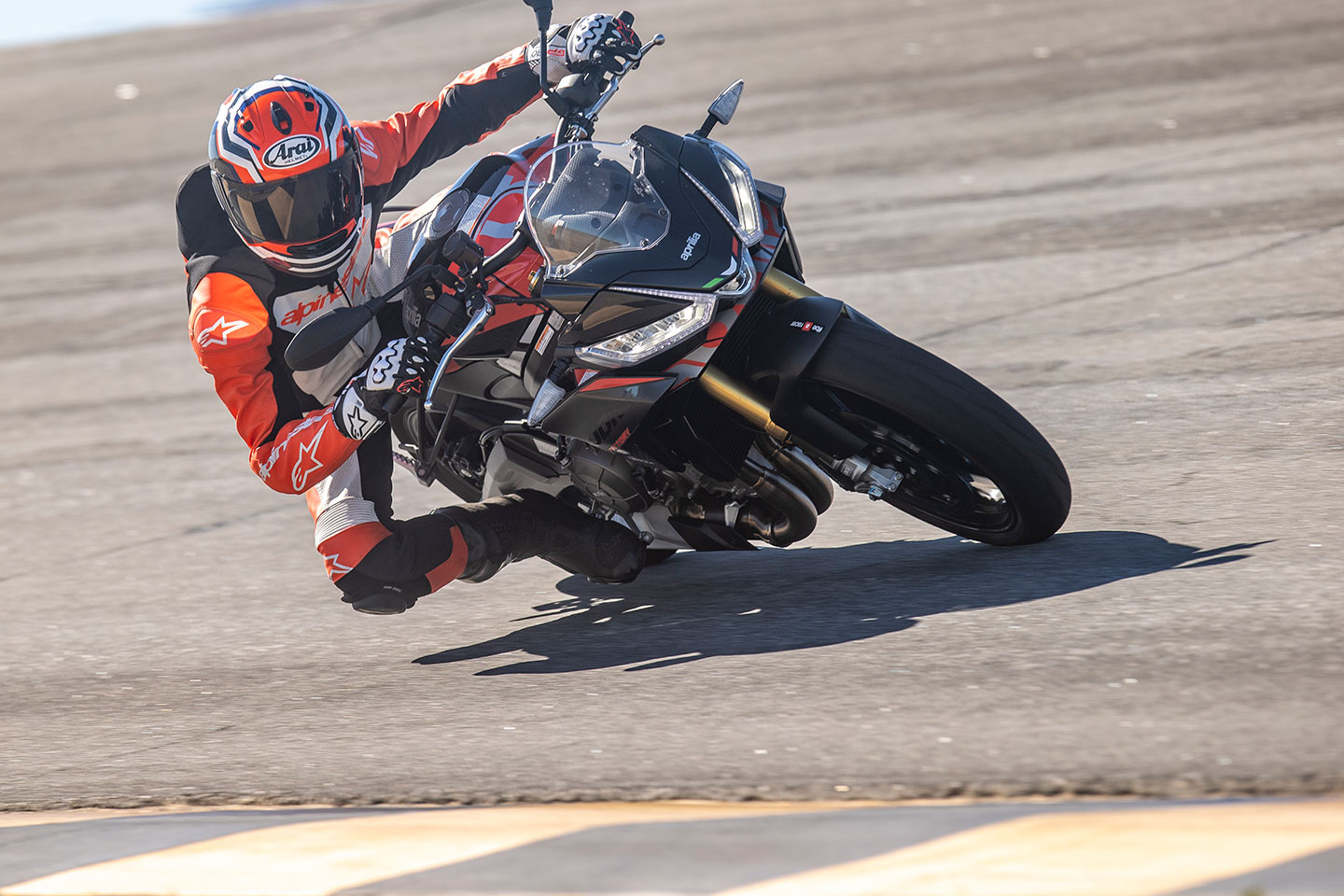
The 2026 Aprilia Tuono 660 Factory is a middleweight naked motorcycle built around sporty performance without abandoning street usability. In Cycle World's review, the rider achieved a personal-best lap at Chuckwalla Valley Raceway on a completely stock Tuono 660 Factory. That result does not make it an uncontested class winner, but it illustrates the performance available without aftermarket changes. The US MSRP is $11,599; the supplied evidence does not establish a Greek price or availability.
What the Factory version changes
The Tuono 660 Factory shares its engine platform with the Aprilia RS 660 and Tuareg 660, but its specification differs from the standard Tuono 660 in ways intended to matter when the pace rises. It uses 52mm throttle bodies, which are 4mm larger than those on the standard model, and redesigned exhaust header pipes. Aprilia claims 105 hp at 10,400 rpm—five horsepower more than the standard Tuono—and 51.6 pound-feet of peak torque at 8,400 rpm.
The engine is a 659cc, liquid-cooled, DOHC, eight-valve parallel twin with a 270-degree crankshaft and a six-speed transmission. Its 81.0mm bore and 63.9mm stroke accompany a 13.5:1 compression ratio. The fuel system uses electronic fuel injection, ride-by-wire and the 52mm throttle bodies. A wet multiplate slipper/assist clutch is operated by cable.
The review compares this 659cc engine with Yamaha's 689cc CP2, Honda's 755cc engine and Suzuki's 776cc engine. Despite the displacement disadvantage, the Tuono is described as producing the most power among those engines in the comparison. The Triumph Trident 660 is identified as the closest middleweight comparison in claimed output, at 94 hp.
A high-revving engine with a useful middle
Cycle World's riding impressions describe a strong midrange followed by continued pull toward the redline. Low-rpm response remains tractable enough to make launching from a stop easy, while the engine's pulses and exhaust sound give the motorcycle character around town. In twisty canyon riding, the middle of the rev range delivers immediate response. The reviewer also reports that a quick clutch action can lift the front wheel in first, second and third gears.
The top end is particularly effective on highways and track straightaways. Cycle World's reviewer found the engine rewarding when operated at high rpm and close to the rev limiter. The tune favors high-revving performance while retaining sufficient low-end utility for everyday riding. Compared with Yamaha's CP2, however, the Tuono's response at low rpm is described as less playful at slow speeds.
The review also records several drawbacks. The reviewer experienced vague fueling at the initial opening of the throttle, with occasional lag that could make low-speed on/off-throttle application unpredictable. Several hard-starting instances were experienced when the engine was hot after hard riding on hot days. These are observations from Cycle World's test experience and are not presented here as a claim that every example will behave identically.
Electronics that can be tailored separately
The Tuono 660 Factory uses Aprilia's Performance Ride Control, or a-PRC, electronics package. Aprilia says the system is derived from its MotoGP racing experience; that is the manufacturer's description, not an independently verified assessment in the supplied evidence. The package includes wheelie control, launch control and cruise control, along with multiple ride modes, multiple traction-control levels, adjustable ABS and adjustable engine braking. A bidirectional quickshifter is also fitted.
Information is displayed on a 5-inch color TFT instrument panel, and the switchgear is backlit. The test motorcycle used Pirelli Diablo Rosso IV tires. The reviewer primarily selected a custom ride mode with full power, the least intrusive traction-control setting, wheelie control disabled and rear ABS disabled. Cycle World's reviewer considered the engine and tires sufficiently tractable that electronic intervention could generally be reduced.
The separate adjustment of wheelie control and traction control is useful in sporty riding. It allows traction-control assistance to remain active while permitting front-wheel lift, rather than forcing both functions to be treated as a single setting.
A compact chassis with Öhlins hardware
The claimed wet weight is 399 pounds, producing the review's stated power-to-weight ratio of 3.8 pounds per horsepower. That is described as one of the best ratios in the middleweight naked-bike class. The KTM 790 Duke is listed at a nearly identical 3.9 pounds per horsepower, while the Suzuki GSX-8S is given a 5.4-pound-per-horsepower ratio.
The engine serves as a stressed member of the chassis. The motorcycle uses a twin-spar aluminum frame and an engine-mounted cast-aluminum swingarm. The basic frame and swingarm components are the same as those used on the standard model, but they are painted black on the Factory. The specifications describe the frame as a twin-spar aluminum half frame, creating a terminology difference from the narrative description.
Cycle World's reviewer describes the handling as direct, precise, balanced and neutral rather than excessively sensitive. The Tuono is responsive without being unpredictable or strenuous to steer, and it feels planted, stable and balanced through curves. Compared with the standard model's Kayaba suspension, the Factory uses fully adjustable Öhlins components: a 43mm NIX30 fork with adjustable spring preload, rebound and compression damping, plus an STX46 shock with the same adjustment range.
The Öhlins equipment improves composure during sporty riding. On flowing canyon roads, the suspension remains firm and composed through the upper part of its stroke. The tires remain planted during transitions, and the reviewer reports a strong connection between the front wheel and the handlebars. On track, the suspension remained firm while retaining feel and grip under acceleration and hard braking.
The compromise is comfort over small urban bumps, particularly when the suspension has not been adjusted away from track settings. The supplied material names the fork “NIX30” in the narrative and “NIX 30” in the specification table. This is a nomenclature inconsistency, not evidence of two different fork designs.
Brembo brakes and track-focused dimensions
The front brake uses dual four-piston radial-mount Brembo calipers and 320mm floating discs. At the rear is a two-piston caliper and a 220mm disc with ABS. The reviewer reports strong initial bite and progressive stopping power, and was able to brake hard and late on track without brake fade. ABS calibration was considered precise, with track intervention only when necessary.
The cast-aluminum wheels measure 17 x 3.5 inches at the front and 17 x 5.5 inches at the rear. Tire sizes are 120/70-17 and 180/55-17. Listed geometry includes a 24.3-degree rake, 4.1 inches of trail and a 54.4-inch wheelbase. Ground clearance is listed as N/A in the supplied specifications.
A naked derivative of the RS 660 Factory
The Tuono 660 Factory is derived from the RS 660 Factory supersport. Compared with the RS 660 Factory, the Tuono uses a one-piece handlebar and less bodywork. Its claimed seat height is 32.3 inches, while fuel capacity is 4.0 gallons.
The review characterizes the Tuono's range as combining performance with comfort. At the same time, its cockpit is described as more cramped than those of other standard motorcycles cited by the reviewer. The high footpeg placement provides cornering clearance for track riding without excessive hard-part dragging. The result is a motorcycle suitable for street riding and occasional trackdays, though its ergonomics remain focused enough to support that circuit use.
Position in a crowded middleweight class
The middleweight segment now includes options from nearly every manufacturer. Nakeds, supersports, retro motorcycles and ADVs use shared midsize platforms, and that cross-platform component sharing can reduce costs while increasing refinement. It also makes differences in engine tuning, chassis equipment and intended use more important to the buying decision.
The review presents the Tuono 660 Factory as especially attractive to buyers prioritizing performance, features, style and Italian character. Its comparison includes the Honda Hornet 750, Suzuki GSX-8S, Yamaha MT-07, Kawasaki Z650, Triumph Trident 800 and KTM 790 Duke—motorcycles with sub-800cc engines and similar or lower prices. Cycle World's reviewer states that few of those motorcycles match the Factory's combination of outright performance, features and adjustability.
The listed Ducati middleweight street models sit above the Tuono in price. The 890cc Streetfighter V2 is listed at $15,995, the Streetfighter V2 S at $18,995 and the 890cc Monster+ at $14,995. The review also positions the Tuono below larger, more exotic hyper-nakeds that typically cost about twice as much. These are US figures and do not establish pricing in Greece.
The final assessment is deliberately qualified. Cycle World's reviewer does not claim to have established which motorcycle is definitively the best overall in the class for the year. The Tuono 660 Factory cannot remove its displacement disadvantage against larger engines, but its power-to-weight ratio, chassis and handling keep it competitive in twisty riding. Within the balance of performance, features, utility and price, it stands out in the middleweight segment without being presented as an uncontested class winner.
THE EVIDENCE BEHIND THE STORY
Sources
Spotted something that needs correcting? Contact the editorial team ↗