
A 89kg Ski-Equipped Vespa Was Pulled Up a Ski Jump by Hand
Günter Schachermayr hauled the combined 89kg weight of a Vespa, skis and rope to Gate 34 at Hinzenbach after three years of preparation.

3 min read
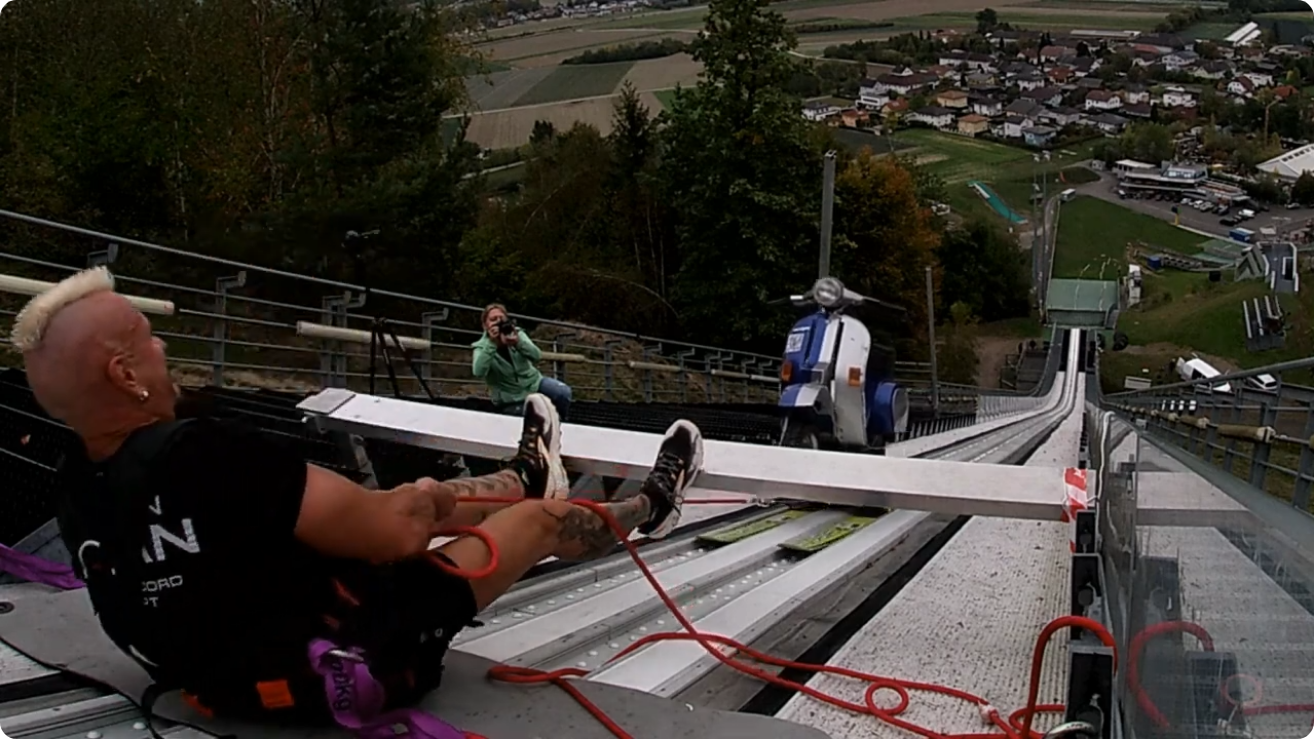
Günter Schachermayr has hauled a ski-equipped Vespa up the inrun of the Hinzenbach ski jump in Upper Austria, using his own physical effort to pull it towards the starting gate. The 48-year-old extreme-sports athlete made the attempt on 10 October 2026, targeting a potential world record with a challenge that combined a steep track, a specially prepared scooter and a substantial amount of manual force.
The 89-kilogram figure refers to the complete moving load: the Vespa, its specially adapted skis and the towing rope. Schachermayr and his team spent three years preparing the attempt and built a dedicated arrangement that included a pulley system. The pulling line was made from technical fibre, measured 110 metres in length and had a diameter of 14 millimetres. After a thorough warm-up, a countdown and the start signal, Schachermayr took hold of the rope attached to the scooter and began working uphill metre by metre.
The steep section changed the challenge
The opening part of the climb had an incline of approximately 11 degrees. After roughly 16 metres, however, the gradient increased sharply, reaching as much as 45 degrees. That change made the resistance immediately more demanding. The load accumulated in Schachermayr’s forearms, hands and back as he kept the Vespa moving up the track.
The physical strain became especially severe as the ascent continued. At around the 35-metre mark, Schachermayr began feeling intense pain in his back. Near 55 metres, his forearms had tightened and his grip strength had largely faded. He nevertheless continued, stopping three times in total for safety reasons. During the pauses he drank water, took deep breaths and recovered enough strength to resume the pull.
Safety was a central part of the setup. Schachermayr wore personal protective equipment that included a climbing harness, intended to protect him in the event of an unexpected fall. His position was kept in the centre of the ski-jump track while he worked towards the starting bar. That bar, also described as the starting gate, is the point from which ski jumpers begin their runs.
Encouraged by spectators and supported by his team, Schachermayr used his remaining strength to reach the starting bar near Gate 34. The route covered approximately 79 metres along the ski-jump track. Reaching that point represented the result of three years of preparation, the specially designed pulley arrangement and a sustained effort under increasingly difficult physical conditions.
After the attempt, Schachermayr thanked everyone involved, saying that it would not have been possible without them. The audiovisual material and the documentation of the challenge are due to be submitted to Guinness World Records. Schachermayr hopes the effort will be officially recognised and included in the record book, but the attempt still has to be assessed against the organisation’s formal criteria. Whatever the eventual decision, the completed climb stands as an unusually demanding demonstration of strength, preparation and controlled risk management: a 89-kilogram combined load pulled by hand up a track that rises to a gradient of 45 degrees.
THE EVIDENCE BEHIND THE STORY
Sources
Spotted something that needs correcting? Contact the editorial team ↗