
Kawasaki returns above 250cc two-strokes with the 2027 KX327 and KX327X
Kawasaki’s first new large-displacement two-stroke engine in more than 20 years powers two fuel-injected 327cc off-road motorcycles, one for motocross and one for cross-country use.

4 min read
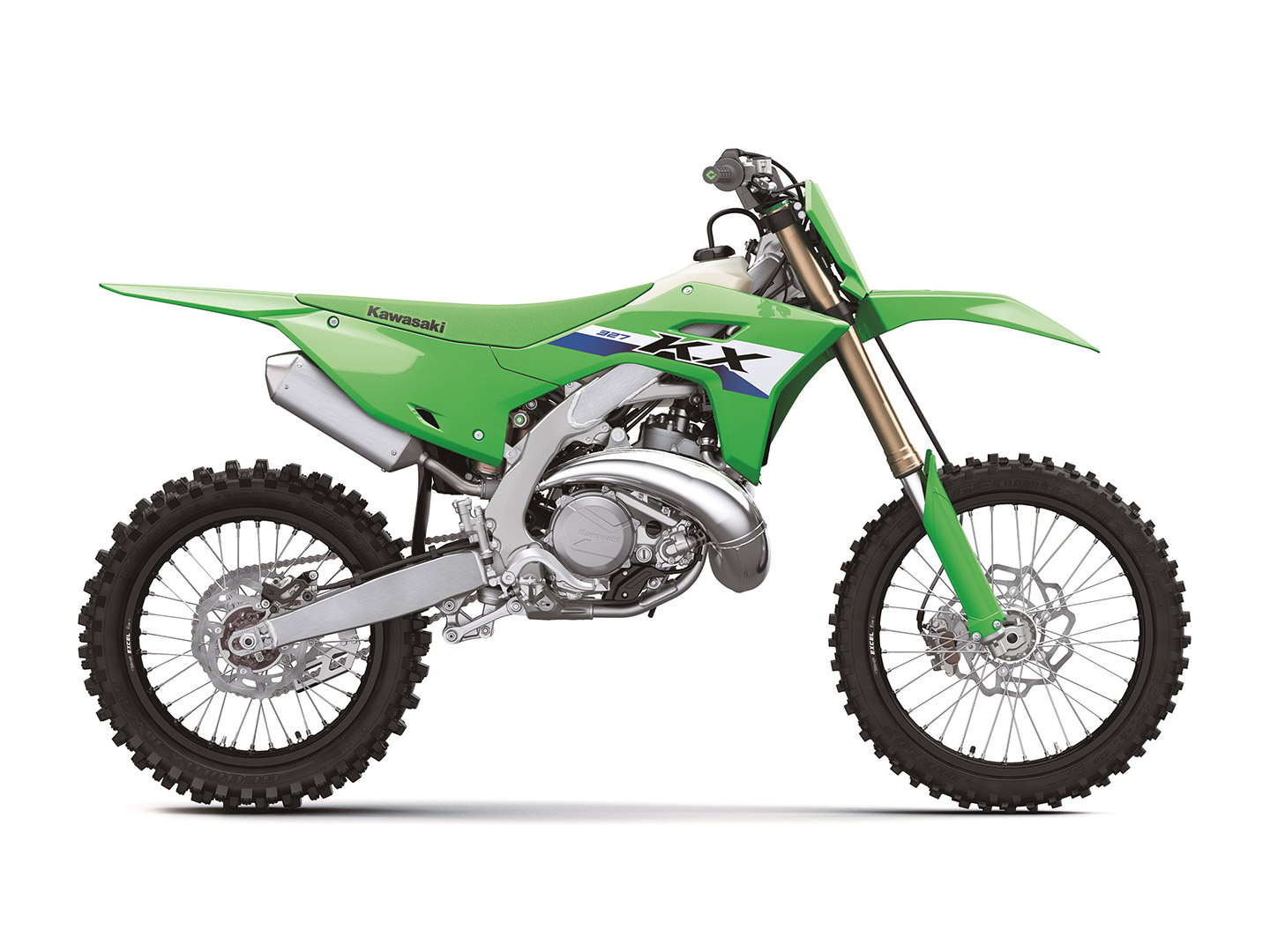
Kawasaki is introducing the KX327 and KX327X in 2026 as 2027 models, marking the company’s first two-stroke motorcycles above 250cc in more than two decades. The announcement arrives as two-strokes regain attention in motocross and enduro, after stricter emissions rules around the turn of the millennium pushed manufacturers to discontinue many two-stroke road motorcycles. The 1998 Yamaha YZ400 helped drive the rise of a new generation of four-stroke motocross and enduro machines; Kawasaki is now returning to the larger-displacement two-stroke category with two distinctly focused models.
The renewed interest in two-strokes is associated with their mechanical simplicity, high specific output and typically lower-cost maintenance compared with four-stroke powerplants. Open motocross classes, which do not enforce strict engine-capacity limits, have also helped maintain interest in larger two-stroke engines. Existing examples cited in connection with this market include KTM’s 250SX and 300SX, their Husqvarna and GasGas equivalents, Beta’s RX 2T 250 and 350, and Yamaha’s YZ250.
One engine, two intended uses
At the centre of both Kawasaki models is a liquid-cooled, single-cylinder, 327cc two-stroke engine. Kawasaki describes it as its first completely new large-displacement two-stroke engine in more than 20 years. Fuel injection, a 39mm throttle body and electronic controls are intended to smooth the torque curve, potentially giving the engine a more tractable character than the peaky response associated with older two-strokes. The injection system is also intended to remove the need to adjust jets for changes in altitude or weather conditions.
Both motorcycles use premix lubrication, battery-and-coil engine management/ignition, a wet multi-disc clutch and chain final drive. Electric starting and two selectable power modes are standard on both. Smartphone connectivity allows riders to change motorcycle settings, download riding logs and access maintenance information.
The basic distinction is in the intended terrain and transmission. The standard KX327 is configured for motocross, with a five-speed gearbox and a 19-inch rear wheel. The KX327X is aimed at cross-country use and receives a six-speed transmission with an ultra-low first gear for slow-speed sections, together with an 18-inch rear wheel. Both use a 21-inch front wheel.
Kawasaki also says both versions have a newly designed exhaust-valve system intended to improve throttle response and power delivery. The company has not disclosed the technical details of those changes, and published horsepower and torque figures remain to be announced.
KX450F-derived chassis and KYB suspension
The motorcycles use an aluminum perimeter frame derived from the four-stroke KX450F design. Its construction combines forged, extruded and cast aluminum sections. Kawasaki lists a claimed weight of 233.7 pounds for the KX327, while press materials give the KX327X the same figure. That number warrants confirmation: the cross-country model’s six-speed transmission, skidplate, hand guards, linkage guard and rear-disc protection could make it heavier, although the available information does not establish that it is.
Both models use KYB suspension, including a 48mm Air-Oil Separate inverted front fork with compression and rebound damping adjustment. At the rear, Kawasaki’s Uni-Trak system provides separate high- and low-speed compression adjustment, rebound adjustment and preload adjustment. Four handlebar positions and two footpeg positions allow the riding position to be tailored to rider preference.
The braking hardware comprises a 270mm single petal front disc with a dual-piston Nissin caliper and a 240mm single petal rear disc with a single-piston Nissin caliper. The KX327 is specified with 80/100-21 front and 120/80-19 rear tires; the KX327X uses the same front size and a 120/80-18 rear tire.
Published specifications still have gaps
Both specification tables list a 2.2-gallon fuel capacity. That is notably larger than the 1.6-gallon tanks used by the KX250F and KX450F four-stroke models. However, images appear to show the same tank on the KX327 and KX327X, leaving uncertainty over whether the two motorcycles actually use different tanks.
Several fundamental figures remain TBA for both models: bore, stroke, compression ratio, claimed horsepower, claimed torque, rake, trail, wheelbase, ground clearance and seat height. Kawasaki had also not released full US-market specifications. European details were limited, although those versions are not expected to differ substantially from motorcycles intended for US dealers.
The announced US-market MSRP is $9,099 for the KX327 and $9,699 for the KX327X. Both are expected to reach US dealers in late 2026. No Greek or broader European price, release date or availability has been established by the available information.
THE EVIDENCE BEHIND THE STORY
Sources
Spotted something that needs correcting? Contact the editorial team ↗