
Honda patents sketch a petrol-electric Motra revival
New designs revive the 1982 Motra concept with one shared tubular chassis and two possible powertrains, though production is still unconfirmed.

2 min read
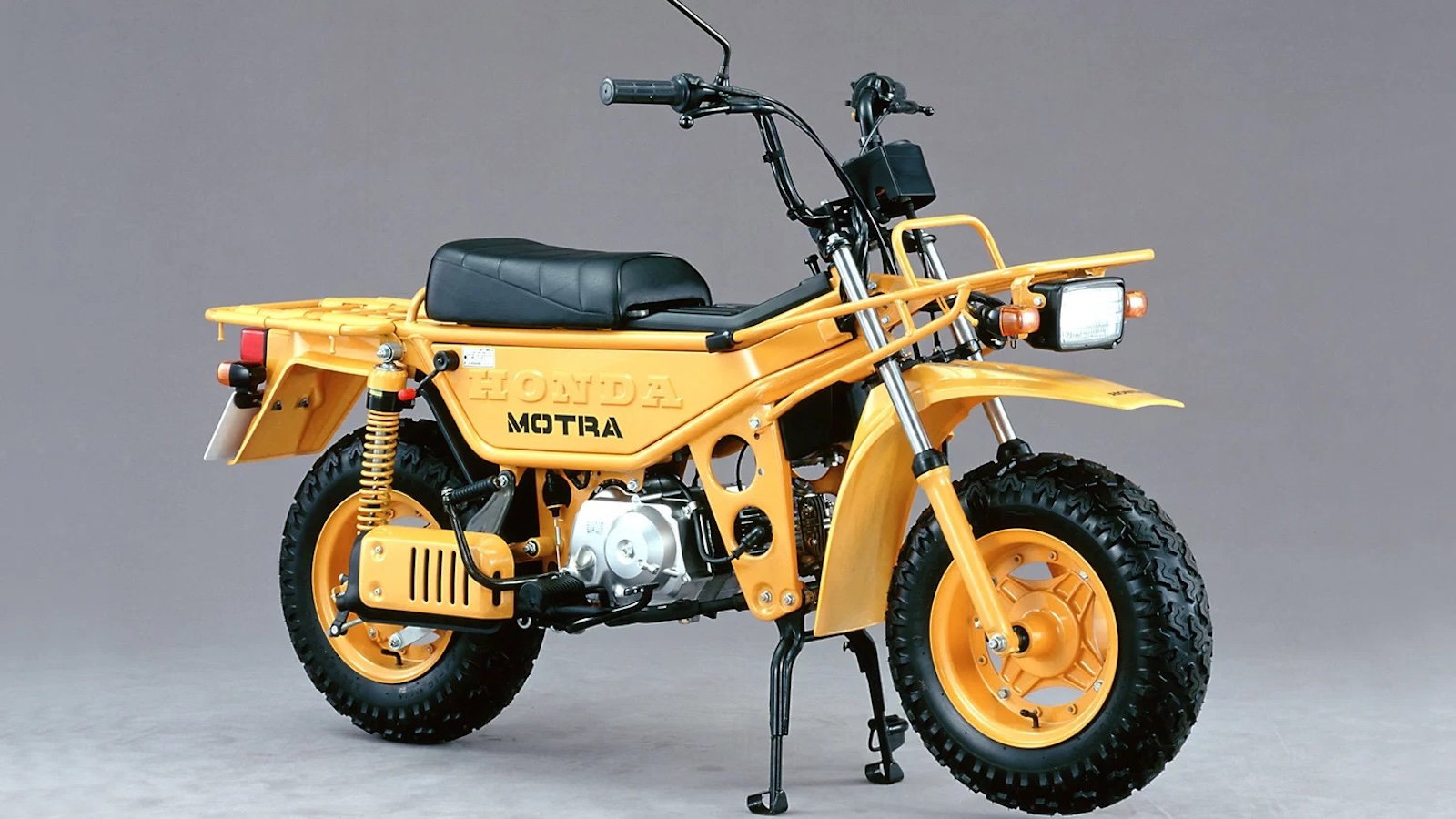
Honda appears to be examining a modern return for the Motra, its distinctive utility motorcycle from the 1980s. Patent designs show two possible versions: one powered by a petrol engine and gearbox, the other by an electric drivetrain. Both use the same basic tubular-steel chassis, with mounting points arranged to accept either mechanical layout.
The original Motra was introduced in Japan in 1982 as a recreational machine with an unusually practical character. Its transmission combined a three-speed gearbox with a separate two-speed range selector, giving the rider high and low ratios. That arrangement brought to mind the operating logic of an off-road utility vehicle, while the motorcycle itself had a deliberately chunky, almost toy-like appearance. Despite its bulky look, the Motra weighed 76 kg. Production ended after 1983, and the model subsequently became a rare sight.
A shared chassis for two powertrains
In the petrol design, the drawings show a single-cylinder engine and transmission layout related to the units used in Honda’s C125 Super Cub, Monkey and MSX125/Grom. Those motorcycles use air-cooled, four-stroke engines with a capacity of 125cc. The patent concept does not establish the final engine specification, power output or gearing for a production Motra, so the component selection should not be treated as a confirmed specification.
The electric version rearranges the same compact package. Its battery occupies the space used by the combustion engine in the petrol model, while the swingarm incorporates the electric motor instead of using the conventional swingarm shown in the petrol layout. Battery capacity, motor output, riding range and charging details remain unspecified, leaving the practical performance of this version open.
The two concepts nevertheless preserve the visual language that made the original Motra unusual. Both have compact, boxy proportions, chunky tyres, an exposed tubular frame and luggage racks at the front and rear. The racks are intended to provide carrying space, while the frame remains the structural centre of the motorcycle. That combination keeps the design focused on simple utility rather than conventional road-bike styling.
Honda has not officially announced a new Motra, and neither design confirms that it will reach production. If the project advances, the company would have a way to revisit the 1982 machine’s utility-focused format without committing to only one type of propulsion. For now, the important development is Honda’s exploration of a shared chassis that could accommodate either a small petrol powertrain or an electric alternative.
THE EVIDENCE BEHIND THE STORY
Sources
Spotted something that needs correcting? Contact the editorial team ↗