
Honda Hawk 11: the Japan-only café racer that disappeared too soon
The Hawk 11 combined Africa Twin-derived performance, 1980s-inspired details and a distinctive road-sport design, but Honda kept it exclusively in Japan until production ended in 2023.

5 min read
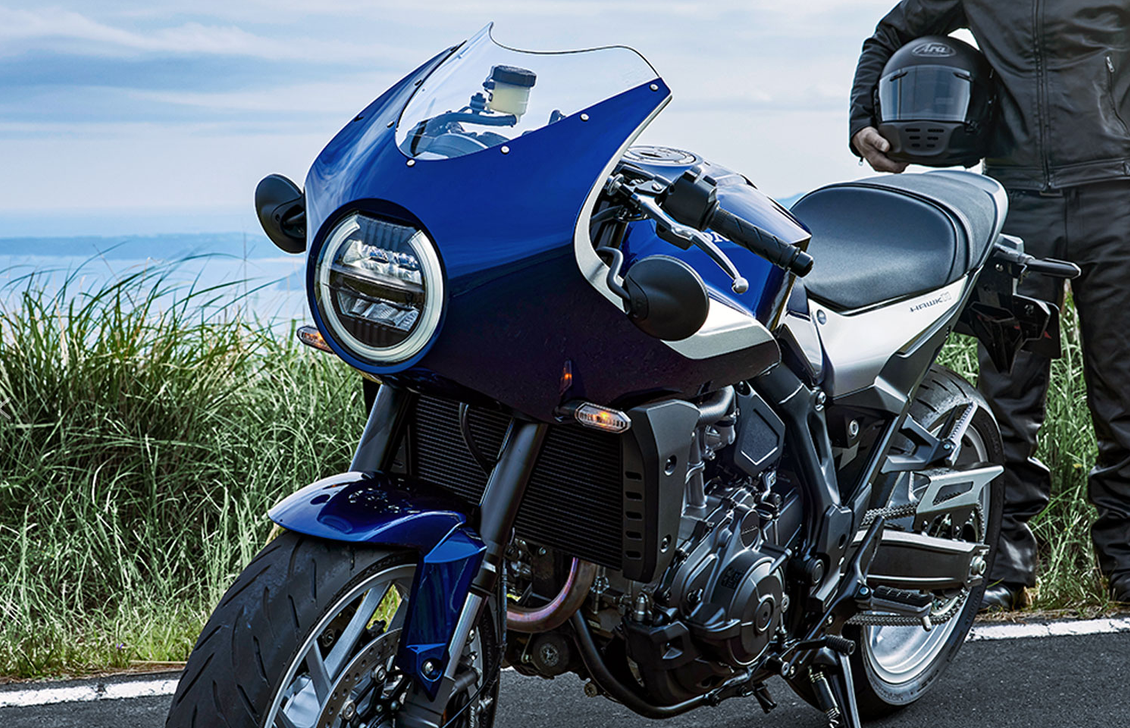
Honda’s Hawk 11 was one of the company’s most individual modern-retro motorcycles, yet its story ended almost as quickly as it began. Revealed at the 38th Osaka Motorcycle Show in 2022, the café racer-style road bike entered production in April of that year and remained a Japan-only model. Honda stopped making it in December 2023, after a short run that lasted about 19 months from its market launch.
The Hawk 11 had the ingredients of a motorcycle with broader appeal: a large parallel-twin engine, a compact fairing, classic proportions and contemporary chassis and electronic equipment. Instead, Honda Japan chose not to offer it in any market outside Japan. The model was later described by Honda as a limited-production motorcycle, while its brief commercial life ensured that the design remained a relatively rare sight even in its home country.
A new Hawk with an old family name
The name connected the 2022 motorcycle with the Hawk GT, also known as the NT650, Bros in some markets and RC31. Introduced in 1988, the earlier Hawk was a naked motorcycle powered by a 650 cc V-twin producing 58 horsepower and 42 Nm of torque. Its aluminium perimeter frame was reinforced, and the rear suspension used Honda’s Pro-Arm single-sided swingarm. Despite the shared name, the two Hawks had very little in common mechanically.
The new motorcycle belonged to Honda’s modern-retro or Neo-Sports category, but its design was not simply an exercise in copying the past. The curved fuel tank rose prominently before dropping towards the rear, while a strong vertical transition separated the tank from the subframe. The riding position used slightly lowered handlebars and gave the bike a clear sporting intent. A slim seat and compact tail provided space for two people, with the rear LED light integrated into the tail for a cleaner appearance. The indicators and number-plate mount sat in a separate assembly above the rear wheel.
There was also a visible link to Honda’s CB4 Interceptor concept from 2017. The concept and the Hawk 11 shared a similar treatment of the frame and fairing lines, suggesting a common design direction. Unlike the CB4 Interceptor, however, the Hawk 11 was developed for production. The relationship was mainly visual: the concept was associated with a 998 cc, 142-horsepower engine derived from the Fireblade, while the production Hawk used a completely different powerplant.
Africa Twin power in a road-sport package
The engine was Honda’s liquid-cooled 1100 parallel twin from the Africa Twin family. In the Hawk 11 it delivered 102 horsepower and 104 Nm of torque, figures described as matching those of the Africa Twin. It was the first application of that engine in a dedicated road-going sports platform rather than a dual-sport motorcycle, giving the Hawk a substantially different character from the older 650 cc V-twin Hawk GT.
Honda also drew on other parts of its range. The Hawk 11 used the tubular semi-double-cradle frame associated with the NT1100 Sports Tourer, together with 17-inch wheels, an aluminium swingarm, the wheels, the brakes and the exhaust headers. The shared hardware helped create a practical technical base, but the finished motorcycle did not look like a lightly restyled NT1100. Its bodywork was purpose-designed and gave it a much stronger visual identity.
The front treatment followed a compact, rounded “bullet” theme associated with motorcycles such as the MV Agusta Superveloce. The tank’s pronounced hump and descending rear section created a continuous retro-sport silhouette, while the clean line into the tail kept the motorcycle visually light. Honda’s design also made a deliberate distinction between the large front section and the narrow rear, reinforcing the café racer profile without turning the Hawk into a single-seat machine.
Period details, modern equipment
At the front was a circular LED headlight with a bright daytime-running-light ring and a visually divided lens. The indicators were positioned low in the small fairing, and the mirrors used a deliberately retro shape. Behind them, the LCD instrument display adopted graphics inspired by the 1980s. These details gave the motorcycle its period character without replacing the electronic equipment expected from a contemporary Honda.
The suspension package consisted of an inverted Showa fork with black fork tubes and a rear monoshock working through Honda’s Pro-Link system. Electronics included three riding modes and the option to configure a personalised setting. ABS was standard equipment, while Honda’s selectable Torque Control system was designed to limit rear-wheel slip. The result was a motorcycle that combined a visually simple layout with a more sophisticated control package beneath the surface.
Honda also offered owners a selection of aftermarket equipment and accessories. Collaborations with the Japanese companies Moriwaki and Daytona covered both urban use and touring, allowing the Hawk 11 to be adapted to an owner’s preferences. That support broadened the motorcycle’s practical possibilities and showed that Honda was presenting it as a complete road-going model rather than only as a styling statement.
A short-lived opportunity
The Hawk 11’s most decisive limitation was not its engine or equipment but its distribution. Honda Japan kept it out of every market beyond Japan, even though its combination of large-capacity parallel-twin performance, classic styling and modern electronics could have fitted the growing international interest in modern-retro road bikes. Its closest comparison in the category was the Kawasaki Z900RS, a retro-sport model that continued in production and achieved international sales, while the Honda remained confined to its domestic market.
The Japanese price was approximately €10,500, a figure described as competitive for the package. That did not produce the reception Honda had expected in Japan, and production ended in December 2023. The company subsequently referred to the Hawk 11 as a limited-production model. In the end, the motorcycle became a short chapter in Honda’s modern-retro range: a Japan-only road sport machine with Africa Twin power, NT1100-related hardware, clear café racer intentions and enough design character to stand apart from both its predecessors and its donor models.
THE EVIDENCE BEHIND THE STORY
Sources
Spotted something that needs correcting? Contact the editorial team ↗