
Ducati’s Collezione 100 links ten limited motorcycles to its history
For Ducati’s 2026 centenary, ten numbered models revisit milestones ranging from Imola and Daytona to the Pantah, Scrambler and Pantah Ice.

8 min read
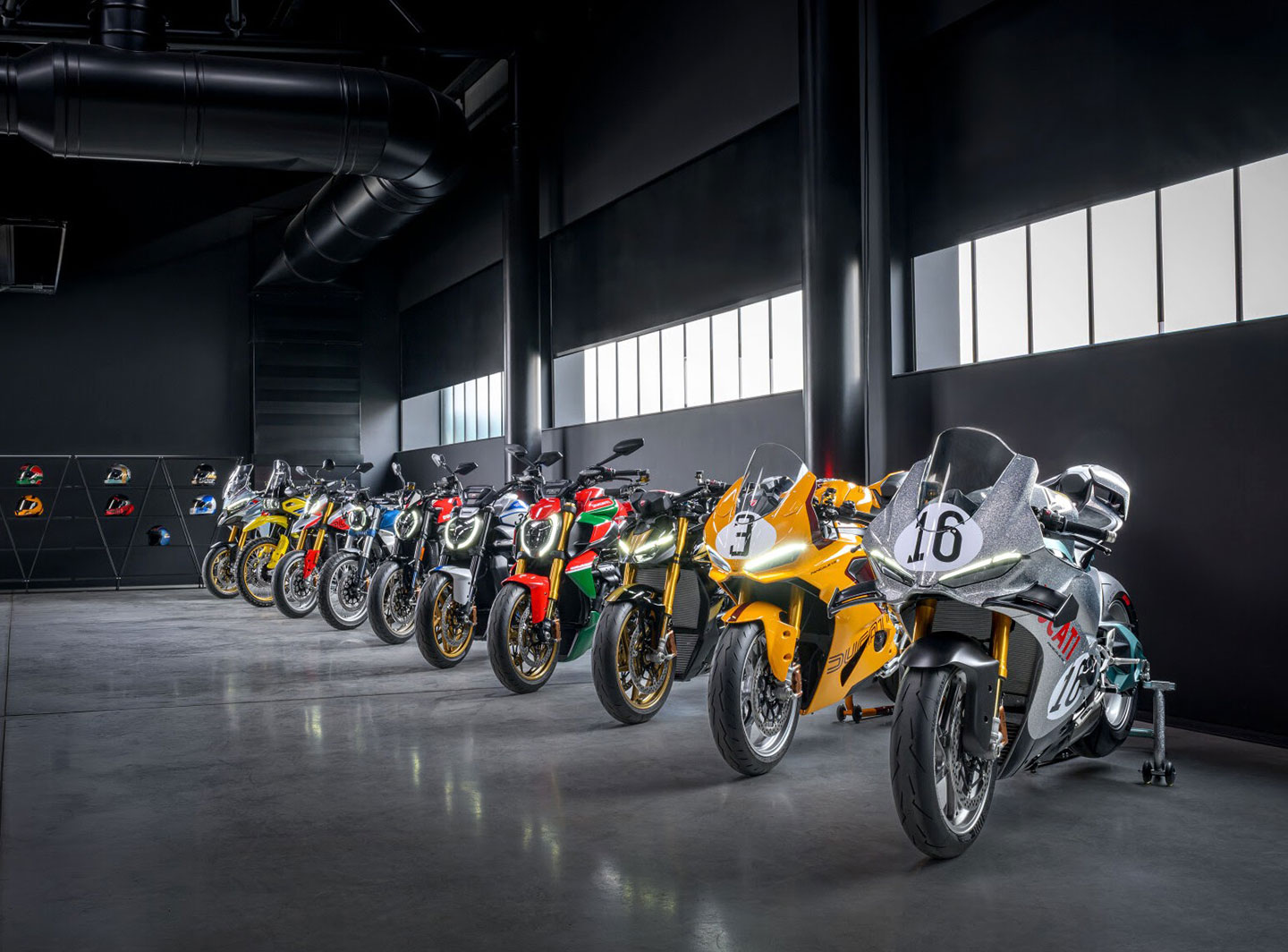
Ducati is marking its founding centenary in 2026 with Collezione 100, a series of ten limited-edition motorcycles. Each model is restricted to 100 numbered units and receives a livery connected to a Ducati motorcycle or moment from the company’s history. The collection follows other centenary projects, including the Formula 73 and Superleggera V4 Centenario special editions.
The significance of Collezione 100 is therefore broader than a single anniversary colour scheme. It treats the current range as a set of historical references: the Panigale models recall racing victories and early desmodromic road bikes, while the Diavels, Multistrada, Scrambler, Hypermotard and DesertX draw on other chapters, from American racing and the Pantah to ice-track demonstrations.
A numbered collection with shared details
The motorcycles use model-specific liveries and equipment, rather than one identical specification applied across the range. The collection’s stated details include premium seats with embroidered logos, Centenario Bronze brake calipers, dry clutches and high-performance exhausts, with the exact equipment varying by model.
Every motorcycle comes with a model-specific plaque and a certificate of authenticity. Two numbered prints, carrying the motorcycle’s serial number and signed by Ugo Nespolo, are included as well. Nespolo is described as a prominent late-20th-century Italian artist and a Ducati enthusiast. Owners in North America also receive a limited-edition helmet and jacket with the package.
The motorcycles were unveiled at Mugello alongside works by Nespolo and the Lenovo team’s two Desmosedici GP machines. Those race bikes were scheduled to compete on Sunday with matching liveries. The Collezione 100 motorcycles can also be viewed at World Ducati Week, the Goodwood Festival of Speed and Bologna museums later in the year.
Panigale V4 S 100: the Imola connection
The Panigale V4 S 100 takes its graphics and paint inspiration from Ducati’s 1972 Imola 200-winning motorcycle, the 750 Imola Desmo. Paul Smart and Bruno Spaggiari rode that machine. The 750 Imola Desmo had been developed from Ducati’s first twin-cylinder road motorcycle: it retained the 750 GT’s mechanics, added desmodromic valves and used bodywork from the 500 GP machine.
The 1972 victory was followed the next year by the 750 Supersport Desmo, described as Ducati’s first twin-cylinder desmodromic road motorcycle. The modern anniversary Panigale brings that lineage into its own hardware and finish. It has an Alcantara seat embroidered with the Ducati 100 logo, carbon-fibre front and rear fenders, and carbon-fibre engine and exhaust covers. Its name and serial number are displayed on a Centenary Bronze plate riveted to the aluminium triple clamp.
A dry clutch and titanium Akrapovič exhaust are part of the specification. The equipment also includes mirror-removal and licence-plate-removal kits, an open clutch cover and a bronze billet-aluminium fuel-tank cap. These elements are intended for track use rather than public-road use. The open clutch cover is not road-legal because of EPA noise standards, while the tank cap does not meet emissions standards. The motorcycle is shipped in a custom-made wooden crate.
Panigale V2 S 100 and Streetfighter V4 S 100
The Panigale V2 S 100 refers to Franco Uncini’s 750 Super Sport Desmo from the 1975 Italian Championship. Its yellow paint recalls road-going 750 Sport models, while brown is associated with marine engines assembled at Borgo Panigale at the time. The motorcycle has an Alcantara seat with an embroidered Ducati 100 logo, billet sport handlebars and a steering damper. A Centenary Bronze plate on the billet triple clamp carries its name and serial number.
This is described as the first motorcycle in Ducati’s V2 family to use a dry clutch. Its standard equipment includes mirror-removal and licence-plate-removal kits, an open clutch cover and a bronze billet-aluminium fuel cap; all of these additions are described as not road-legal.
The Streetfighter V4 S 100 takes a different historical route, using black and gold inspired by Ducati’s 1979 900 Sport Desmo Darmah. Gold wheels and a matching stripe on the tail section reinforce the reference. The bike adds an Alcantara Ducati 100 seat, carbon-fibre rear fender, engine cover and exhaust, plus a Centenary Bronze plate with the motorcycle’s name and serial number on the billet-aluminium triple clamp.
Its track-oriented equipment includes mirror-removal and licence-plate-removal kits, an open cover for the dry clutch and a Centenary Bronze billet-aluminium fuel-cap crown. These components are not road-legal.
Monster and the two Diavel references
The Monster 100 uses the tricolour livery of the first-generation Monster S4Rs Tricolore as its historical reference. It has a dry clutch with a carbon-fibre cover described as not road-legal, an Alcantara seat embroidered with the Ducati logo, and a windshield and seat-cover kit intended to create a single-seater appearance. Its Centenary Bronze plate, carrying the name and serial number, is mounted on the billet steering clamps. A matching bronze fuel-tank-cap ring and brake calipers complete the treatment.
The evidence uses both “XDiavel 100” and “XDiavel V4 100” for the next motorcycle, so the naming is not consistent. Ducati says the XDiavel V4 100 is inspired by the 750 Super Sport that won the 1977 Daytona 200. Known as the California Hot Rod, that motorcycle was ridden by Cycle journalist Cook Neilson with support from Phil Schilling, and its development was documented in Cycle magazine. The result was presented as a production-derived AMA Superbike victory in the United States and as an important moment for Ducati’s performance image in America.
The reviewer’s assessment of the design is more selective: the reviewer approves of the colours and of the Diavel generally, but considers the link between the Daytona-winning number 31 and a forward-control cruiser arbitrary. That is an attributed opinion, not a Ducati technical claim.
The motorcycle has a leather seat with an embroidered Ducati logo and a machined-from-solid central handlebar section. Its serial number sits on a riveted Centenary Bronze plate. A dry clutch is described as not road-legal, while standard equipment includes a leather passenger seat, a Centenary Bronze fuel-cap ring and an open clutch cover.
The Diavel V4 RS 100 uses the Desmosedici Stradale engine, adjustable Öhlins suspension and Brembo Stylema calipers. Its livery recalls Ducati’s 1979 road-going 900 Replica, whose green and red colours were inspired by Mike Hailwood’s 1978 Isle of Man-winning motorcycle. The 900 Replica was Ducati’s first road-going replica of a racing motorcycle and became one of its most successful models.
The RS 100 has an Alcantara seat embroidered with the Ducati 100 logo, a machined-from-solid handlebar centre, a Centenary Bronze plate with its name and serial number, and a matching fuel-cap rim. Its equipment includes an Alcantara passenger seat, a machined fuel cap and an open clutch cover that is not legal for street use.
Pantah, Scrambler and endurance-racing references
The Multistrada V4 RS 100 looks back to the 500 SL Pantah, Ducati’s first motorcycle with a trellis frame. The Pantah engine replaced the company’s long-used bevel gears with belt-driven camshafts. The modern Multistrada adopts graphic elements from that motorcycle and places a Desmo logo on the tail fairing. It uses the Desmosedici Stradale engine, along with an Alcantara seat, a named and numbered bronze plate on the handlebar clamps and billet triple clamp, a bronze fuel-cap ring and a carbon-fibre open clutch cover. The fuel-cap ring and open clutch cover are not approved for road use.
The Scrambler 100 is based on the Scrambler Nightshift and wears graphics inspired by the 1962 250 Scrambler, described as the first Ducati Scrambler produced exclusively for the US market. American importer Joe Berliner requested the off-road dirt-track motorcycle that led to that model. The anniversary version has an Alcantara seat with an embroidered Ducati logo, a Centenary Bronze plate carrying its name and serial number on the billet steering clamps, and a billet fuel cap with a Centenary Bronze ring.
The HyperMotard V2 SP 100 draws on the prototype Ducati 860 Desmo. That motorcycle appeared after the 1972 Imola 200 victory and was developed for the stresses of long endurance races. It later became the road-going Ducati 900 Super Sport, and the 860 Desmo won the 1975 24 Horas de Montjuïc in the bright colours of the Nepoti and Caracchi NCR team.
The modern model is based on the SP version of the Hypermotard and uses graphics from that race. Its equipment includes Öhlins suspension, forged wheels, an Alcantara seat embroidered with the Ducati 100 logo, a Centenary Bronze numbered plaque on the handlebar clamps, a bronze fuel-tank cap and a dry clutch with a carbon-fibre open cover. The open cover is not approved for road use.
DesertX 100 and Pantah Ice
The DesertX 100 references the 1981 Pantah Ice, a modified Pantah 500 fitted with studded tyres and stripped of its braking system for use on Alpine ice tracks. These motorcycles entertained crowds between car races on ice rinks and appeared in different liveries. The yellow-and-blue scheme selected for the DesertX comes from a Pantah Ice motorcycle in the Ducati Museum collection.
The DesertX 100 has a numbered Centenary Bronze plate and an Alcantara seat embroidered with the Ducati 100 logo. Its Centenary Bronze fuel cap and headlight grille are not approved for road use. That detail is representative of the collection’s character: the motorcycles are numbered historical objects with highly specific finishes, but some of their supplied or displayed equipment is intended for track or show use rather than unrestricted road riding.
THE EVIDENCE BEHIND THE STORY
Sources
Spotted something that needs correcting? Contact the editorial team ↗