
Ducati Desmo250 MX brings desmodromic technology to the 250 class
After taking the 2024 Italian Prestige Motocross Championship with the Desmo450 MX, Ducati is preparing its smaller Desmo250 MX for dealer arrival in September.

5 min read
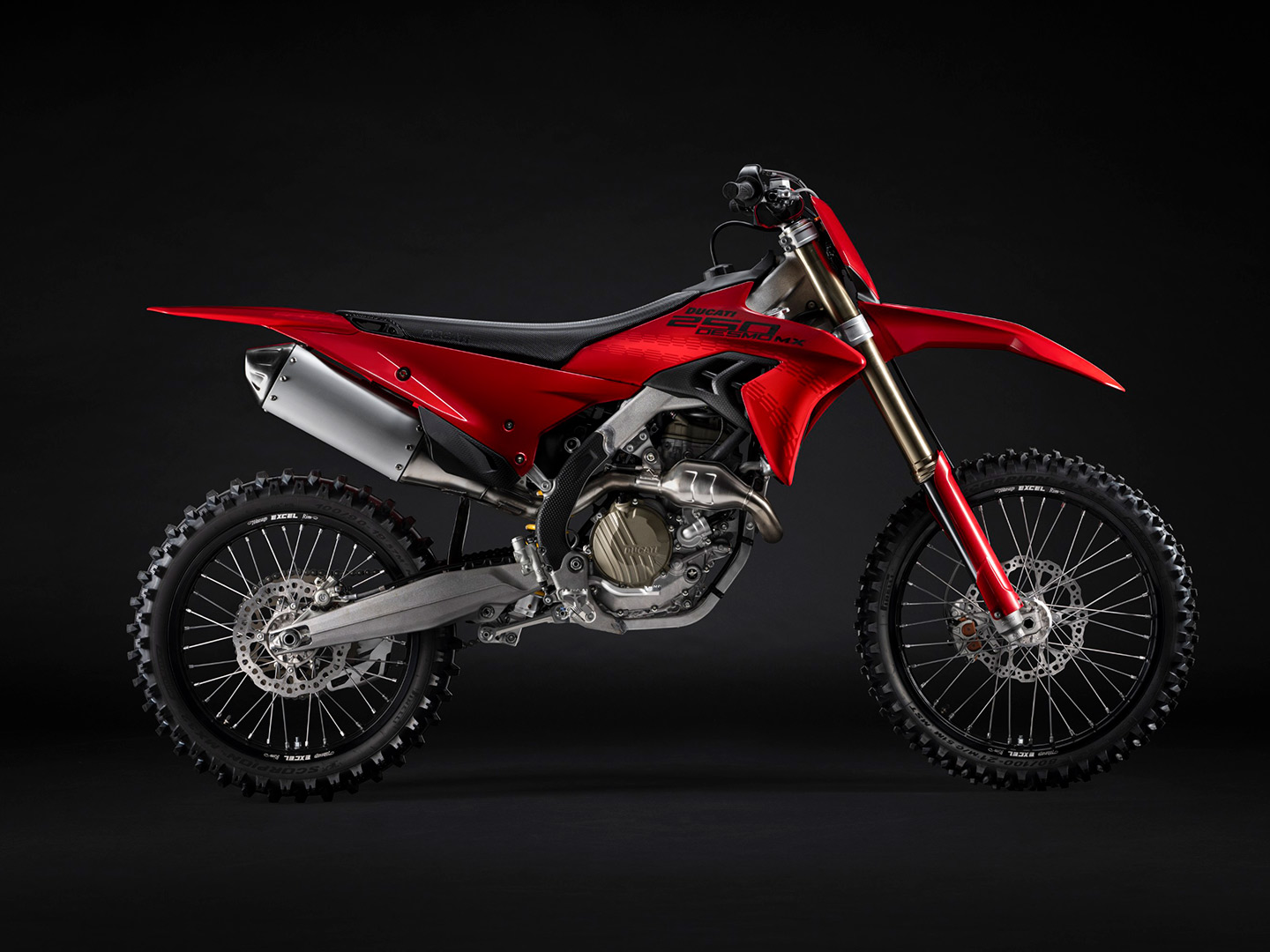
Ducati’s second motocross model is moving from prototype competition to production. The Desmo250 MX is scheduled to reach Ducati dealers in September, following a development programme that saw its prototype finish second overall in the Italian championship with Alessandro Lupino. It follows the Desmo450 MX, whose prototype won the 2024 Italian Prestige Motocross Championship at its first attempt with Lupino aboard.
That progression marks a significant expansion for a company long associated with road racing and high-level asphalt competition. Ducati entered motocross in 2024, initially an unexpected direction for the brand. The Desmo250 MX now extends that project into a smaller-displacement class while retaining much of the visual and technical identity established by the 450.
A smaller MX with familiar Ducati hardware
The 2027 Desmo250 MX looks nearly identical to the Desmo450 MX. Its chassis is based on the 450’s welded aluminium perimeter frame, which combines cast and forged sections, and the two motorcycles share their bodywork. The engine, however, is described by Ducati as completely new: a liquid-cooled, single-cylinder 249.7cc unit with four valves, DOHC architecture, an 81mm bore and a 48.4mm stroke. Compression is 14.5:1.
Desmodromic valve control is central to the concept. Instead of relying on conventional valve springs to close the valves, the system uses additional cam lobes and rockers. Ducati attributes this arrangement with allowing high engine speeds without the risk of valve float. The Desmo450 MX uses the same general valve technology.
The 250’s claimed peak output is 44.5 hp at 12,500 rpm, with a stated maximum engine speed of 15,000 rpm. Ducati lists peak torque of 21 lb-ft at 8,800 rpm. The figures give the smaller engine a claimed specific output of 178 hp per litre, compared with 141 hp per litre for the 450, which produces a claimed 63.5 hp at 9,400 rpm and has an 11,900-rpm redline.
The 250’s 81mm bore and 48.4mm stroke match the dimensions stated for Ducati’s Panigale V4 R and Desmosedici MotoGP machines. Ducati’s development logic is that lessons related to gas flow and combustion-chamber shape can be transferred from those applications to the motocross engine. The 250 engine weighs 54.4 lb, approximately 4.4 lb less than the Desmo450 MX engine. Complete wet weight is listed at 227 lb, four pounds below the 450’s stated 231 lb.
Designed for drive out of corners
Maximum power is only part of the motocross equation. Ducati says it developed the Desmo250 MX engine for responsiveness at low rpm as well as peak performance, with traction and the ability to keep pulling through corners identified as important requirements. The transmission is a five-speed unit with chain final drive and an upshift-only quickshifter.
Electronic adjustment is handled through the Ducati X-Link app. Riders get two customisable engine maps, three traction-control levels, two engine-braking settings and three launch-control options. Ducati says the traction-control system is specific to the Desmo250 MX and differs from rival systems, while also using patented technology developed through MotoGP and WorldSBK experience.
There is one fuel-system detail that requires clarification before publication. The narrative description identifies a 44mm Mikuni throttle body, while the specifications table lists Keihin injection together with a Mikuni 44mm throttle body.
Race-focused chassis and equipment
Suspension comes from Showa. Up front is a fully adjustable 49mm inverted fork with Kashima coating and 12.2 inches of travel; at the rear is a fully adjustable Showa monoshock with 11.9 inches of travel. The motorcycle uses Takasago Excel rims measuring 1.6 by 21 inches at the front and 2.15 by 19 inches at the rear, fitted with Pirelli Scorpion Mid Soft tyres in 80/100-R21 and 100/90-R19 sizes.
Braking hardware comprises a Brembo hydraulic multiplate clutch, a two-piston Brembo front caliper and a single 260mm Galfer front disc. At the rear, a single-piston caliper works with a 240mm Galfer disc. Ducati lists a 26.9-degree rake, 4.6 inches of trail, a 59-inch wheelbase and a 38.2-inch seat height. Fuel capacity is 1.9 gallons.
Maintenance is part of the ownership calculation
The X-Link app also provides access to a predictive-maintenance algorithm. Rather than basing service guidance only on running time, the system assesses engine stresses in real time. Ducati says this is intended to distinguish the needs of amateur riders from those of professionals, whose usage loads can be very different.
The company expects valve-clearance checks at 45 hours of use, piston replacement between 45 and 60 hours, and a major full service between 90 and 120 hours. These are Ducati’s stated expectations, not universal intervals for every rider or operating condition; the app’s load-based approach is part of the maintenance strategy.
Price and upgrade path
The Desmo250 MX has a stated MSRP of $10,595, or $900 less than the standard Desmo450 MX. Optional Ducati Performance equipment can push the price higher. The listed upgrades include Factory billet triple clamps, an Akrapovič titanium slip-on silencer or complete exhaust system, higher-spec Brembo Racing brakes and upgraded Showa suspension.
Ducati’s smaller motocross machine therefore combines a competition-backed project, a distinctive desmodromic single-cylinder engine and a comparatively extensive electronic and maintenance-management package. Its production status is planned rather than current: dealer arrival is scheduled for September.
THE EVIDENCE BEHIND THE STORY
Sources
Spotted something that needs correcting? Contact the editorial team ↗