
2027 Ducati Desmo450 EDS brings Desmo power to the street-legal dirt-bike class
Based on the Desmo450 MX, Ducati’s first street-legal off-roader pairs a 42-hp single with race-derived hardware and demanding service requirements.

6 min read
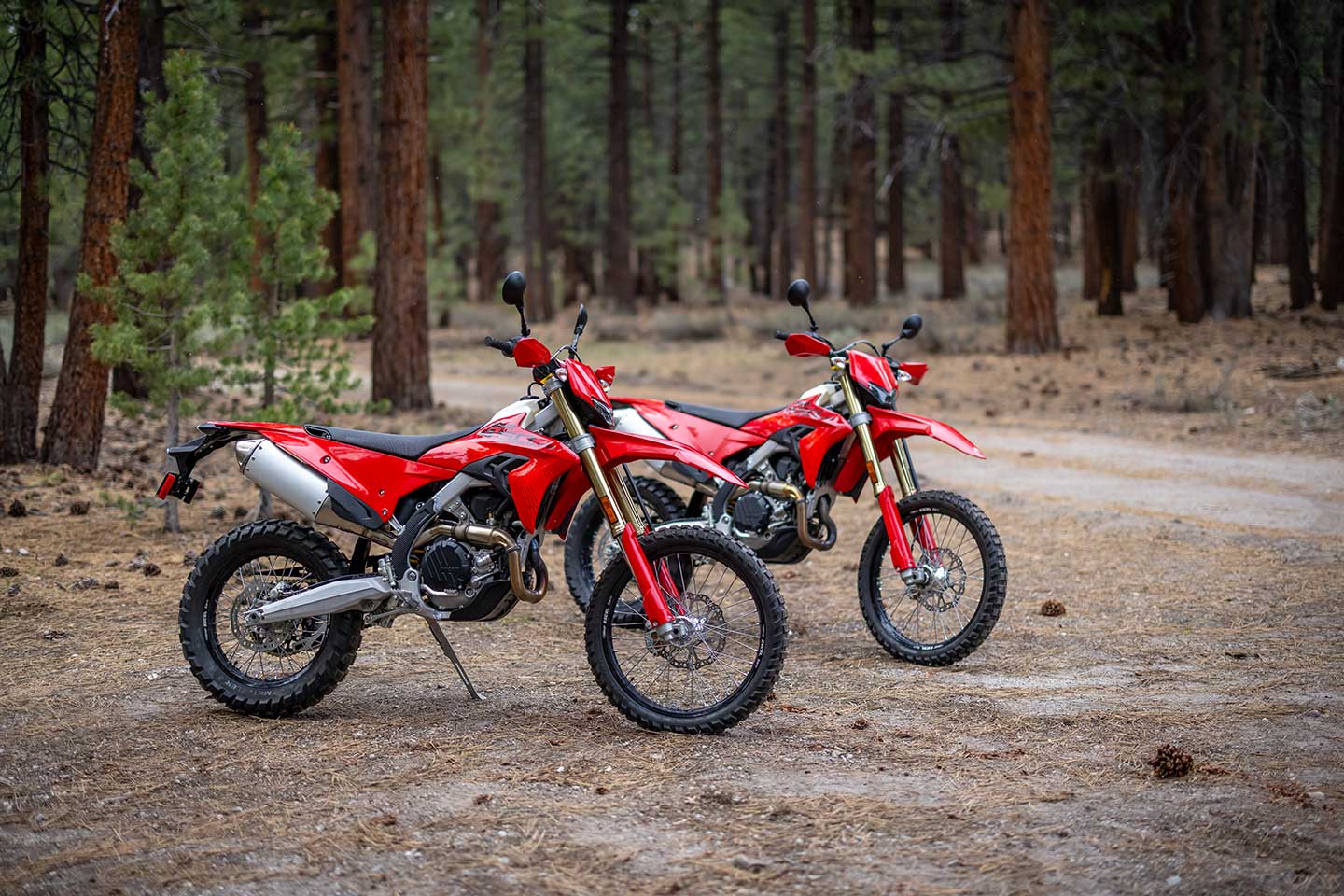
Ducati has detailed the 2027 Desmo450 EDS, its first street-legal off-roader. Previewed at the previous year’s EICMA show, the EDS is a hardcore dual-sport based on the Desmo450MX and positioned as the third model in Ducati’s off-road lineup. Its specification makes the central trade-off clear: this is a road-equipped motorcycle built around a high-performance, race-derived single-cylinder engine rather than a low-maintenance streetbike powerplant.
A modified Desmo450MX engine
The EDS uses a liquid-cooled, 450cc single with four valves and Ducati’s desmodromic valve actuation. Bore and stroke measure 96.0mm and 62.1mm, respectively, while the compression ratio is 12.9:1—lower than the Desmo450MX’s stated 13.5:1. Ducati also specifies revised camshafts, a higher-inertia connecting-rod assembly, and changes to the crankshaft and flywheel. The throttle bodies are 42mm rather than the MX’s 44mm units, and fuel delivery is electronic.
In standard form, Ducati claims 42 hp at 6,750 rpm and 33 ft.-lb. of torque at 5,750 rpm. The six-speed transmission uses chain final drive, with a shorter first gear, a taller sixth gear and revised spacing for the intermediate ratios compared with the MX. An up-only quickshifter is standard. The clutch is wet, multiplate and hydraulically actuated. A radiator fan supports slower riding, while the radiators use a rhomboid shape.
MX foundations, street-legal equipment
The EDS retains the MX’s frame design, combining forged, cast and extruded sections. Ducati says revised engine mounting points are intended to optimize stiffness, and puts the frame weight at just under 20 pounds. The specifications identify the frame material as aluminum.
Suspension is supplied by Showa. Up front is a fully adjustable, inverted 49mm fork with a model-specific spring rate and 12.2 inches of travel. The rear uses a fully adjustable progressive-link Showa monoshock with 11.9 inches of travel.
Braking hardware comprises a two-piston Brembo caliper and 260mm Galfer disc at the front, plus a single-piston Brembo caliper and 240mm Galfer disc at the rear. The brake pads are unique to the EDS. Spoked wheels use Takasago Excel rims, measuring 21 x 1.6 inches at the front and 18 x 2.15 inches at the rear. Metzeler Karoo 4 tires are fitted in 90/90-21 and 140/80-18 sizes.
The listed geometry includes 27.3 degrees of rake, 4.6 inches of trail and a 58.8-inch wheelbase. Seat height is 38.2 inches, and the fuel tank holds 2.2 gallons. Ducati claims a 264-pound dry weight with that tank empty. The EDS is 35 pounds heavier than the MX according to the article, with the added weight attributed to street-legal running gear.
For protection and road equipment, the EDS replaces the MX’s magnesium clutch cover, ignition cover and valve cover with aluminum units. Handguards, engine guards and LED lighting are standard equipment.
Electronics require the Racing Kit
The EDS uses the electronic rider-aid suite developed for the Desmo450 MX, but those functions are accessed only after installing the Ducati Performance Racing Kit. With the kit fitted, the motorcycle has engine maps, four levels of traction-control intervention, launch control and engine-braking control. The aids can be adjusted from the handlebars or customized through Ducati’s X-Link app.
Ducati claims that the Racing Kit raises output to 54 hp. The kit is rated for track-only use. Its price is reported in two ways: $261.70 in one passage and approximately $260 in the specifications and later discussion. That discrepancy should be resolved before purchase information is treated as definitive. Relative to the EDS’s stated $12,995 MSRP, either figure appears small, while the kit adds 12 hp and supplies electronic controls that are standard on competing models.
Richard Kenton, Ducati North America’s technical director, says the kit enables advanced electronics that are not permitted on the street-legal configuration because of local emissions standards. He also says the closed-loop Ducati Traction Control system was designed for racing and is not homologated for the street-legal EDS. Under certain conditions, that system modifies the ignition curve to reduce torque. Offering the functions as an accessory allows Ducati to sell one model rather than two separate versions, serving both leisure riders and customers who want to ride competitively. The kit’s low reported price is presented as a sign that Ducati is serious about attracting customers in a category where it lacks an established position.
The ownership question is maintenance
The EDS’s most important practical distinction may be its service burden. The X-Link app displays the maintenance schedule, while a Desmo450-specific algorithm calculates a real-time engine-stress index from operating parameters and conditions of use. Ducati says the schedule is adjusted according to that index, with the app indicating which of two service types the engine requires.
The Mid service is described as a top-end rebuild including pistons and valve-clearance checks. The Full service is a complete engine overhaul. The cited press release projects the Mid service at approximately 90–120 engine hours and the Full service at approximately 180–240 hours.
Those figures place the EDS closer to the race-motor-like, maintenance-heavy side of the dual-sport market than to motorcycles built around streetbike durability. The article identifies the Suzuki DR-Z4S and KTM 390 Enduro R as examples of the latter category; the 390 Enduro R shares its single-cylinder engine with the 390 Duke, 390 SMC R, 390 Adventure and RC 390. By contrast, KTM is described as having invented, or at least widely popularized, the enduro-with-lights segment, with the 500 EXC-F presented as the obvious inspiration for the EDS.
The KTM’s recommended schedule includes a valve check at 35 hours and a 70-hour service with a full engine check and crank inspection. These intervals are not a direct comparison with the EDS figures. The broader point is that the Ducati uses the kind of high-performance dirt-bike engine for which rebuilds are an accepted part of ownership among hardcore riders. Ducati’s adaptive system could nevertheless reduce uncertainty about when service is needed by tying the schedule to calculated engine stress.
Arrival timing remains unclear
The article gives the Desmo450 EDS an MSRP of $12,995 and says it will arrive at selected U.S. dealerships in August 2026. That timing does not align transparently with the motorcycle’s identification as a 2027 model: the relationship between the model year and the August 2026 arrival date is not explained. No broader availability claim is established. Ducati lists ducati.com as the contact website.
THE EVIDENCE BEHIND THE STORY
Sources
Spotted something that needs correcting? Contact the editorial team ↗