
2026 Ducati DesertX: a new V2, broader electronics and a sharper adventure focus
Ducati’s substantially revised DesertX gains an 890cc V-twin, revised gearing, more accessible maintenance and extensive chassis updates, while suspension setup remains a question mark.

7 min read
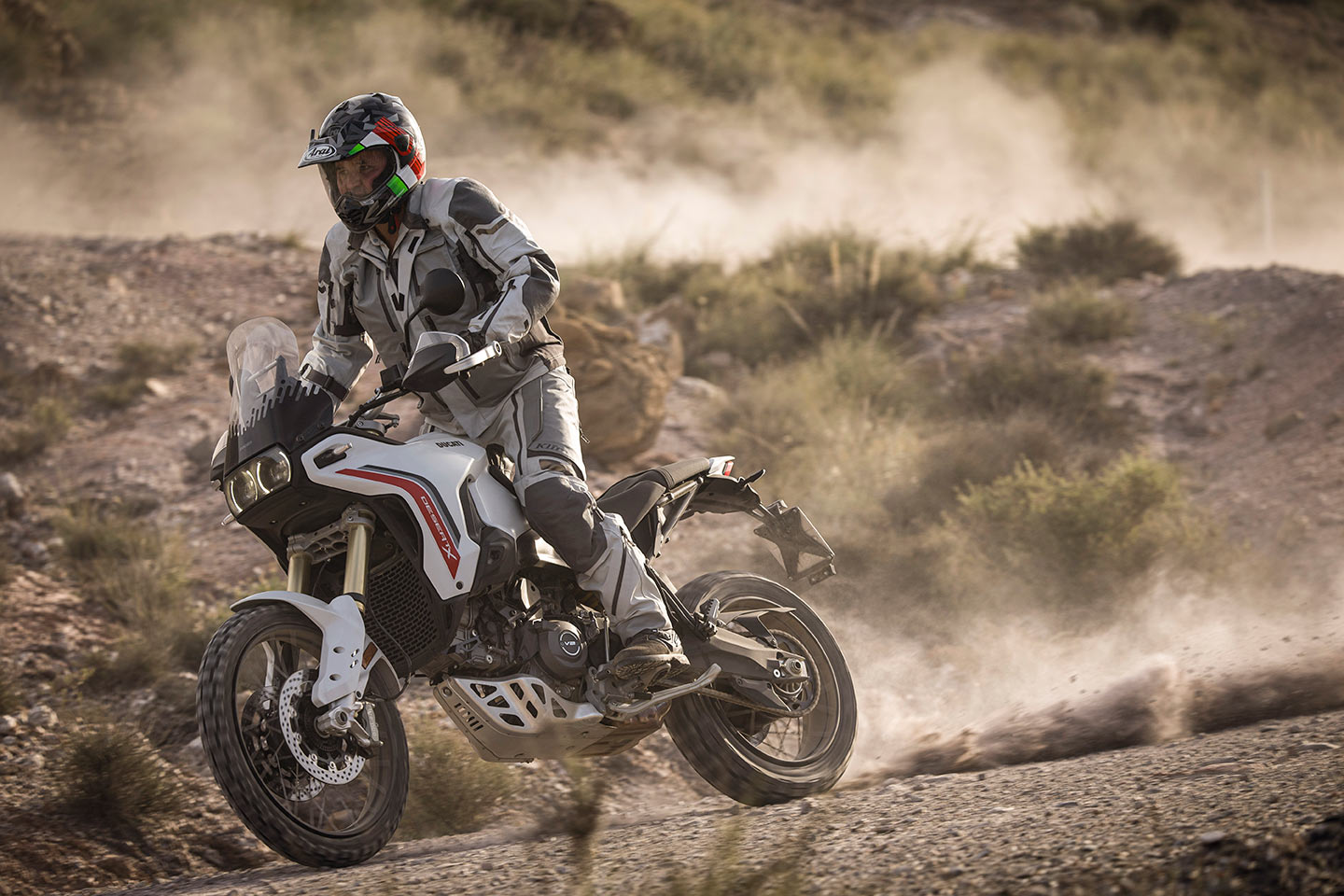
The 2026 Ducati DesertX is substantially new rather than a minor update. Its most important change is the adoption of Ducati’s 890cc V-twin, joined by revised gearing, expanded rider aids, updated suspension hardware and several practical improvements intended to make the adventure motorcycle easier to use and maintain. The color scheme also recalls Cagiva’s Dakar motorcycles, an association the article considers intentional.
The result is an adventure bike aimed primarily at mixed road and dirt-road exploration. A riding test on winding roads through Andalucía, Spain, found the DesertX particularly strong on extremely twisty roads, while also identifying limitations in the seating position and a need for further suspension adjustment.
A new 890cc V2 replaces the Testastretta
The DesertX’s new liquid-cooled 90-degree V-twin was first introduced in 2025 in the Panigale V2, Streetfighter V2, Multistrada V2 and Monster. It replaces the previous Testastretta engine and is lighter and more compact than the unit it supersedes. Unlike that engine, it does not use desmodromic valve actuation.
The engine has 890cc of displacement, a 96mm bore and 61.5mm stroke, and a 13.1:1 compression ratio. It uses four valves per cylinder, Ducati’s Intake Variable Timing system, electronic fuel injection, a 52mm throttle body and ride-by-wire. The six-speed transmission drives the rear wheel by chain.
Ducati’s stated service figures are a 9,000-mile oil-change interval and 28,000 miles between valve-clearance checks. The engine is described in the article as producing 110 hp at 9,000 rpm and 68 lb.-ft. of torque at 7,000 rpm. However, the specifications table lists 110.3 hp at 9,000 rpm and 67.9 lb.-ft. at 7,000 rpm. Those figures should therefore be treated as a documented discrepancy rather than merged into a single number. The engine is also said to deliver 80% of peak torque from 3,000 rpm to redline.
During the riding test, the author found the V2 smoother and more charismatic than the class’s parallel-twin engines. It was described as willing and enjoyable, while also tolerating imperfect gear selection. The clutch was precise and light to operate. It is hydraulically controlled and, according to the specifications, is a slipper and self-servo wet multiplate design.
The revised transmission uses shorter first through fourth gears and a longer sixth gear than the prior arrangement described in the article. The intention is to make the bike more useful both in slow off-road riding and during highway cruising. Ducati has also moved the quickshifter inside the engine cases; its internal sensors worked properly during the test.
A wide range of electronic adjustment
The DesertX is presented as having Ducati’s broadest set of rider-aid options. Traction control offers multiple settings, including off, while ABS has several intervention levels and can be switched off. Wheelie-control and engine-braking levels are adjustable as well.
In standard Rally mode, the ABS, engine-braking and traction-control parameters can be changed while riding. The selected rider-aid settings generally remain stored after the ignition is switched off. The front ABS-off selection is the exception to that behavior described in the article, so it should not be assumed to remain selected after a restart.
The front brake rotors are now 305mm, down from 320mm on the previous model. The narrative identifies Brembo M4.32 calipers, while the specifications describe radially mounted Brembo monobloc four-piston units. The system uses dual semi-floating discs and cornering ABS. With knobby tires fitted, the author judged the front brake powerful yet manageable and communicative. At the rear is a single 265mm disc with a Brembo two-piston floating caliper and cornering ABS.
More attention to routine ownership
The new DesertX brings several changes aimed at making ordinary service work less complicated. Its air filter is user-serviceable, unlike the one on the first-generation model. Access requires removing three screws. The filter itself is flat and rectangular, positioned near the steering head.
The front axle now uses a six-sided nut intended to be easier to service than the previous 12-point nut, which required a special tool. The motorcycle’s more vulnerable areas are designed, where possible, to use inexpensive panels rather than critical or expensive components. The evidence does not establish additional details about those panels. One less convenient point remains: the service light cannot be reset by the owner and requires dealer intervention.
Chassis, ergonomics and suspension
The DesertX uses a dedicated aluminum monocoque front frame that also functions as the airbox, plus a model-specific swingarm. Seat height is 34.6 inches, but Ducati offers both low and high seat options as well as a suspension-lowering kit.
Compared with the previous generation, the motorcycle is narrower between the rider’s knees. The footpegs are slightly farther rearward and the handlebars slightly farther forward. The author, who is 5 feet 11 inches tall, found the riding position comfortable while seated and natural when standing. Airflow over an Arai XD-5 helmet was smooth, with no buffeting, although wind was noticeable.
There are caveats to the seated position. The front of the seat sits too far rearward for the author and transitions steeply toward the fuel tank. That places the rider’s weight too far back for aggressive off-road cornering. Standing substantially improves front-end feel and traction. The footpegs are relatively low and wide, while the shifter and brake lever are easy to use but sit away from the motorcycle’s centerline. The author does not consider the DesertX likely to be used for trials-style terrain.
Suspension comes from KYB. Up front is a 46mm inverted fork with 9.1 inches of travel; both legs have compression and rebound adjustment, making the fork fully adjustable. At the rear is a fully adjustable KYB monoshock with remote preload adjustment, a full-floater progressive linkage and 8.7 inches of travel. The new rising-rate linkage is intended to improve bottoming resistance, and its position above the shock rather than below the skid plate is intended to reduce exposure to terrain damage.
The author’s principal reservation concerned the standard suspension settings. The fork initially felt too stiff and resistant to its first movement, but once moving through its stroke it could continue farther than expected. The resulting impression was of suspension that was simultaneously too stiff and too soft. The test was too short for the author to alter the settings, leaving further adjustment or tuning as an unresolved part of the assessment.
Key specifications and U.S. pricing
- Power: 110 hp at 9,000 rpm in the narrative; 110.3 hp at 9,000 rpm in the specifications table
- Torque: 68 lb.-ft. at 7,000 rpm in the narrative; 67.9 lb.-ft. at 7,000 rpm in the specifications table
- Wheels: tubeless cross-spoked, 21-inch front and 18-inch rear
- Tires: Pirelli Scorpion Rally STR, 90/90-21 front and 150/70-18 rear
- Geometry: 27-degree rake, 4.5-inch trail and 63.6-inch wheelbase
- Fuel capacity: 4.8 gallons
- Claimed wet weight: 461 pounds
- U.S. MSRP: $16,995
The available options include soft panniers, hard panniers, a high fender, low and high seats, and the suspension-lowering kit. The article states that U.S. dealerships are expected to receive the motorcycle around July. That timing and the listed MSRP apply to the United States; the supplied evidence does not establish a Greek price, availability or arrival date.
Overall, the 2026 DesertX improves its capabilities in most situations relevant to adventurous riders. The new V2, rider-focused electronics and maintenance-related changes are significant advances, while the revised ergonomics and gearing broaden its practical range. Its strongest fit appears to be a fast, mixed route of asphalt and dirt roads rather than outright off-road domination. The suspension, however, needs further adjustment or tuning before its full potential can be assessed with confidence.
THE EVIDENCE BEHIND THE STORY
Sources
Spotted something that needs correcting? Contact the editorial team ↗