
Marc Márquez renews with Ducati through 2028 as title fight tightens
Ducati has extended Marc Márquez’s contract for two years, while a rapid points recovery has reopened the championship battle with Aprilia’s Marco Bezzecchi.

4 min read
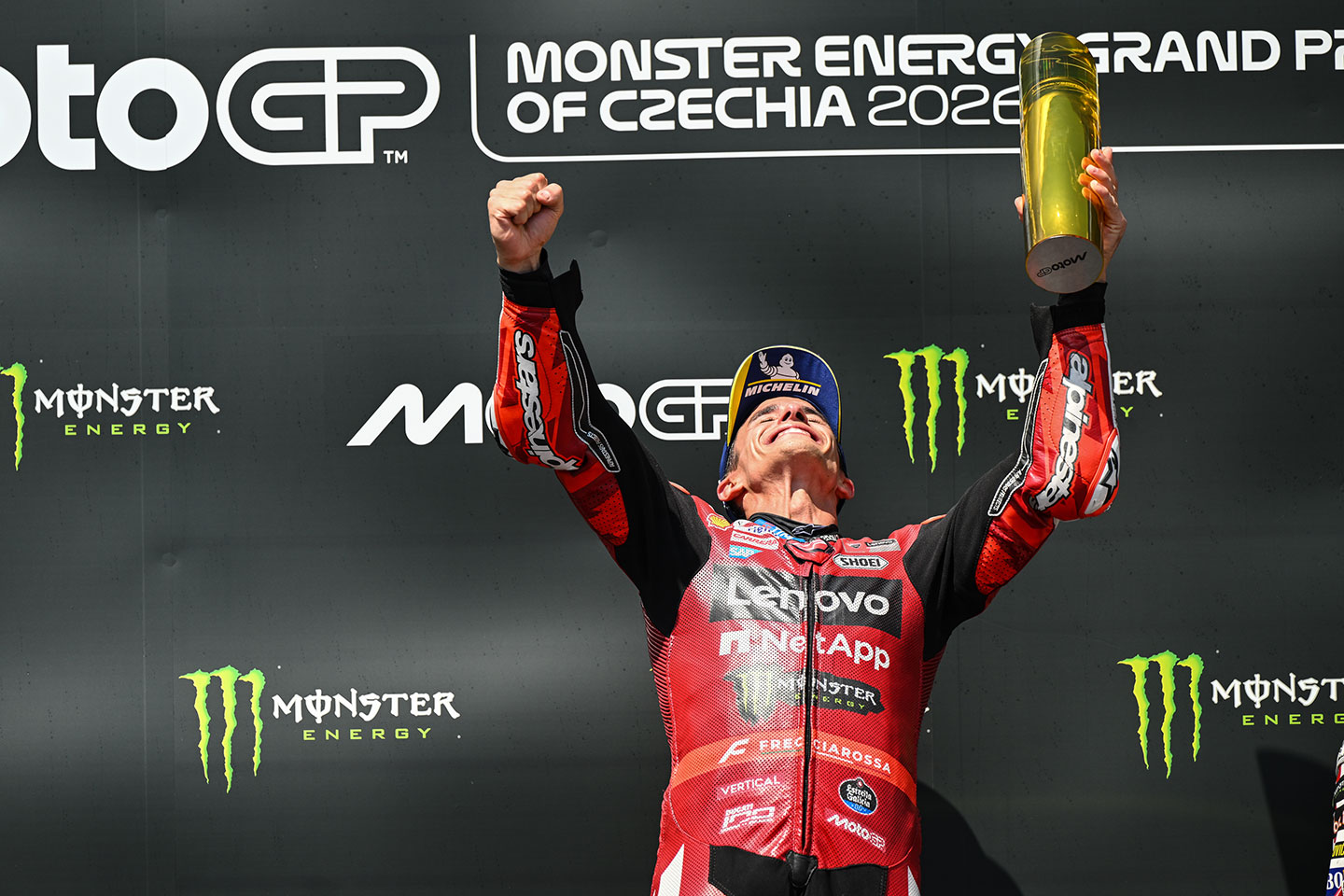
Ducati announced on June 23 that Marc Márquez has renewed his contract with the team for two years, extending his commitment through 2028. The agreement arrives during a sharp change in the MotoGP championship picture: Márquez has scored 62 points across the Hungary and Czech Republic race weekends, winning both races and reducing his deficit to Aprilia leader Marco Bezzecchi to 40 points.
That turnaround came quickly. Three weeks earlier, after Mugello, Márquez was 102 points behind Bezzecchi. The scale of the recovery does not point to a single explanation. Aprilia had held a slight technical advantage during the first part of the season, but Ducati subsequently recovered performance relative to its rival. At the same time, incidents involving Bezzecchi affected the points table, while Márquez converted the opportunities in front of him.
A championship reopened by speed and mistakes
At Balaton, Bezzecchi was taken out by his Aprilia teammate Jorge Martín in an incident described as overly aggressive. At Brno, Bezzecchi crashed on the penultimate lap of the Sprint race and struck a marshal who was trying to help lift the Aprilia. He was subsequently disqualified from Sunday’s Czech Grand Prix. Those events followed a Mugello result described as a triumph that had appeared to place the championship securely in Bezzecchi’s favor.
Instead, the contest became open again, with seven riders separated by 53 points. Ducati had reduced the performance gap to Aprilia, but the available picture is not one of simple motorcycle superiority: the technical balance, Márquez’s execution and errors by rivals all contributed to the new standings.
Brno belonged to the rider as much as the motorcycle
Before the Czech Republic Grand Prix, Márquez argued that the decisive factor at Brno’s old-style circuit would be the riders rather than the difference between the Aprilia and Ducati machines. Ai Ogura of Japan took pole position and set a lap record during the weekend, while Bezzecchi’s disqualification was announced on Saturday evening. Francesco Bagnaia won the Sprint, but Márquez took Sunday’s Grand Prix.
The performance was portrayed as a combination of instinct, race management, emotion and intelligence. Márquez responded to Ogura’s attacks and said he rode the final three laps in an almost apnoeic state because he did not trust the Japanese rider. He also recalled advice from someone in the paddock: victory can go to the rider who resists the most, not necessarily the fastest rider. Márquez described the immediate phase as one of resisting pressure and called the final six laps the longest of his year.
His pre-race expectations had been notably restrained. Márquez expected Brno to be difficult, more like Mugello than Balaton, where he said conditions had suited him. Brno was not among his preferred circuits, he said he needed to conserve energy, and his stated target was a top-five finish—one that would have satisfied him. Pedro Acosta responded to that modest forecast with the line that champions always lie.
Experience after the long recovery
The Brno victory also sits within Márquez’s longer return story. The nine-time world champion suffered a right humerus fracture at Jerez in 2020, followed by a period of repeated operations. He had also not been considered fully fit after a shoulder injury in Indonesia the previous year. After that career ordeal, he returned to the top step of the podium with Ducati.
The account says Márquez was less physically fit than during his championship-winning 2025 season. Its interpretation is that his continued advantage came not from complete physical readiness, but from champion-level ability and experience. His two latest victories are presented as demonstrations of class and determination, even though mistakes by rivals helped shape the results.
Márquez’s approach also extends beyond outright speed. The article compares his pressure tactics and momentum-building methods with those associated with Valentino Rossi, portraying him as a rider who can influence opponents psychologically as well as beat them on track. He said that the rider still makes the difference in MotoGP, while acknowledging that a competitive motorcycle remains necessary; he also described Ducati’s machine as competitive from the start of the season.
His next stated challenge is Assen, the “cathedral of speed”. Bezzecchi and the other contenders will need to recover quickly and continue fighting. Márquez, meanwhile, described the Brno win as especially important because the circuit contains many right-hand corners, and reaffirmed the quality that has defined this phase of his career: he never gives up.
THE EVIDENCE BEHIND THE STORY
Sources
Spotted something that needs correcting? Contact the editorial team ↗