
Bezzecchi turns a childhood Mugello dream into an Aprilia victory
Marco Bezzecchi won at Mugello for Aprilia, an emotional home-circuit triumph that also left him leading the World Championship.

6 min read
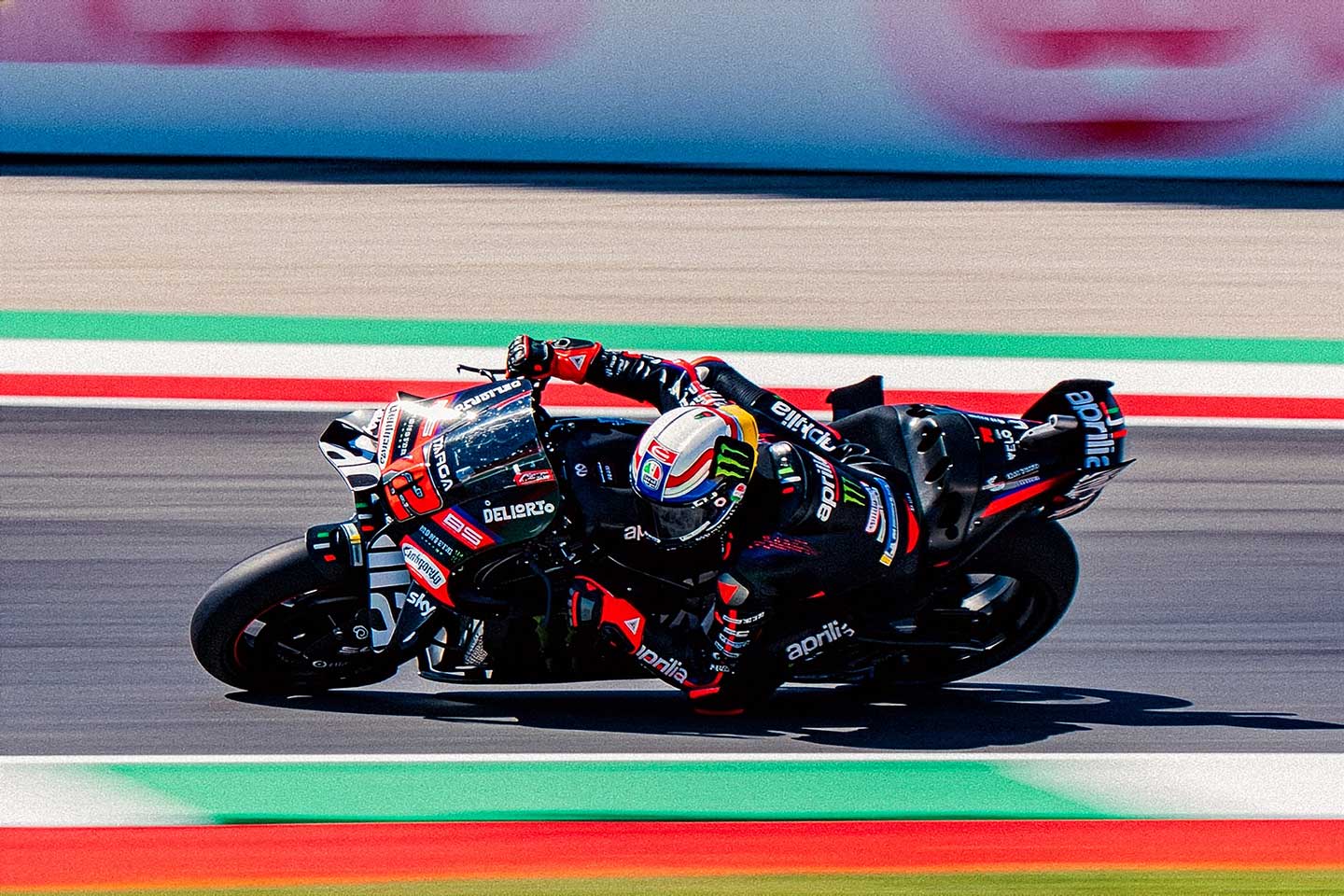
Marco Bezzecchi won the Italian Grand Prix at Mugello while riding for Aprilia, turning a childhood ambition into one of the most emotionally significant victories of his career. After crossing the finish line, he was overwhelmed and called out to his mother: “Mom, it’s all real!” The race took place “last Sunday”; no calendar date or season year is established here.
Bezzecchi’s connection with Mugello began long before he raced there. As a child, he visited the circuit with his father Vito, his mother Daniela and his sister Silvia. He watched races from the lawns, imagining a future as a professional rider and dreaming specifically of winning at the track. He later described himself as having effectively grown up at Mugello, first as a spectator and then as a rider.
His first ride at the circuit came at approximately 12 or 13 years old, in the PreGP category, now called Moto4. The experience changed his understanding of the venue: from the grandstands and lawns, the track had seemed one way; riding it revealed something different from what he had imagined. His first outing on a MotoGP motorcycle brought another perspective, this time making the machine’s very high speed impossible to ignore.
A finish charged with meaning
The symbolism of the victory extended beyond the result itself. Bezzecchi cried inside a helmet dedicated to Alex Zanardi, using it to communicate a message associated with Zanardi’s life and example. He also made clear that he had never personally known Zanardi, so the tribute should not be read as evidence of a personal relationship.
Andrea Kimi Antonelli waved the chequered flag as Bezzecchi crossed the line. The two are close friends, and Bezzecchi said they had known each other before Antonelli made his Formula 1 debut. Antonelli was described as the leader of the Formula 1 World Championship, and Bezzecchi spoke of him as a highly likeable person and a source of pride in motorsport.
Once the gates opened, fans entered the track and made their way towards the podium on foot, scooters and bicycles. Their celebration released the tension Bezzecchi had accumulated across the 23-lap race. He called the win a childhood dream and said the crowd’s response was difficult to describe. During the final lap, after securing victory, his focus had already shifted towards sharing that moment with the spectators.
A championship lead in an open fight
Bezzecchi left Mugello leading the World Championship. He stressed, however, that the season remained long and that he intended to stay grounded. His approach to a race weekend now includes the wider championship picture and the interests of the entire Aprilia team. When victory is not available, his objective is to collect the maximum points possible rather than force an unnecessary outcome.
He identified Jorge Martín as one of the strongest title contenders while emphasising that the fight involves many riders. Pedro Acosta, he said, was riding very fast. Fabio Di Giannantonio, Pecco Bagnaia and Marc Márquez were also among those he considered capable of remaining involved in the title battle. The available evidence establishes Bezzecchi’s championship lead, but not its margin or any wider standings detail.
Continuity with Aprilia, refinement on the rider’s side
Bezzecchi calls his Aprilia motorcycle “Albarosa” and says he is deeply attached to it. He also describes it as enjoyable to ride. In technical terms, he said the bike’s fundamental character had not changed. Regulations prevented the team from making many major changes between 2025 and the current season, whose calendar year is not identified in the available evidence.
That continuity did not mean the motorcycle remained untouched. The bike received updates, while Bezzecchi improved aspects of his riding style. The evidence does not establish that either factor alone caused the Mugello victory, but together they describe a season built on adaptation within a relatively stable technical framework.
Discipline away from the spotlight
Bezzecchi’s working method also reflects a background outside the insulated rhythm of the racing paddock. After high school, he worked in his father’s garage. His father intended the job to teach discipline, including getting up early, while also giving him a trade and a clearer understanding of adult life. Bezzecchi contrasts that experience with the paddock, a world centred almost entirely on motorcycles and somewhat detached from ordinary reality.
At the VR46 Academy ranch, he trains with Luca Marini, Franco Morbidelli, Valentino Rossi, Celestino Vietti and Pecco Bagnaia. He describes the riding as a close competition. Marini usually performs best among the group, with Morbidelli and Bezzecchi recently close behind. At race weekends, Rossi sometimes works with Bezzecchi in the garage and watches his lines from trackside, then sends feedback about different sectors. Bezzecchi says that advice has a major effect and gives him additional motivation.
The rider is sometimes compared with Marco Simoncelli. Bezzecchi welcomes the comparison because he was a major Simoncelli fan as a child and sees it as a source of pride, but he does not want it to define him. He also considers MotoGP and Formula 1 fundamentally different disciplines on track, even as the fan experience at race weekends has improved substantially. He credits MotoGP management with making events busier and more energetic while improving what spectators experience.
Risk, perspective and the next race
The Barcelona Grand Prix was presented as dangerous and unpredictable. Bezzecchi credited his team with helping him remain calm after the incidents and said dangerous episodes are occurring less frequently in the sport. Despite two major accidents there, Zarco and Alex were reported to be unharmed or doing well. Bezzecchi says he does not feel afraid while riding, although he may think about risk when he is relaxing at home.
Away from racing, he finds happiness with friends, family and his dog, whose excited greeting particularly moves him after a race weekend. Yet riding remains one of the few experiences that produces intense, unfiltered emotion for him. At Mugello, that emotion arrived at the place where the dream began: first from the grass with his family, later from the saddle, and finally from the top step of the podium for Aprilia.
THE EVIDENCE BEHIND THE STORY
Sources
Spotted something that needs correcting? Contact the editorial team ↗