
Pirelli ends its 23-season WorldSBK tyre partnership
The final Jerez round closed Pirelli’s exclusive WorldSBK supplier period, linking 23 seasons of racing development with road-tyre technology and a substantial statistical legacy.

4 min read
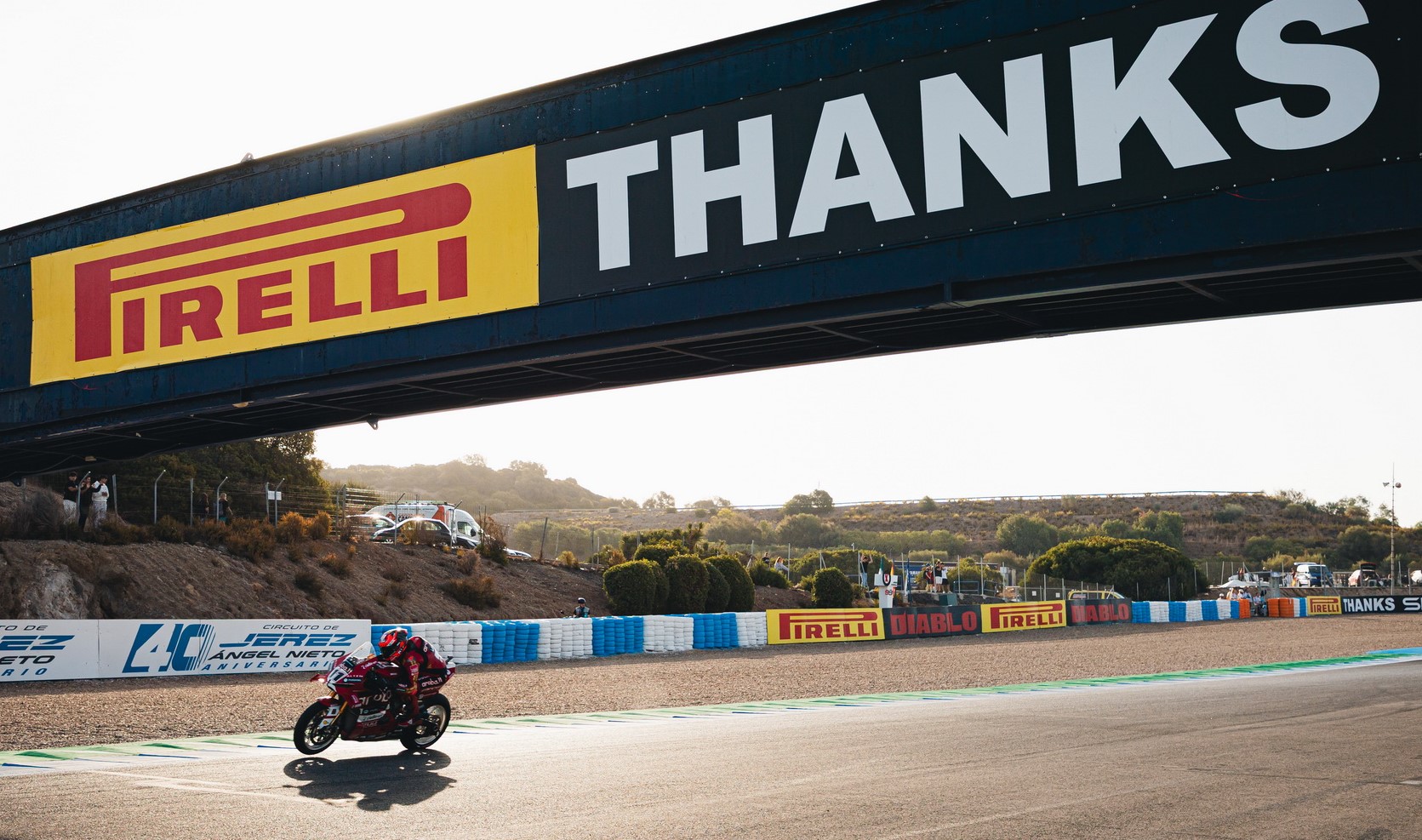
Pirelli’s 23-season run as the official and exclusive tyre supplier to the FIM Superbike World Championship ended with the 2026 Spanish round at Jerez de la Frontera. The partnership, which covered every season from 2004 through 2026, made WorldSBK a long-term development platform for compounds, constructions, sizes and other solutions that could later be adapted for road use.
For Pirelli Motorcycle Racing Director Giorgio Barbier, the conclusion is not a break in technical development. He said the company would continue to develop racing products while strengthening the technology and performance relevant to road riding. Across the partnership, the tyre manufacturer worked with organisers, the federation, manufacturers and teams, with safety and reliability remaining alongside performance as core objectives.
The relationship also grew beyond the strictly technical side. Pirelli’s links first with Infront and later with Dorna expanded into marketing and communication initiatives. Activities initially created for Pirelli guests gradually reached the wider paddock, helping make the championship more attractive to supporters and a broader audience.
A production-bike championship as a development lab
Pirelli’s involvement in major production-based motorcycle racing began in 1989, when the company appeared officially with the Rumi team, a Honda RC30 and Fred Merkel. The American rider narrowly missed the podium in his first race at Donington Park, then claimed pole position and won both races at the Hungaroring, establishing the basis for his title defence.
After withdrawing from the major motorcycle racing championships during the 1990s, Pirelli returned in 2004 when the WorldSBK organiser selected it as the championship’s official and exclusive supplier. The strategy was closely tied to the nature of WorldSBK: because the series is based on production motorcycles, Pirelli sought racing tyres that remained relatively close in concept to products available for the market, rather than solutions designed only for competition.
That approach created a two-way link between the circuit and the road range. Pirelli’s racing work could address the demands of high-level competition, while the resulting knowledge and new sizes could support the development of sports tyres for road motorcycles. Barbier described the aim as continuous improvement despite the single-supplier format, with particular attention to products that bridge the gap between racing use and road riding.
From Diablo Superbike to slick tyres across the classes
The Diablo Superbike arrived in 2005 and became a reference in racing slicks. The Diablo Supercorsa followed in 2007 for the championship’s support categories, and its development contributed to the Diablo Supercorsa SP road tyre introduced in 2008. In 2012, Pirelli introduced the SC0 compound for the Diablo Superbike; it entered the road-tyre range the following year.
The technical relationship with production motorcycles was reinforced in 2013, when the championship changed wheel diameter from 16.5 to 17 inches. In 2018, Pirelli introduced the 125/70 front and 200/65 rear tyre dimensions. Further steps followed with the supersoft SCX compound in 2019 and the extrasoft SCQ in 2022. SCQ was developed to maximise performance over a single fast lap. From 2020 onwards, every championship class used slick tyres.
Pirelli continued updating its tyre families through the final season. For 2026, riders had 17 tyre specifications available: five front specifications and twelve rear specifications. The season produced 10 outright lap records and 11 race-lap records, adding a final set of performance markers to the partnership’s history.
The final season and the long statistical record
The sporting arc of the Pirelli era began with James Toseland, the first WorldSBK champion of that period in 2004, riding a Ducati 999 F04. It ended with Nicolò Bulega, who dominated the 2026 season on a Ducati Panigale V4 R and won 30 of its 36 races.
Between 2004 and 2026, the partnership covered 289 events and 661 races. A total of 1,020 riders competed across 33 circuits, while WorldSBK racing laps accumulated 1,143,782 kilometres. The highest recorded top speed was 339.500 km/h, set by T. Sykes on a Kawasaki at Monza in 2012.
Monza also produced the period’s highest race-average speed: M. Melandri recorded 201.814 km/h on a BMW in 2013. The highest lap-average speed was 205.459 km/h, achieved by T. Sykes on a Kawasaki at the same circuit in 2013.
Italy hosted the most events during the period, with 51, followed by Spain with 41 and the United Kingdom with 30. Four circuits—Magny-Cours, Phillip Island, Assen and Misano—each hosted 54 races, the highest total for an individual venue. In 2026 alone, 30 riders took part, 5,544 tyres were used and WorldSBK racing laps covered 52,090 kilometres.
Pirelli therefore leaves its exclusive WorldSBK supplier role after a period measured not only in championships and records, but also in a sustained effort to connect racing development with road products. The company’s stated plan is to carry the experience gained in the series into future work in both motorsport and road tyres.
THE EVIDENCE BEHIND THE STORY
Sources
Spotted something that needs correcting? Contact the editorial team ↗