
Honda, Ducati and the World Superbike battle over power and flex
The RC30, RC45 and RC51 faced Ducati’s evolving V-twins in a technical contest shaped by midrange torque, combustion and chassis feel.

10 min read
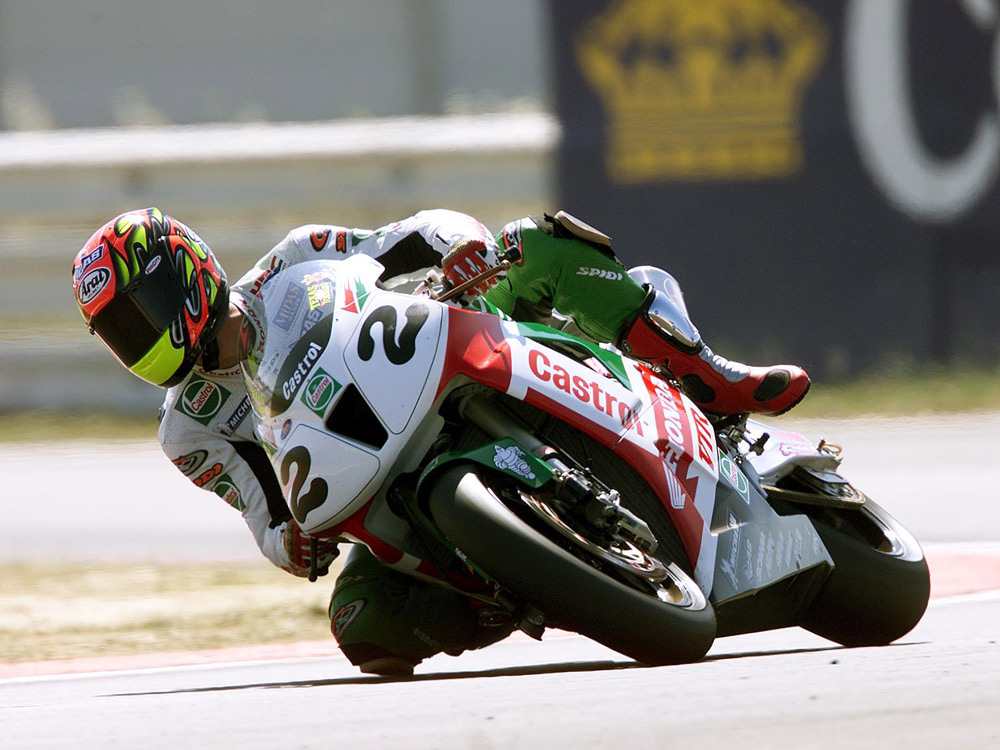
Honda and Ducati’s World Superbike rivalry between 2000 and 2002 was a contest between more than two manufacturers and two riders. Colin Edwards carried Honda’s V-twin RC51, while Troy Bayliss raced Ducati’s Testastretta. Behind them stood two distinct engineering approaches: Honda’s V-four racing heritage and emphasis on a balance between top speed and acceleration, against Ducati’s 90-degree V-twin development, strong cornering feel and evolving approach to engine flexibility and midrange torque.
The championship results captured the changing balance. Edwards and Honda won in 2000, Bayliss and Ducati took the 2001 title, and Edwards returned to the top in 2002 after Honda altered the RC51’s chassis behaviour. The result was not simply a story of one engine architecture defeating another. It was a lesson in how power delivery, combustion design and controlled chassis movement can determine what a rider can do at the limit.
The two starting points
World Superbike began in 1988. Honda entered that first season with the 750cc V-four RC30, also designated RVF750R, while Ducati arrived with the 90-degree V-twin 888. The RC30 evolved from Honda’s V-four Interceptor, a motorcycle created for the first 1983 season of AMA Superbike, whose rules opposed 1000cc twins to 750cc fours. Honda subsequently won five AMA Superbike championships with VFR-based V-four motorcycles.
That experience shaped Honda’s view of race performance. A circuit normally has one or more straights and at least 10 turns. Peak power is valuable at the end of a straight, but acceleration matters repeatedly when a motorcycle exits corners. Honda therefore treated the relationship between maximum speed and drive out of turns as central rather than as a choice between two unrelated targets. Honda won the first two World Superbike championships, in 1988 and 1989, with the RC30.
Ducati’s route came partly from Formula 1 engine thinking studied by Massimo Bordi during his time at Cosworth, the English Formula 1 engine builder. At Ducati, Bordi developed a 748cc four-valve desmodromic V-twin. It grew first to 851cc and then to 888cc. The engine used relatively long cam timings associated with four-wheel racing, but the transfer was not straightforward: Formula 1 cars have greater tyre grip and downforce, while motorcycles have a smaller tyre contact area and corner more slowly. A World Superbike normally takes 25–30% longer than a Formula 1 car to lap the same circuit.
Midrange torque versus corner speed
Early RC30 engines are described as having their torque threshold at 7,500 rpm. Ducati’s late intake-valve closing and generous valve overlap left its engine weaker in the midrange compared with the Honda. Ducati riders compensated by carrying more speed through corners, but that solution demanded more from the tyre and the rider. Kenny Roberts is cited as warning that riding at the grip limit throughout a corner increases risk.
Pier-Francesco Chili identified Ducati’s midrange problem early. Carl Fogarty later argued strongly for more midrange torque. Ducati progressively addressed it with shorter-duration camshafts and higher valve lift. Fogarty eventually asked Ducati to stop increasing the midrange torque, or to reduce it, after the team supplied more than he wanted. Handling consultant Dale Rathwell considered the Ducati’s chassis looseness acceptable because the engine’s power delivery lacked sudden torque hits and was easy to manage.
Displacement also changed the balance. Ducati developed versions including 926, 916, 955 and 996, among others. As its engine grew and developed, the RC30 fell behind in power. Honda responded with more aggressive cam timing, raising the RC30’s torque threshold first to 8,500 rpm and eventually to 10,500 rpm. That made the Honda more difficult to ride at the highest level.
Why chassis flex became part of the fight
The RC30’s principal chassis problem was limited front-end feel. Its chassis had the extreme stiffness associated with a 500cc Grand Prix two-stroke, including a particularly stiff steering-head region. Lateral flex can help a tyre follow surface undulations and maintain grip in a corner. When pushed, the RC30 is described as skipping from crest to crest rather than maintaining consistent tyre contact. A laterally stiff motorcycle can consequently give its rider less cornering feel and less warning of the limit.
Ducati’s tubular chassis provided better cornering feel, although it brought compromises. Its front cylinder was almost horizontal, angled upward by only 15 degrees. That layout moved the heavy crankcase rearward and required a swingarm approximately 19.1 inches, or 485mm, long. The short swingarm required limited suspension travel to keep changes in swingarm angle small. Excessive rear-spring stiffness reduces mechanical grip, and an unusually stiff rear spring can indicate a suspension problem.
The practical distinction was not that one manufacturer understood flexibility and the other did not. It was that each motorcycle exposed a different compromise. Honda’s stiffness could restrict feel and tyre follow-through, while Ducati’s greater movement could provide grip and feedback but also produce wallow. Flexibility is not automatically better than stiffness, and these race solutions cannot be transferred unchanged to every road motorcycle.
From the RC30 to the RC45
Honda began developing a replacement for the ageing RC30, but the RC45 did not arrive until 1994, three years later than intended. The new machine retained the stiff chassis concept while changing the engine’s combustion geometry. It used a flatter combustion chamber with a 26-degree included valve angle rather than the RC30’s 38 degrees. Bore increased from 70mm to 72mm, allowing 28mm inlet valves instead of 26mm ones. The larger valves increased valve area by 16%.
Honda also moved the cam drive from the centre of the crank to the crank end, allowing three main bearings instead of four. Ball cam bearings were replaced by plain journals, increasing radial stiffness and damping. Early RC45s achieved little, with part of that result attributed to an unsuccessful first fuel-injection system. Honda made a major technical effort for 1997, and John Kocinski won one World Superbike championship with the RC45. RC45 motorcycles also won AMA Superbike championships in 1995 and 1998.
Honda eventually concluded that continuing to develop the RC45 towards 20,000 rpm would waste resources. It began a new 1000cc 90-degree V-twin design, which became the RC51. That decision reflected a broader change in the championship as much as a change in Honda’s engineering priorities.
Combustion, bore size and the Testastretta
Ducati developed expertise in applying Cosworth-style four-valve, big-bore, flat-tumble combustion chambers to motorcycle engines. Japanese manufacturers took longer to develop comparable combustion knowledge. Suzuki adopted a larger bore in 1988 but reverted to its previous dimensions after initially failing to match the earlier engine’s performance. Rob Muzzy said Kawasaki needed two years to equal the power of its previous smaller-bore engine after adopting a larger bore in 1991.
Ducati’s development process varied bore-and-stroke combinations while changing intake downdraft angle and intake-port internal diameter. Engineers measured tumble speed with an in-cylinder anemometer. Downdraft angle determined the balance between cylinder filling and retaining intake energy as in-cylinder tumble. Port diameter influenced incoming flow velocity; making it too large reduced midrange torque.
Tumble is a loop of air motion inside the cylinder: from the intake valves across the underside of the cylinder head, down the far wall, across the piston and up the near wall. Near the end of the compression stroke, that motion breaks into turbulence, accelerating flame propagation through the combustion chamber. These details connected the Ducati’s high-rpm potential with the midrange response its riders needed.
As Ducati enlarged its 851-based engine, major components suffered failures. Larger bores made the cylinder spigots thinner and prone to cracking. Ducati also experienced chronic crankcase cracking and repeatedly changed engines during this period. In the 916, wristpins scuffed and transferred aluminium from hot pistons. Pankl addressed that problem by modifying the titanium connecting rods so oil could travel from each big-end bearing through a drilled passage to the crankpin.
Massimo Bordi later characterized the heavily modified, 15-year-old basic Ducati design as having reached its limits and argued for a clean-sheet engine. A new World Superbike engine required homologation of its basic components, making the process time-consuming. Work on the engine that became the Testastretta began in late 1998 or early 1999 with assistance from retired Ferrari engineer Angiolino Marchetti.
The 2000–2002 reversal
Honda introduced the RC51 in 2000 with Colin Edwards as its rider. Despite a difficult season, Edwards and Honda won the championship with the new design. In 2001, Troy Bayliss and Ducati’s Testastretta took the title. The Ducati is described as having substantial chassis wallow in corners while delivering superior grip. Edwards put the behaviour plainly: “Yeah, they wallow. But they dig in and go around the corner.”
That observation is consistent with a chassis that allows the front tyre to follow bumps at high lean angle rather than skating over them. It should not be treated as an independent measurement or as a general conclusion about every Ducati. There is also an unresolved wording issue around the description of the 2001 Ducati as having a “Massimo Tamburini-designed chassis” and the later discussion of Ducati’s MotoGP chassis response; the available evidence does not establish whether the same design lineage is intended.
A later comparison came from Ducati’s MotoGP experience. In 2008, Casey Stoner complained that a tube-framed MotoGP Ducati could not hit the same track point on consecutive laps. Ducati responded by moving to a very rigid pyramidal carbon-fibre chassis rather than making a moderate increase in stiffness. Stoner said that the rigid chassis could produce identical entry-speed and line data while still sending the rider into the gravel without an obvious explanation.
Honda had been studying chassis rigidity as a possible cause of poor corner grip around 1997. Engineer Shuhei Nakamoto described development of the NSR250 chassis for Max Biaggi: Honda first made the chassis stiffer, then tested a less-stiff version. The very flexible NSR250 reportedly could not reach top speed without a weave oscillation combining pitch, yaw and roll. Softening the RC45 subsequently produced valuable effects.
According to a legend presented in the available account, Honda bought a new Ducati chassis and measured its stiffness. The alleged result was that the Ducati chassis was approximately half as stiff laterally as the RC51 chassis. Because this is identified as legend, the measurement should not be presented as confirmed fact. Honda nevertheless prepared an RC51 kit of spacers, washers and instructions that progressively allowed more lateral movement at the steering head. During testing, Edwards reported that each increase allowed him to push harder and lap slightly faster before chatter stopped progress.
The modified RC51 gained enough of the Ducati’s cornering behaviour for Edwards to defeat Bayliss and win the 2002 World Superbike championship. The competitive cycle then changed. MotoGP began in 2002, and for 2003 World Superbike adopted a 1000cc displacement limit for all motorcycles, alongside other measures intended to equalize lap-time potential. Honda withdrew the RC51 from World Superbike for 2003, while Ducati won every 2003 World Superbike race according to the available record.
The RC51’s final year of production was 2006. Its competitive purpose had been fulfilled: Honda’s V-twin had won in 2000, adapted its chassis behaviour to beat Ducati in 2002, and closed a chapter in the Honda–Ducati engineering contest.
THE EVIDENCE BEHIND THE STORY
Sources
Spotted something that needs correcting? Contact the editorial team ↗