
Brembo CCM-R: the pricier brake that could cost less in WorldSBK
Brembo says the higher initial price can be offset by lower consumption, simpler management and more consistent braking.

3 min read
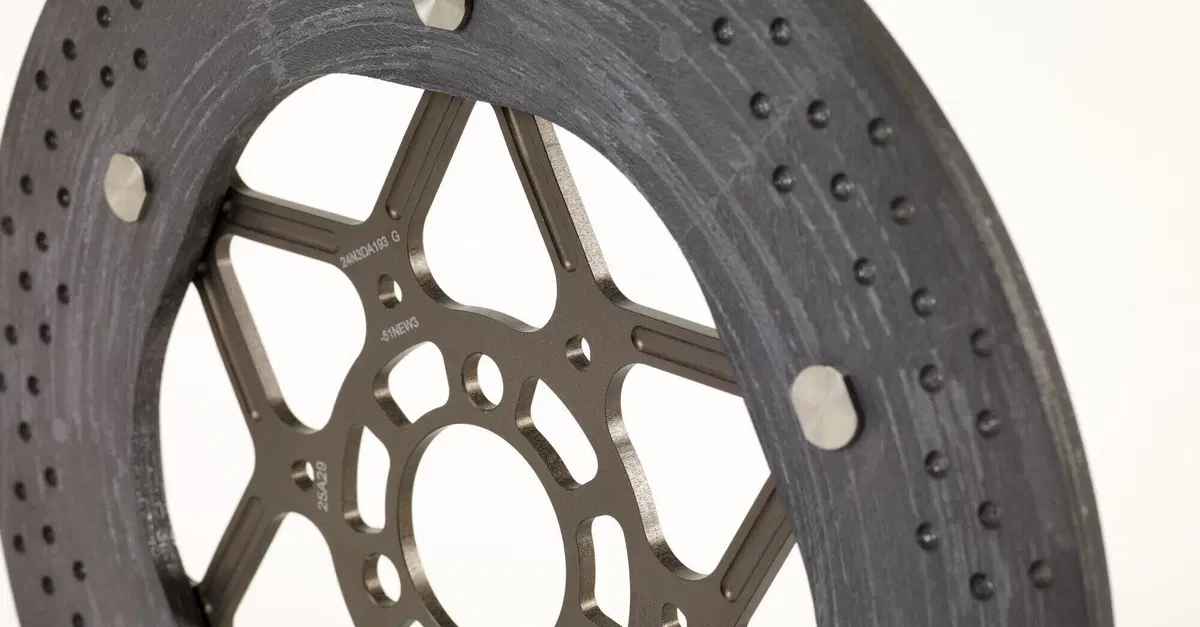
Brembo’s CCM-R carbon-ceramic system is entering WorldSBK with a higher purchase price than steel discs, but the company says that does not automatically mean a more expensive racing season. Its argument is based on total operating cost rather than the first order alone. Service life, consumable use and the resources required at the circuit all affect the final calculation.
Mario Almondo, Chief Officer of Brembo Performance GBU, says the project took about ten years to develop. Around six years were devoted to creating the material, with the remaining time spent sizing the system. Brembo links the result to both bench testing and positive assessments from people who have used it, while making clear that an increase in outright speed is not the main purpose.
Why the purchase price is only part of the calculation
The CCM-R starts at a financial disadvantage. It is still made in smaller volumes and requires a more delicate manufacturing process, whereas steel discs rely on more traditional and optimized production methods. Brembo says the meaningful comparison is Total Cost of Ownership across several seasons. On that basis, it expects the first season’s cost to be equal to or lower than the steel alternative, with the advantage becoming more significant over a longer period.
Management is another part of the equation. The carbon-ceramic system is associated with one technical specification, compared with three for the steel discs. Brembo also says its CCM-R pads cost less, wear more slowly and can be used without a bedding-in process. Steel discs require bedding whether the work is carried out at the circuit or on a test bench, and that operation carries its own cost.
Mileage is included in the same calculation. Brembo says that comparing the maximum expected mileage of the CCM-R with the maximum mileage of the three steel specifications produces a result in favor of the new system. For this programme, the company says it has agreements with the federation and Ducati, using the resulting figures to support its cost assessment.
Safety, not speed, is the central case
Brembo’s primary claim for the CCM-R is about safety. The company says braking remains more consistent from the first lap to the last, and that a more predictable lever response may reduce crashes associated with changes in the behavior of steel discs. Faster lap times are presented as a possible consequence of consistency, not as the system’s defining objective.
There is still a clear financial risk in a crash. A carbon-ceramic disc damaged in an accident costs more to replace than a conventional disc. Brembo’s position is that this exposure should be considered alongside lower consumption and more stable operation, rather than treated as the complete cost picture on its own.
The CCM-R is not limited to racing. It has been approved for road motorcycles, and the Ducati Panigale Superleggera displayed at EICMA uses the system exclusively. Brembo says that, when paired with its own calipers, the CCM-R dissipates heat more efficiently than steel and maintains more consistent performance.
Brembo’s agreement with Dorna for a single braking system in WorldSBK follows the same logic. The company argues that top-level racing must remain a place where new technologies are applied; otherwise, motorcycles risk falling behind wider technical development. The championship also gives the CCM-R racing visibility while providing Brembo with further development experience. The intended benchmark, in the company’s view, is therefore not simply more speed but safer, more consistent braking for high-performance motorcycles on track and on the road.
THE EVIDENCE BEHIND THE STORY
Sources
Spotted something that needs correcting? Contact the editorial team