
Tesla Assisted Driving in Italy: what changes for motorcyclists
The provisional approval covers an urban Level 2 system, but detecting and predicting motorcycle movements remains a demanding task for ADAS.

5 min read
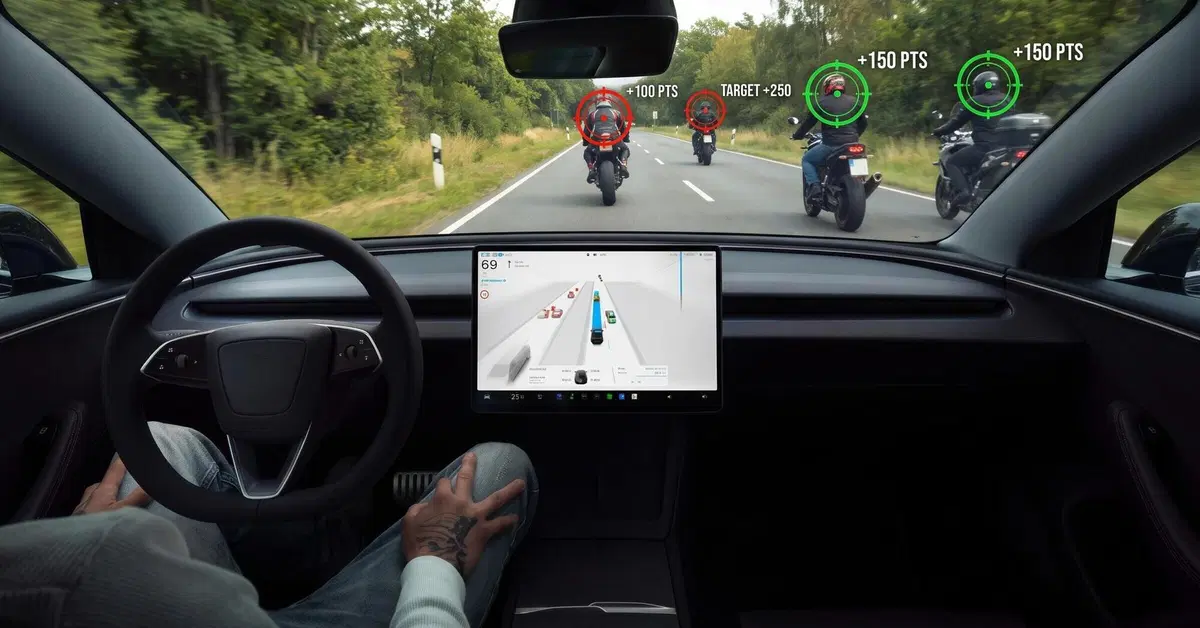
Italy recognised the provisional approval of Tesla Assisted Driving on 19 November, clearing the way for its activation in compatible cars. The approval had been issued by the Dutch authority RDW on 10 April. Matteo Salvini announced the decision the following day and publicly thanked Elon Musk. Italy thereby became the twelfth European Union country to permit the system and the first among the EU’s four largest markets.
The decision is not only relevant to car drivers. The system can steer, accelerate and brake, follow a route set in the navigation system, change lanes, pass through junctions and roundabouts, and park. It also operates in urban traffic rather than being confined to high-speed roads. That puts its interaction with motorcycles in a setting where lane changes, filtering and rapid shifts in position are common.
What has actually been approved
Tesla Assisted Driving is the European name for the system called Full Self-Driving (Supervised) in the United States. It remains a Level 2 driver-assistance system. The driver may take their hands off the steering wheel, but cannot take their attention off the road. They must keep watching traffic and remain ready to intervene. Legal responsibility for the vehicle’s actions remains with the driver, not the car.
The function had not yet been activated. It was expected to reach compatible cars through a software update, with no date announced. The expected price was 99 euros per month. Italy’s approval is provisional and uses a European procedure that allows an individual country to move ahead with innovative technology before common legislation exists across the EU.
The European version is not identical to the American one. On 3 November, the RDW approved a software change that limited the system’s permitted speed-exceedance margin to 10%. The vehicle uses eight cameras for 360-degree coverage and processes their data in real time through the car’s computer. This configuration has no radar or lidar; it relies on computer vision.
Why motorcycles remain a difficult target
Demonstrations in Paris and Rome showed Teslas dealing with motorcycles and bicycles in traffic. That indicates a capability, but it does not answer the question for every road layout, lighting condition or weather situation. The issue is broader than this particular system. Recognising a motorcycle is only the first step; predicting what it will do next is a separate and more difficult task.
In 2022, two fatal incidents in the United States raised suspicions that Tesla assistance software had failed to recognise motorcycles travelling ahead. FEMA challenged the five-star Euro NCAP rating for the Model Y, citing issues involving motorcycles. The software has evolved since then, but that history explains why the Italian approval matters to riders as well as motorists.
The IIHS studies discussed in the coverage show a gap between cars and motorcycles. Collision-avoidance systems were associated with a 53% reduction in rear-end crashes involving cars, compared with 41% for rear-end crashes involving motorcycles. They also intervened less often and reacted more slowly when the motorcycle was stationary. Dutch tests by MAG and KNMV found that several ADAS struggled to recognise motorcycles travelling towards the side of a lane rather than along its centre.
A motorcycle’s narrow profile, movement within the lane, rapid acceleration, lean angle and ability to filter through queues all make its behaviour harder to predict. Camera-based perception has further limits: darkness, glare and heavy rain can degrade the image. European tests have recorded errors during overtaking and right-of-way situations, precisely the manoeuvres in which a motorcycle’s position can change quickly.
Why communication between vehicles matters
C-ITS could provide another layer of information by allowing vehicles and infrastructure to exchange data without a direct line of sight. In principle, a car could receive a warning about a motorcycle approaching from behind a corner before that motorcycle entered the cameras’ view. Adoption remains fragmented, however. Few vehicles are equipped for it, and its use is not compulsory.
Tesla Assisted Driving, as described, relies on its cameras and does not exchange information with the approaching motorcycle. For a rider, that means the system cannot be treated as a guarantee that the car has understood their presence. Hands-off operation also creates a human-factors concern: a driver may overestimate the system despite the obligation to watch the road and intervene. Legal responsibility remains clear, but it does not remove the reaction time that may be lost in a real conflict.
Italy’s wider technology dilemma
The Italian decision also highlights the difference between Level 2 assistance and Level 4 vehicles, which are designed to operate without a driver. A road-code reform currently before Parliament would allow testing only when it is not directly aimed at type approval, while rules for remote supervision are deferred. Niulinx, an Italian startup in which CDP Venture Capital has a stake, is preparing tests in Spain and Germany rather than Italy.
Tesla had registered 10,919 cars in Italy from January to October, so the change may affect everyday traffic rather than remaining limited to demonstrations. For motorcyclists, the practical conclusion is measured: provisional approval enables a new car function, but does not mean that cars will always recognise or predict motorcycles correctly. Rider attention remains essential while the technology depends mainly on cameras and communication between vehicles has not become widespread.
THE EVIDENCE BEHIND THE STORY
Sources
Spotted something that needs correcting? Contact the editorial team