
New York records 406 e-bike battery fires in 2026
Two fatal fires have intensified the debate over micromobility battery safety, enforcement and the cost for delivery workers.

5 min read
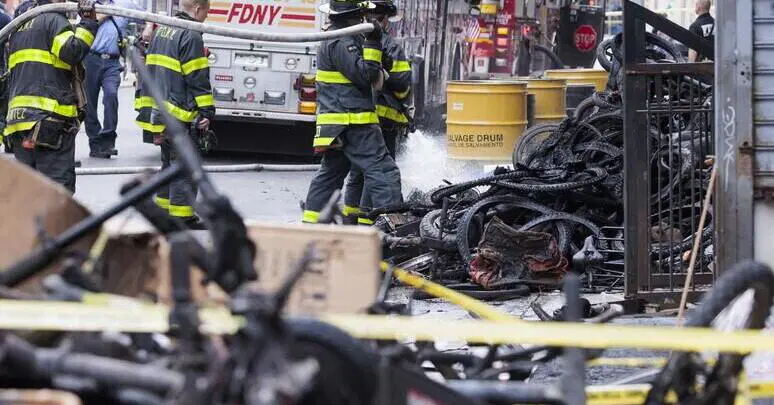
New York is dealing with a record number of fires linked to lithium-ion batteries used in electric bicycles and scooters. The FDNY had counted 406 incidents by early November 2026, compared with 241 during the same period in 2025. That is an increase of roughly 70%, while two fatal fires in little more than a week have pushed the issue from a technical safety concern into city politics and federal policymaking.
Two fires, ten deaths
On 28 October, an e-bike battery caught fire in a public-housing apartment in the Bronx. Four members of the same family died, including an 11-year-old child. FDNY commissioner Lillian Bonsignore explained that the bicycle had been parked close to the entrance. Once the flames took hold, they blocked the only escape route, making the bicycle’s position a crucial factor in the tragedy.
On 5 November, another fire at a two-storey home in Sunset Park, Brooklyn, killed six people and injured at least seven. The official cause had not been determined, although investigators recovered two burned e-bikes and several batteries from the wreckage. The close timing of the two incidents increased pressure on New York’s City Council and on mayor Zohran Mamdani’s administration.
Why the risk is so acute
In New York, an e-bike is more than a means of transport. It is an essential working tool for a large part of the food-delivery workforce, whose riders cover substantial distances every day. Heavy use places greater demands on batteries and creates a need for replacements. When price becomes the deciding factor, some owners may turn to cheap parts, uncertain-quality products or non-original batteries sold through parallel channels.
Housing conditions add another risk. Many delivery workers live in small, crowded apartments, where a bicycle may be left in a corridor or beside the front door while its battery charges overnight, sometimes in a bedroom. If a cell enters thermal runaway, a fire can develop very quickly and cut off the exit before occupants have time to react.
Age is another part of the problem. The growth of micromobility left the city with a large fleet of e-bikes and scooters that have now been in use for several years. Fire officials connect ageing batteries with the rising number of incidents. Since 2023, New York has allowed the sale only of e-bikes and batteries certified to UL standards. That rule does not remove products already in circulation or eliminate the market for non-compliant replacement batteries.
Safety rules and the cost for riders
The City Council is considering two severe interventions: making possession or use of batteries that fail safety standards a criminal offence, and banning batteries from being stored inside apartments. Council president Julie Menin has described action as urgently necessary. Such measures, however, directly affect people who rely on an e-bike to work.
Lillian Bonsignore and other FDNY officials have raised concerns that a blanket restriction would hit delivery workers first. For a low-income worker, losing an e-bike or being unable to charge it at home could mean losing the main tool used to earn a living. The Mamdani administration has likewise argued that strict restrictions could place a disproportionate burden on this group.
The city has stepped up market enforcement. Since August, the Department of Consumer and Worker Protection has inspected more than 200 sellers, issued 85 warnings and 41 penalties, and closed three businesses. After the fires, Mamdani and Bonsignore advised residents not to leave e-bikes near doors, not to charge them overnight and, where possible, to store them outdoors.
From New York to Washington
The debate has now reached the federal level. On 19 November 2026, the US Senate unanimously approved legislation directing the Consumer Product Safety Commission to establish mandatory safety standards for lithium batteries used in e-bikes and other micromobility vehicles. The House of Representatives had already approved the bill, which is linked to senators Chuck Schumer and Kirsten Gillibrand.
The figures show that the problem extends beyond New York. Between 2017 and 2024, 45 deaths were recorded in the United States from fires involving batteries used by micromobility vehicles. Nineteen of those deaths were linked to e-bikes. A federal framework could move oversight earlier in the supply chain, at import and sale, but it would not remove batteries already being used in homes.
What it means for Europe
Europe operates under a different framework. Approved pedelecs are described as 250 W, 25 km/h electric bicycles complying with EN 15194. EU Regulation 2023/1542 also covers batteries for light means of transport, with emphasis on sustainability, labelling, replaceability and recycling.
Standardisation does not eliminate the risk. Modified bicycles, conversion kits and replacement batteries bought online without clear guarantees remain weak points. The basic precautions are practical: use the original charger, avoid charging while asleep or unattended, and keep the battery away from bedrooms, doors and escape routes. A battery that is swollen, dented or has been dropped should be taken out of service.
THE EVIDENCE BEHIND THE STORY
Sources
Spotted something that needs correcting? Contact the editorial team