
Motorcycle makers are taking e-bikes more seriously
Honda, Ducati and Fantic are moving beyond badge engineering, while battery cells, certification and after-sales support expose the real cost of electric two-wheelers.

6 min read
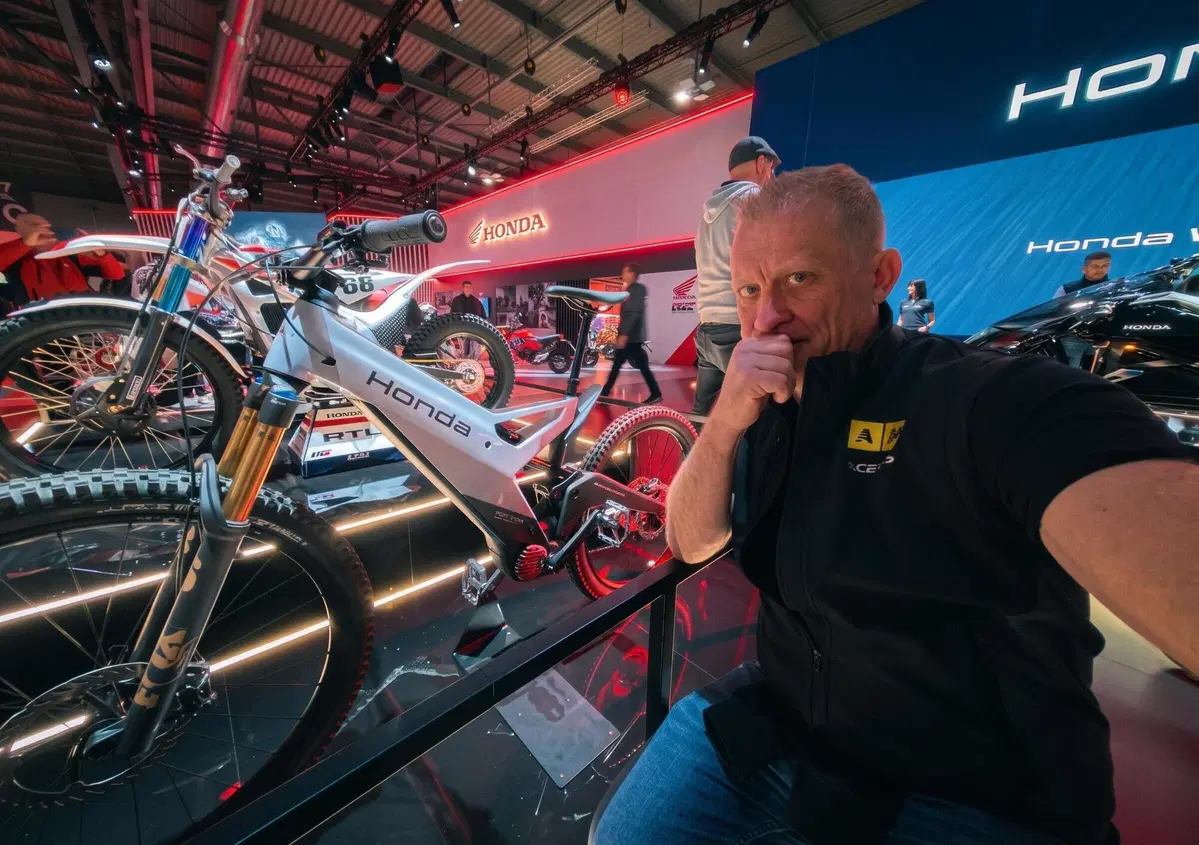
E-bikes carrying motorcycle brands have been part of EICMA for years. The significant change visible at the 2026 show, open to the press on 3 and 4 November and to the public through 8 November, is the level of involvement behind them. Manufacturers are increasingly taking responsibility for frame design, geometry, component choice and the overall technical direction instead of simply licensing their names to specialist bicycle companies. Honda’s RN0, Ducati’s new DM models and Fantic’s Rhapsody Extreme show that movement at the high end, while the Yosma and Hurba examples broaden it into small electric off-road motorcycles and scooters. The result is a market where the badge still matters, but no longer tells the whole story.
Honda RN0: a first high-end e-MTB
Honda presented the RN0 as its first high-end electric mountain bike. Its name recalls the RN01 downhill bicycle with which Honda won the 2005 UCI World Cup. The new project was developed with German company Rotwild, but it is not presented as an existing bicycle carrying a different logo. Honda has brought motorcycle chassis experience into the project, particularly in the way the frame and suspension layout are conceived.
The RN0 uses a carbon-fibre monocoque frame and a swingarm shaped to evoke the gull-arm arrangement seen on Honda motorcycles. Its electrical system is built around a Shimano drive unit producing 100 Nm of torque and 750 W peak power, supplied by a 720 Wh battery. The specification also includes a Fox 36 Factory fork with Kashima coating, Shimano equipment and DT Swiss wheels. A 65-degree head angle places the bike firmly in the all-mountain part of the e-MTB market, rather than presenting it as a general-purpose commuter.
Honda expects the RN0 to reach the European market during 2027. No price or availability details have been announced. That leaves the commercial position open, but the engineering approach is already clear: the RN0 is being treated as a distinct product with its own chassis identity, not merely as a marketing extension of Honda’s motorcycle range.
Ducati puts carbon and Avinox at the centre
Ducati makes the same change even more obvious with the DM-160 R and DM-170 RR, part of its Cycling 2027 range. Both e-MTBs are based on a carbon-fibre platform designed internally and developed with the Zecchetto Group. That matters because Ducati is involved in creating the foundation of the bicycles rather than limiting its contribution to colours and branding on a third-party frame.
The two models share a DJI Avinox M2S motor. Nominal torque is 130 Nm, rising to 150 Nm in Boost mode, while peak power reaches 1,300 W. An integrated 800 Wh battery supplies the system. The DM-160 R has 160 mm of suspension travel and 29-inch wheels. The DM-170 RR increases travel to 170 mm and uses a mullet layout, Öhlins suspension and an SRAM GX AXS electronic drivetrain. Both models are equipped with FSA components and a carbon-fibre handlebar.
The DM-160 R costs 7,990 euros and the DM-170 RR costs 9,490 euros. Their specification points towards enduro, all-mountain riding and downhill enjoyment, placing them in a very different market from a basic urban e-bike. Ducati is therefore competing in the premium section, where long-travel suspension, high output and expensive components define the price as much as the badge does.
Fantic and Yosma target different riders
Fantic displayed the Rhapsody Extreme, a concept based on its top-end enduro e-bike. The Rhapsody uses a Bosch Performance Line CX motor, an 800 Wh battery and 180 mm of travel, while the range is priced from 6,490 to 9,990 euros. The show concept links the bicycle visually to Fantic’s motorcycle range through its red, white and blue colour scheme. The connection is also visible in the hardware: the prototype carries an EXT fork with 180 mm of travel and Brembo brakes.
The Yosma NL11 Pro occupies a different niche. It is a small electric off-road motorcycle aimed at beginners and younger riders, with an expected price of around 1,800 euros. The quoted specification includes a 72 V, 27 Ah battery, a maximum range of 85 km and four assistance levels, with Race as the highest setting. Its role is light off-road riding, early tricks and general enjoyment rather than long-distance transport.
Battery cells reveal the less visible cost
Price discussions tend to focus on motors, suspension and the equipment that can be seen. Greenway instead highlighted the Max Continuous Discharge C-rate, a less familiar but important measure of a cell’s capability. It describes the continuous current a cell can deliver in relation to its capacity. A 30 Ah cell rated at 2C can therefore deliver up to 60 A continuously. Depending on the cell design, a similar principle also applies to charging.
Cell selection affects the cost of the complete battery pack. Greenway says a pack using high-quality cells can cost between 1,000 and 2,000 euros. At the other end, Joy says a complete low-cost e-bike can leave the factory at around 200 euros. That level, however, does not cover the certifications required for sale in Europe. Joy places the minimum at approximately 800 euros including VAT for an e-bike with a safe battery and the certifications required by the European market. The difference is therefore not simply one of styling or motor output; it also concerns the reliability and compliance of the complete product.
Hurba treats support as part of the vehicle
Hurba is attempting to differentiate itself through support as well as manufacturing. The company has developed its own portal for remote diagnostics and assistance to workshops, keeps spare parts in Italy and assembles its vehicles there. That approach makes the period after the sale part of the product strategy, since access to repairs and parts can be as important to an electric vehicle owner as the original specification.
The Hurba 150S is the company’s first scooter designed entirely in-house. Its design is by Aldo De Giovanni and assembly takes place near Rome. The scooter has a 16-inch wheel, a removable battery and a motor rated at 6 kW nominally and 11 kW at peak. Top speed reaches 110 km/h. The two-battery Long Range version is quoted with a range of up to 260 km. Prices are 4,190 euros for the 150S and 5,190 euros for the Long Range, with deliveries expected from March 2027.
The supply chain remains international even when the final brand has a European identity. Amo, a Taiwanese company active since 1974, builds frames and complete e-bikes for other brands, including frames compatible with the Avinox motor. Amo says that roughly 70% of the components need to originate in Europe for a bicycle to qualify as Made in Europe. EICMA 2026 therefore presented a two-sided picture: motorcycle manufacturers are becoming more directly involved in electric bicycle design, but the value of the finished product is also determined by its cells, certification and the support available after purchase.
THE EVIDENCE BEHIND THE STORY
Sources
Spotted something that needs correcting? Contact the editorial team