
LEDs, lasers and reflective gear make the rider easier to read at night
The LazrWeb shows one way to expand visibility beyond a motorcycle’s lamps, while illuminated clothing and retroreflective materials add height and movement.

4 min read
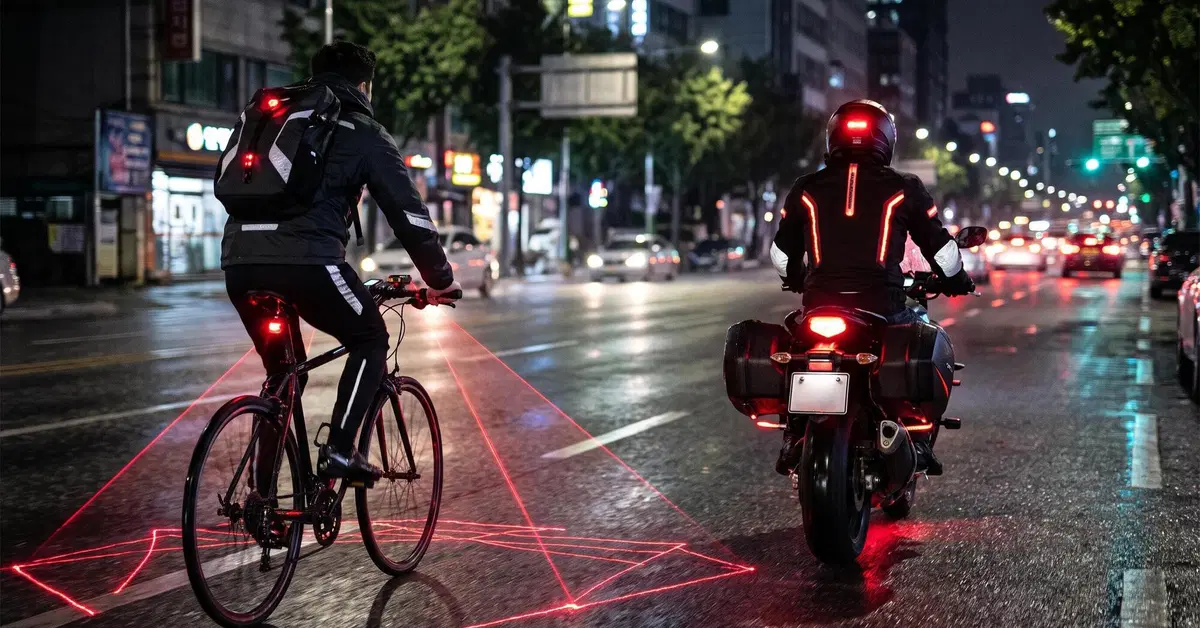
After dark, visibility is not only about lighting the road ahead. A two-wheel user also needs to be recognised in time as a person and as a moving vehicle, with enough distance and lateral space for other road users to react correctly. A small rear lamp signals presence, but it does not always make the rider’s distance or required overtaking clearance immediately obvious.
That is the thinking behind the LazrWeb Spider Laser Bike Light, a bicycle device that combines a red LED with a laser projected onto the road. Its two beams create a grid around the bicycle, making the space beside the rider part of the visible warning. One unit mounts to the handlebar and the other to the seat post, allowing the projections to define the bicycle’s surrounding zone.
The product is not motorcycle equipment, but its principle is relevant to motorcycle visibility. A larger light pattern can give a driver more spatial reference points than a single red lamp. It is not a replacement for proper vehicle lighting or road positioning; it is another way of making the area occupied by a vulnerable road user easier to interpret.
What the LazrWeb adds
The system separates its position-light function from the projection on the ground. The LEDs have four high-intensity modes, while the laser offers four modes controlled by a dedicated LD button. Charging is through USB, water resistance is stated as IPX5 and mounting uses cable ties without tools. Those specifications point primarily to everyday bicycle use rather than a device that can simply be transferred to a motorcycle.
The case for a clearer outline becomes stronger after sunset. Peripheral vision is reduced, judging relative distances becomes harder and oncoming headlights can cause temporary glare. Night-time visibility is therefore not limited to illuminating the lane ahead; it also depends on how clearly the rider can be recognised within the surrounding traffic.
The helmet and jacket become part of the light signature
A motorcycle’s main headlamp sits relatively low. In urban traffic it can blend with car lights in the background or disappear in a vehicle’s mirror blind spot. Illuminated elements on a jacket, vest, backpack or helmet raise the rider’s light signature and make it less dependent on the motorcycle’s single lamp position.
Rain adds another complication. Spray from wet asphalt can dirty and scatter low-mounted lamps. LEDs placed on the shoulders of a waterproof jacket or on the rear of a helmet sit higher and may remain easier to pick out through the curtain of water. Through a bend, the main beam also moves towards the inside of the corner, while a light mounted on the rider occupies a different position in relation to surrounding traffic.
Retroreflective materials complement LEDs without needing a battery. Fluorescent materials depend on ambient light, whereas retroreflective materials use glass microspheres or microprisms to return headlight beams towards their source. A garment that appears black or anthracite in daylight can therefore develop a strong luminous presence when illuminated at night.
Reflective inserts are especially useful on moving areas such as ankles, calves, elbows, shoulders and gloves. Movement helps a driver identify a human figure rather than a fixed surface on the torso. Ergonomic studies cited in the presentation associate this placement with recognition at up to three times the distance of a fixed panel on the torso.
The practical answer is layered rather than gadget-based: front and rear lights kept ready for use, self-lit LEDs on a helmet, jacket or backpack, and retroreflective surfaces on moving parts of the body. For bicycles and scooters, road-projecting lasers can be added to that approach. None of this guarantees that a rider will be seen in every condition, but it can make the rider’s shape and occupied space clearer in rain, at junctions and in dense traffic.
THE EVIDENCE BEHIND THE STORY
Sources
Spotted something that needs correcting? Contact the editorial team