
Flax becomes a targeted carbon-fibre alternative on Suzuki’s GSX-R1000R
Bcomp’s ampliTex and powerRibs are being used on Suzuki’s endurance racer, combining lower production emissions with a different crash response.

5 min read
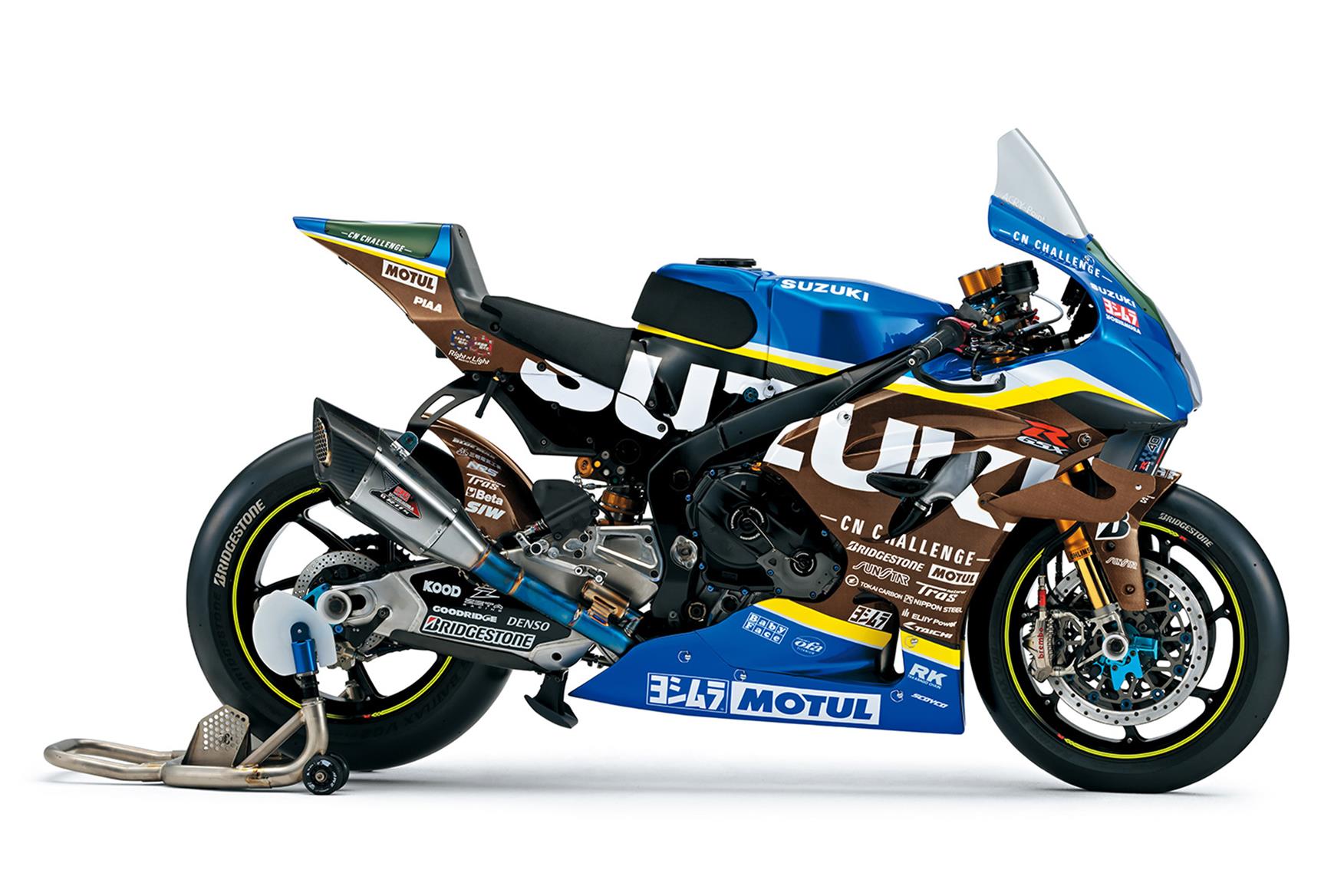
Flax fibre has moved from materials research into motorcycle racing. Bcomp is developing natural-fibre composites for parts where low weight and stiffness matter, but the maximum strength of carbon fibre is not required everywhere. The technology is being used on Team Suzuki CN Challenge’s Suzuki GSX-R1000R, raced at the Suzuka 8 Hours, giving it a demanding competition environment rather than a purely laboratory showcase.
The main difference begins with the fibre itself. Bcomp uses woven flax, bonds it with resin, lays it into moulds and cures it in an autoclave. The manufacturing route is therefore close to established composite production and can use the same general tooling logic. What it avoids is the energy-intensive thermal treatment used to turn a polyacrylonitrile precursor into carbon fibre. Ken Kruck of Bcomp says that stage can reach temperatures of up to 3000°C, while skipping it can reduce production CO2 emissions by up to 85%.
What ampliTex and powerRibs add
Bcomp’s ampliTex is a woven technical flax fabric. powerRibs is a reinforcement grid based on the geometry of leaf veins. Its raised ribs add thickness and stiffness where required, while the spaces between them limit the weight penalty. On a thin-walled shell, the three-dimensional structure can triple flexural bending stiffness while using less base material and reducing manufacturing waste.
In production, the dry powerRibs grid is placed over ampliTex and draws in resin. Bcomp says this also helps distribute resin evenly across the part. A full natural-fibre layup can consequently reach the weight and stiffness of a thin-walled monolithic carbon-fibre structure. The reinforcement can also be applied to carbon-fibre or glass-fibre parts, so the technology can be used in hybrid construction rather than only as a complete replacement for carbon.
Strength remains the important limitation. Kruck says the stiffness can be comparable with carbon fibre, but carbon remains superior for strength. Matching that strength with natural fibre would make the component too heavy. Bcomp is therefore concentrating on bodywork and semi-structural parts instead of every fully structural motorcycle component. It is a selective substitute, not a universal replacement.
The route to Suzuki
The Suzuki connection began through Japanese partner Tras, which presented the material to Suzuki’s then-MotoGP team in 2021. The original target was complete GSX-RR bodywork. A prototype cowl was produced in 2022 and privately tested with positive feedback, but Suzuki’s withdrawal from MotoGP ended that programme. The formal collaboration between Team Suzuki CN Challenge, Tras and Bcomp began in 2024, initially with the motorcycle’s fenders.
At the 2026 Suzuka 8 Hours, the GSX-R1000R used the natural composite for its front and rear fenders, side fairings, seat fairing and winglets. The parts were left unpainted so the flax’s natural colour remained visible. They form part of a wider Team Suzuki CN Challenge sustainability programme that also includes sustainable fuel, tyres containing recycled material, bio-sourced engine oil, an eco-friendly titanium exhaust and team clothing made from recycled fabric.
The material’s behaviour in a racing incident was demonstrated at the 2025 event. The GSX-R1000R suffered serious damage to its centre cowl, but the powerRibs-reinforced panel cracked without shattering and remained attached to the motorcycle. That distinction matters in endurance racing, where damaged bodywork has to be removed and replaced by the mechanics. Carbon fibre can break into sharp fragments, while the natural composite showed a more controlled failure mode.
From racing bodywork to protective equipment
The hybrid approach is already being used outside Suzuki. In Japan’s Super Formula, carbon fibre was used to reinforce component edges while natural fibre formed the rest of the part. In Formula 1, a McLaren Racing seat for Lando Norris used ampliTex and powerRibs throughout. Daniel Ricciardo’s seat used ampliTex between two carbon-fibre layers. These examples show how plant fibre can reduce carbon content while retaining reinforcement where loads are higher.
Bcomp is also considering helmets and protective equipment. Kruck sees hybrid construction as a possible way to address the lower strength of flax, but those applications remain under investigation. The same qualification applies to production motorcycles: Bcomp expects greater use in motorcycling and is considering parts for road-going machines, but there is no confirmed production range in the material described here.
Car racing is helping drive the next stage. Bcomp points to increased adoption in GT categories, particularly GT4, after a rule change covering natural fibre in certain bodywork components. The company is also building a new facility in Eastern Europe to supply some future BMW M model lines. Higher production volumes could improve the cost position, although the material’s lower strength will continue to determine where it makes engineering sense.
The environmental case continues beyond manufacturing. Carbon-fibre parts require pyrolysis, an oxygen-free burning process, to remove resin before the fibre can be recycled or discarded. Natural-fibre composite parts can instead be incinerated for thermal-energy recovery. Bcomp sources its flax from Belgium and the Netherlands, with manufacturing in Switzerland and France. Flax is also used as a regenerative rotational crop, improving soil structure while requiring very little or no nitrogen fertiliser. For motorcycles, the important point is practical: the material has already faced endurance racing and a crash, not just a materials presentation.
THE EVIDENCE BEHIND THE STORY
Sources
Spotted something that needs correcting? Contact the editorial team ↗