
Honda Motra: patents revive the possibility of a comeback
A petrol-powered and electric Motra may be under consideration, continuing Honda’s long habit of building unusual two-wheelers.

5 min read
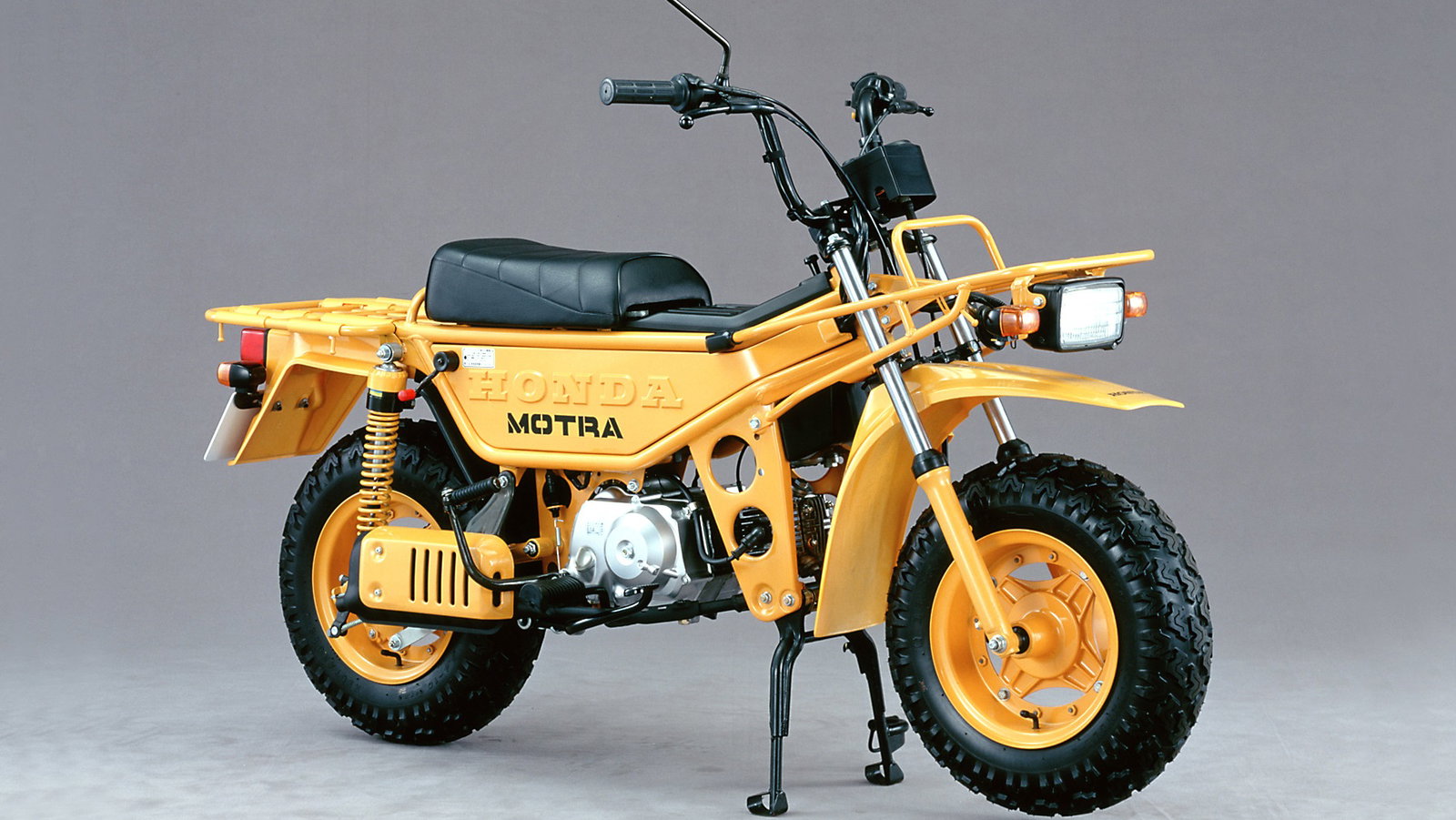
The Honda Motra may be heading back into the conversation, with two possible directions suggested by recent patent designs: one petrol-powered and one electric. That does not confirm a production motorcycle, but it gives the unusual name a new reason for attention. The original Motra was already far removed from a conventional small-capacity machine, and a modern interpretation would fit a company with a long record of exploring unconventional ways to build and use two-wheelers.
The CT50 Motra arrived in 1982 as a recreational motorcycle. Its broad, heavily styled bodywork looked closer to a compact utility vehicle than to an ordinary commuter bike. The mechanical layout was just as distinctive. Honda paired a three-speed gearbox, similar to the unit used by the C90, with a two-range selector. The rider could therefore choose between low and high ratios, bringing an off-road-vehicle idea to a very small motorcycle. Despite its substantial appearance, the Motra weighed 76 kg. Production ran from 1982 to 1983, and the model was sold exclusively in Japan.
Honda’s catalogue of unusual experiments
A Motra revival would not be an isolated break from Honda tradition. The company’s willingness to try different forms of personal transport can be seen in the Roller Through GoGo, a three-wheeled children’s scooter with no engine. Instead of pushing against the ground, the rider operated a lever at the rear to generate movement. A conventional two-wheeled version and a larger adult three-wheeler followed. The concept came from an internal Honda ideas competition, became popular enough for its first production run to sell out within weeks, and remained in production until 1976.
The Z100 Monkey, introduced in 1961, came six years before the Z50M and established an important early chapter in Honda’s miniature-bike story. It was initially used for rides at an amusement park located at the Suzuka circuit. Honda did not sell it to the public, and production numbers were relatively small. The 1987 ZB50 Monkey R took the same broad concept in a more developed direction, adding a beam frame, a disc brake and more sophisticated suspension than the standard Monkey. Its production ended in 1988.
The Juno M80 and M85 demonstrated that Honda’s experimentation was not limited to tiny Monkey-style machines. Introduced in 1961, the two scooters used boxer-twin engines of 124cc and 169cc respectively. Their hydraulic transmissions operated without a clutch, an unusual arrangement for scooters of the period. Neither model remained in the range for long: both lasted roughly a year, and combined production stayed below 6,000 units.
The 1983 FC50 Beat pursued a different kind of technical novelty. Its 49cc two-stroke single used Honda’s V-TACS system, which functioned as a manually operated device in the exhaust. Instead of acting automatically, it was controlled by a pedal operated with the rider’s left heel. Using it above 5,500rpm could improve performance, while operation below that point could produce the opposite effect. The styling matched the mechanical eccentricity, with a car-like front grille, twin headlights and tinted transparent panels around the rider’s knees.
Honda’s Zook, launched in 1990, approached scooter design from the other direction. Its central idea was minimalism. The frame was built around one large tube, the bodywork formed a single plastic shell and the engine was integrated into the swingarm. The seat was not merely a place to sit: its shape also offered a secure location for a helmet. Like several other unusual Honda projects, the Zook had a brief career and remained in production for only one year.
The Gyro family explored three-wheeled transport well before leaning three-wheelers became familiar. The 1984 Road Fox used two rear wheels and a single front wheel, with the front section tilting in the manner of a conventional motorcycle while the rear portion stayed level. Its styling mixed chopper cues with beach-buggy influences, making it unusual even beside Honda’s other Gyro models. It left the range in 1985.
Small Hondas with ambitious engineering
The AX-1 arrived in Japan in 1988 as a derivative of the NX250. Its cast wheels and semi-knobbly tyres created a combination of road-oriented hardware and light off-road styling that was not common at the time. An air-cooled, four-stroke 250cc single produced a claimed 25bhp. The AX-1 was sold only in Japan, limiting its exposure outside that market, but its compact format and mixed-surface character made it a distinctive member of Honda’s range.
The VT250 Spada was more conventional in appearance but just as interesting in engineering terms. Introduced in 1988, it used a liquid-cooled 250cc V-twin and a cast aluminium CASTEC frame rather than a frame assembled from welded aluminium sections. Its gearbox had six speeds. The Spada belonged to Honda’s VT250 family, which later included models such as the Japanese-market VTR250. Its own production ended in 1989, only a year after launch.
That background explains why the possible return of the Motra is more significant than a simple exercise in reusing an old badge. The original combined utility-inspired styling, a distinctive transmission and very low weight. An electric version could reinterpret those qualities for a different technological period, while a petrol model would offer a more direct continuation of the original idea. For now, the Motra remains a possibility linked to patent designs rather than a confirmed production motorcycle. Honda’s history nevertheless shows that the company has repeatedly been prepared to investigate ideas well outside the mainstream.
THE EVIDENCE BEHIND THE STORY
Sources
Spotted something that needs correcting? Contact the editorial team ↗