
Suzuki puts the GSX-S1000GX through 350 km in Lisbon
The first international test focused on the sport crossover’s SAES and SRAS suspension systems, along with comfort and control across varied roads.

4 min read
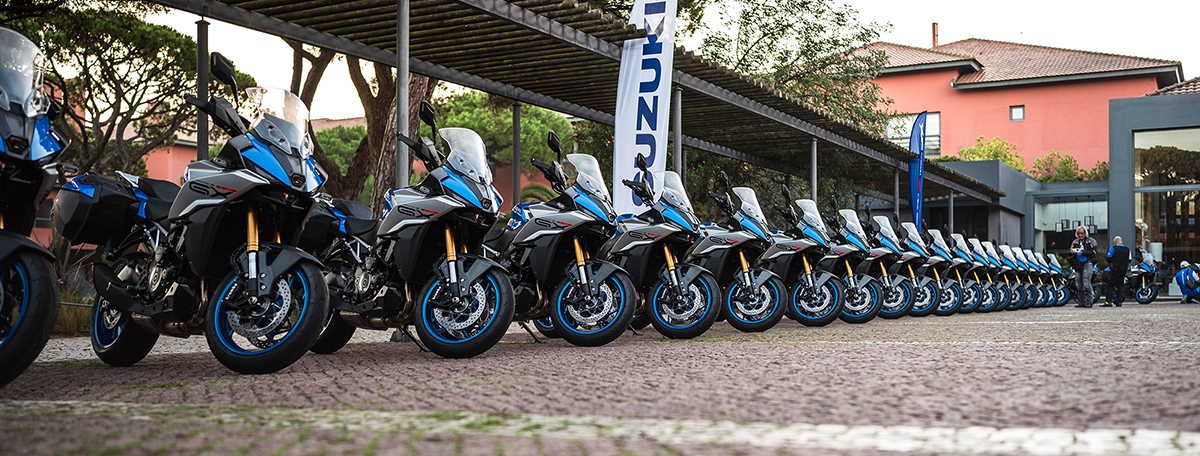
Just days after announcing the GSX-S1000GX at EICMA in Milan, Suzuki organised an international test event for the new sport crossover in Lisbon, Portugal. From Sunday 19 November to Friday 24 November, 48 media representatives from 14 countries in Europe, North America and Asia took part. The programme combined technical briefings with two days of riding, giving the invited journalists a chance to assess the motorcycle in a range of environments.
The opening day was devoted to presentations from Suzuki’s development staff and questions from the press. The following two riding days covered approximately 350 km. Suzuki designed the route to represent more than a single fast mountain ride: it was intended to simulate a longer touring experience and demonstrate the crossover concept behind the GSX-S1000GX.
From cobblestones to mountain roads
The route included urban areas paved with cobblestones, open highways, twisting mountain roads and sections along the coast. On the uneven streets, participants could experience the effect of the suspension’s skyhook effect on comfort. On the longer open sections, they were able to assess the motorcycle’s power and control during more aggressive sport riding. The event material also notes that favourable weather helped the programme run smoothly.
SAES and SRAS take centre stage
The GSX-S1000GX is the first Suzuki motorcycle to adopt Suzuki Advanced Electronic Suspension, or SAES. During the technical briefing, Suzuki engineers explained the role of Suzuki Road Adaptive Stabilization, abbreviated SRAS. According to that explanation, SRAS can switch between high and low levels of skyhook effect depending on road-surface conditions.
The purpose of the system is to address different riding demands without relying on one suspension response for every surface. Suzuki says the technology enables comfortable riding over uneven ground while retaining the potential for aggressive riding on normal, smoother surfaces. That is the manufacturer’s explanation of the system; it is not an independent measurement by Athenian Rider.
The electronic suspension attracted especially positive comments from the participating media. One journalist described it as excellent on poor ground and precise on good roads, while others highlighted its suitability for long rides. The easy use of the riding modes was also mentioned. These are impressions attributed to the invited media, not the result of an Athenian Rider road test.
Engine response, chassis and comfort
Suzuki’s engineers answered questions about the model’s technology, development and performance. In the reported media feedback, the engine stood out for its smooth response to throttle changes, strong performance and wide power range. Participants also mentioned smooth torque that they considered useful in everyday urban riding and on winding roads. No power or torque figures are supplied in the available evidence, so these observations remain qualitative.
The chassis and overall handling also received positive comments. Several participants called the suspension excellent and said that the chassis and suspension worked well together. The riding position was described as combining sportiness and comfort. Other remarks covered the comfort of the seat, the windshield’s protection from turbulence and the controllability of the brakes. One participant said that the front brake, rear brake, engine braking and overall braking system worked harmoniously together.
Styling was another part of the favourable response. Media comments referred to the characteristic front design, the sharp nose and the motorcycle’s distinctive identity. The event material identifies Pearl Mat Shadow Green and Glass Sparkle Black among the colours and states that three colour schemes are available. The name of the third colour is written inconsistently in the supplied material, so it is not reproduced here.
The overall assessment reported from the event matched Suzuki’s stated objective: a crossover combining sporty behaviour with comfort across different situations and road surfaces. The Lisbon test did not supply prices or numerical engine specifications, but it did show how Suzuki wants to position the GSX-S1000GX — as a motorcycle for sport touring and adventure-oriented riding, built around adaptive suspension and everyday usability.
THE EVIDENCE BEHIND THE STORY
Sources
Spotted something that needs correcting? Contact the editorial team ↗