
Ducati Desmo450 SM: a purpose-built supermoto racer
Derived from the Desmo450 MX, Ducati’s new competition supermoto combines Showa suspension, slicks, Brembo brakes and dedicated electronics.

4 min read
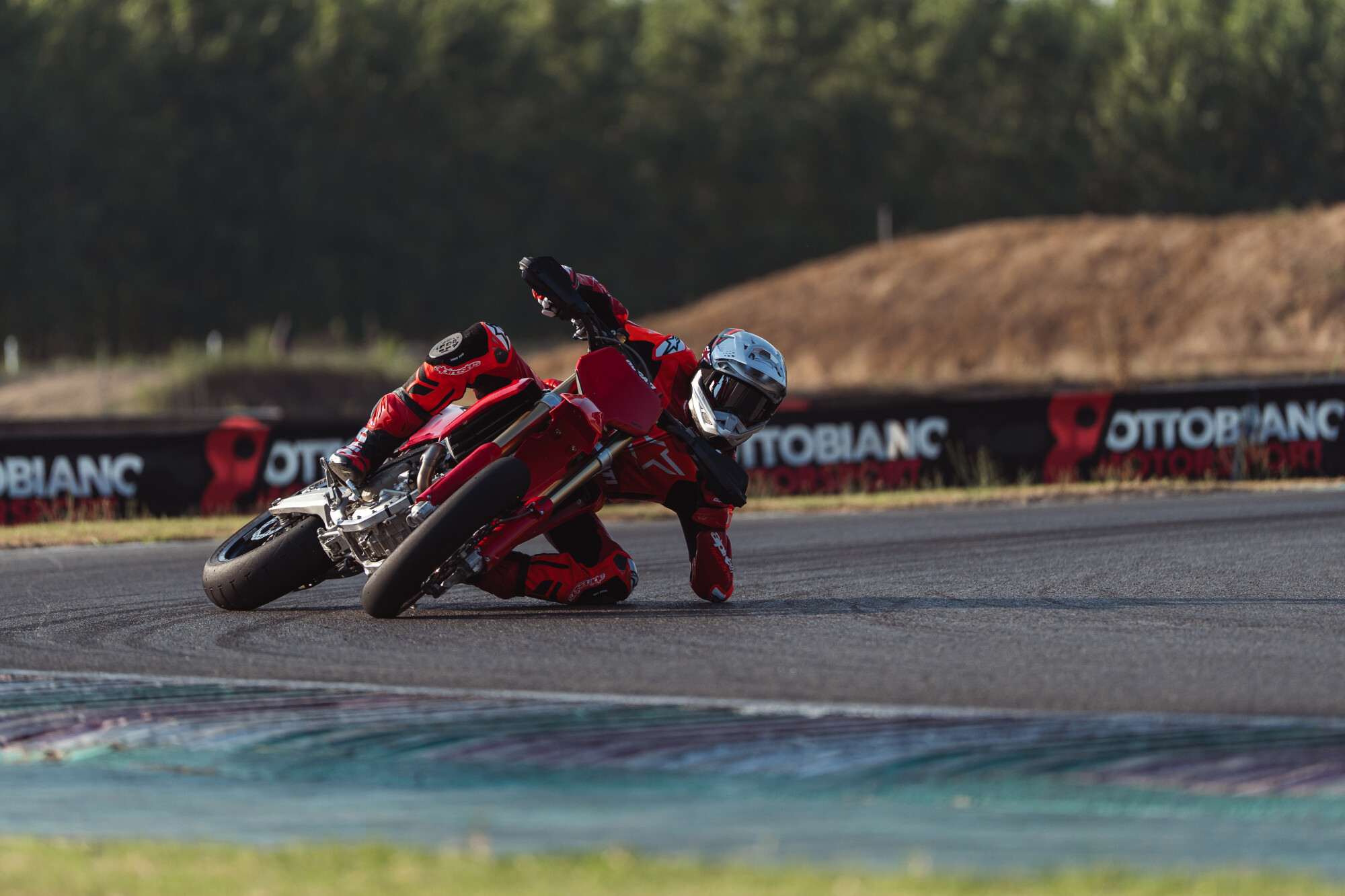
Ducati has introduced the Desmo450 SM as the Borgo Panigale manufacturer’s first competition supermoto. The motorcycle was presented at World Ducati Week on 17 September 2026. It is a dedicated development of the Desmo450 MX platform, which Marc Reiner Schmidt and Team Undici took to victory on its world racing debut.
This is more than an MX motorcycle converted with different wheels. Ducati has revised the suspension, triple clamps, wheels, brakes, final drive, clutch and electronics so that they work as one package for supermoto competition. The company describes the intended result as a machine combining braking support, corner-entry precision, controlled sliding and traction across the changing grip conditions typical of the discipline. Ducati also says that the power delivery, chassis and electronic management are intended to suit professionals and amateurs, reducing physical effort while supporting consistency over a lap.
Showa suspension, race wheels and brakes
Suspension development was a central part of the project. Ducati says this is the first production supermoto for which Showa directly developed the settings. The front end uses a 49 mm inverted fork with a sealed cartridge, full compression and rebound adjustment, dedicated springs and 280 mm of travel. Its outer tubes receive Kashima coating. The left fork bottom carries a radial caliper mount, while the machined-from-solid aluminium triple clamps use increased spacing to provide clearance around the front wheel.
A fully adjustable Showa rear shock works through a progressive linkage and gives the rear wheel 295 mm of travel. Its dedicated calibration is intended to preserve traction and balance during the different stages of riding. The handguards and shortened front mudguard are redesigned for supermoto use, and shorter fork protectors create additional room for the front slick. Ducati also describes the front suspension as remaining effective on off-road sections, an important distinction from a purely tarmac-focused setup.
The aluminium Takasago Excel wheels use the Bartubeless system, removing the inner tubes. Ducati says this cuts rotating and unsprung mass by 1.2 kg, with claimed benefits for agility and suspension behaviour. Wheel dimensions are 16.5 x 3.5 inches at the front and 17 x 5 inches at the rear. Factory tyres are Metzeler Racetec Slick SM units in 125/75 R16.5 and 165/55 R17 sizes.
Braking hardware consists of a Brembo PR15x19 radial master cylinder, a Brembo Stylema radial caliper and a 310 mm Galfer floating front disc with an aluminium carrier. The rear uses a 240 mm Galfer disc and a Brembo floating caliper. The lightweight aluminium twin-beam chassis comes from the motocross motorcycle. Its design limits the number of welds to balance weight, stiffness and strength, while also allowing a straighter intake tract for the engine.
Desmo engine and electronic control
The single-cylinder Desmo engine displaces 449.6 cc and produces a claimed maximum 63.5 CV at 9,400 rpm. The peak-torque figure is not carried into this article because the supplied technical passages give conflicting values for the same motorcycle. Ducati’s desmodromic valve system permits a rev limiter setting of 11,900 rpm. The manufacturer says this gives the rider a broad usable range, allowing each gear to be held longer and reducing unnecessary shifts.
The transmission has an active Quick Shift system for upshifts. A Suter slipper clutch is calibrated specifically for the Desmo450 SM and is intended to help the rider manage rear-wheel slides on corner entry. Ducati Traction Control calculates actual rear-wheel slip, provides four intervention levels and can be switched off. The system acts on engine parameters to improve traction and stability as grip changes.
The electronics package also includes Launch Control and Engine Brake Control, both with different intervention settings, plus two Riding Modes. Ducati says the rider can adapt the modes and their settings to personal requirements and track conditions through the X-Link application, which is available as an accessory. The result is an electronic package designed around the unusual combination of asphalt and off-road surfaces found in supermoto racing.
Service schedule and availability
The maintenance schedule reflects the demands of a competition motorcycle. Oil changes are specified every 15 hours, piston replacement and valve-clearance checks every 45 hours, and a complete engine overhaul every 90 hours. Ducati has also designed the engine for quicker service work: the cylinder head uses a metal gasket, while the alternator and clutch covers use rubber gaskets instead of three-component sealing paste.
The Desmo450 SM introduces a predictive-maintenance concept as well. The optional Com-Link module monitors engine-component wear and evaluates the loads placed on those parts according to usage, allowing routine service intervals to be managed more precisely. Ducati lists the bike in Ducati Red. Selected European dealers are scheduled to receive it from December 2026, followed later by other markets. No price or Greece-specific availability has been supplied.
THE EVIDENCE BEHIND THE STORY
Sources
- Ducati Desmo450 SM: la primera Supermotard de competición de Borgo Panigale ↗
- Ducati Desmo450 SM: la prima supermotard racing della Casa di Borgo Panigale ↗
- Ducati Desmo450 SM: Das erste Supermoto-Rennmotorrad aus Borgo Panigale ↗
- Ducati Desmo450 SM: la prima supermotard racing della Casa di Borgo Panigale ↗
Spotted something that needs correcting? Contact the editorial team ↗