
BMW F450R: a premium new choice for A2 riders
With 46.9bhp, extensive electronics and the Easy Ride Clutch option, BMW’s F450R raises both the specification and the price of the A2 naked class.

5 min read
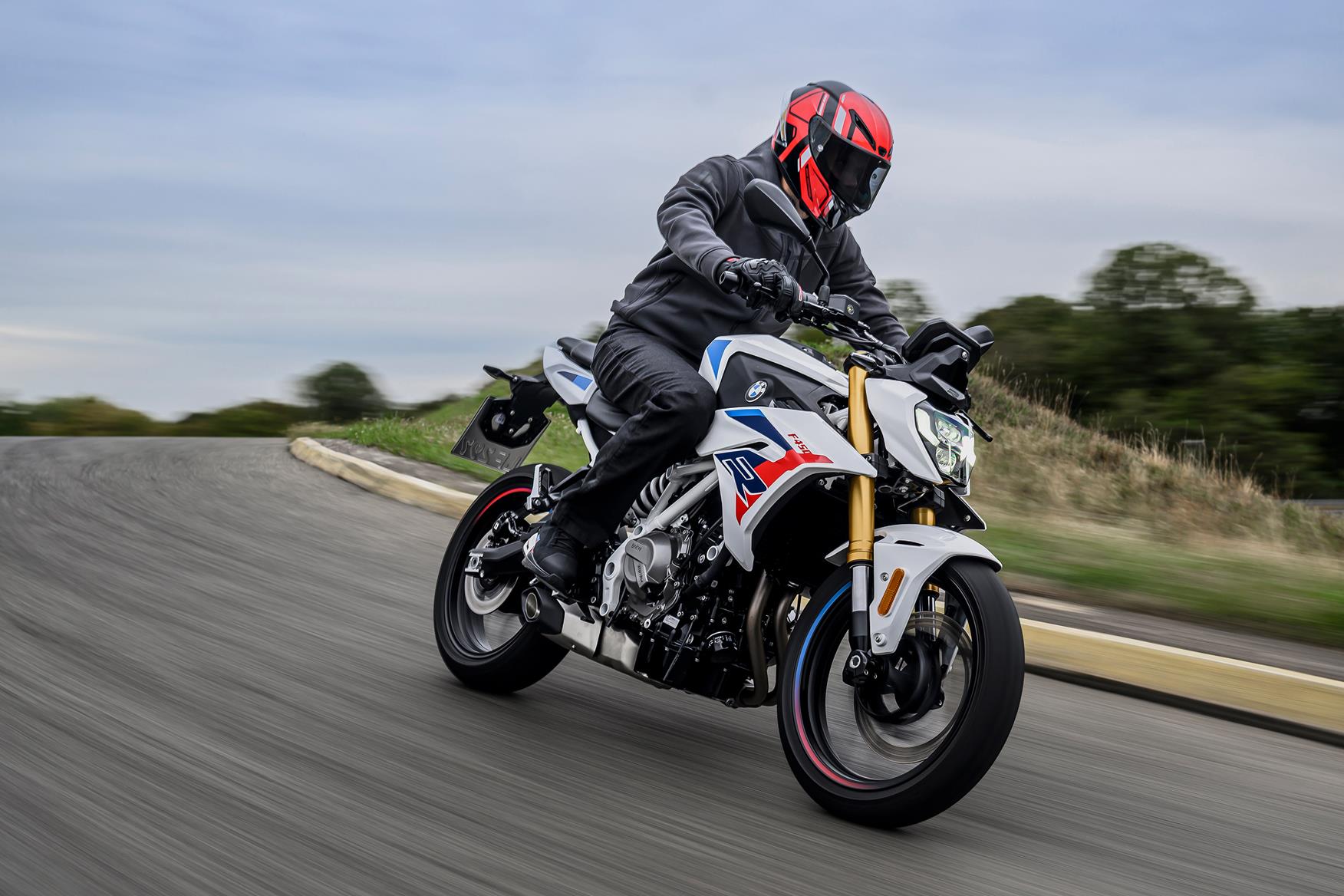
The BMW F450R is the company’s new naked bike for the A2 licence class, and it is aimed at the more sophisticated end of the segment. Its S1000R-inspired styling is backed by a claimed 46.9bhp, a substantial electronics package and the option of BMW’s Easy Ride Clutch. Base pricing is £6,395. That figure places the F450R above the KTM 390 Duke and Triumph Speed 400, while leaving it close to the Yamaha MT-03.
The F450R is the newest member of BMW’s F450 family and shares its platform with the F450GS adventure bike. BMW has adapted the package for road use, while retaining the same basic engine and construction concept. The result is a motorcycle that sits above the usual entry-level formula: it combines a twin-cylinder engine with rider aids and equipment that are not universal in this class.
Twin-cylinder performance at the top of the group
Power comes from a 420cc liquid-cooled parallel-twin built by TVS in India. BMW quotes 35kW, or 46.9bhp, at 8750rpm and 43Nm, equivalent to 31.7lb.ft, at 6750rpm. The company also says that 80% of peak torque is available from 3000rpm. That spread should make the engine useful in everyday riding, rather than reserving its strongest response for the upper end of the rev range. The motor uses a 135-degree crankpin arrangement and a stainless-steel underfloor exhaust, with Euro 5+ compliance stated in the specification.
On the headline numbers, the BMW leads this four-bike comparison for both claimed power and torque. The KTM 390 Duke is the closest on output, with 44bhp and 29lb.ft from a 399cc single-cylinder engine. Triumph’s 398cc single in the Speed 400 claims 40bhp and 27.7lb.ft, while Yamaha’s 321cc parallel-twin MT-03 claims 41bhp and 21.8lb.ft. The F450R is quoted at 74mpg, matching the MT-03 but trailing the 390 Duke’s 83mpg recorded in real-world use. BMW also gives a 0-62mph time of 5.7 seconds and a top speed of 105mph.
The Speed 400’s official figure should be kept separate from a dyno result included in the comparison. That particular measurement recorded 33.7bhp and 23.5lb.ft, while Triumph’s published claim remains 40bhp and 27.7lb.ft.
A substantial chassis, with a weight penalty
BMW uses a welded tubular steel space frame for the F450R, with the engine acting as a stressed member. The wheelbase is 1405mm, with a 23.4-degree steering-head angle and 110mm of trail. Suspension consists of a 43mm KYB upside-down fork with 140mm of travel and a KYB rear shock mounted to an aluminium swingarm. Sport Suspension variants add rebound and compression adjustment at the fork, while rear preload and rebound adjustment are available throughout the range.
The price of that equipment is mass. The F450R weighs 175kg ready to ride, rising to 176kg when the Easy Ride Clutch is fitted. The KTM 390 Duke is listed at 165kg, the Yamaha MT-03 at 168kg and the Triumph Speed 400 at 170kg. The BMW’s 790mm seat height matches the Triumph’s. Buyers needing a different reach can specify an accessory seat 20mm higher or one 15mm lower.
Braking and electronics set it apart
The front brake combines a Brembo four-piston monobloc caliper with a 310mm disc. At the rear there is a ByBre single-piston caliper and a 240mm disc, while the 17-inch wheels carry BMW Motorrad ABS Pro with lean-sensitive operation. KTM counters with a four-piston radial caliper on a 320mm disc, cornering ABS and cornering traction control. Triumph’s Speed 400 uses a four-piston radial caliper and 300mm disc, plus switchable traction control without lean-sensitive operation. Yamaha’s MT-03 has a two-piston non-radial caliper and no traction control.
The F450R’s standard electronic package includes Rain, Road and Dynamic riding modes, Dynamic Brake Control, Dynamic Traction Control and MSR engine-drag torque management. A 6.5-inch TFT display provides the main interface, with a USB-C port and smartphone connectivity through the BMW Motorrad Connected App. Shift Assistant Pro is standard on every version except the Base. The KTM offers a 5-inch colour TFT, Bluetooth, turn-by-turn navigation, Street/Rain/Track modes and launch control, but its quickshifter is an extra-cost option.
The Easy Ride Clutch is the BMW’s most distinctive feature. Its centrifugal mechanism engages according to engine speed and, when combined with Shift Assistant Pro, allows the rider to pull away and change gear without manually using the clutch lever. The lever remains available for manual override. None of the three comparison bikes offers a directly equivalent system. The Speed 400 is equipped with a part-LCD, part-analogue instrument layout without Bluetooth, although it has a USB-C port. The MT-03 uses an LCD display without connectivity.
The premium is clear in the price list
The F450R range starts with the £6,395 Base. The £6,645 Exclusive adds Shift Assistant Pro and Sport Suspension, the £6,770 M Sport adds Riding Modes Pro, and the £6,995 M Sport with Innovation Package includes the Easy Ride Clutch. The Base is £996 more expensive than the KTM 390 Duke and £1,150 more than the Triumph Speed 400.
The Yamaha comparison is less straightforward. The MT-03 initially arrived at £5,300, but is now listed at £6,202, just £193 below the F450R Base. That makes it the BMW’s closest rival on price, even though its electronics are much simpler. The F450R is also cheaper than the F450GS, which launched at £7,760, while representing a substantial step up from BMW’s previous G310R. That model ended production with a 313cc single-cylinder engine, 34bhp and a £5,290 price.
The F450R therefore has a clear position in the A2 class. It brings the highest claimed output in this group, a comprehensive rider-aid package and a clutch system unavailable from its three direct rivals. It is also the heaviest and, apart from the upper BMW variants, the most expensive proposition here. For an A2 buyer, the central question is whether the twin-cylinder performance, Easy Ride Clutch and wider technology package justify paying more than the KTM or Triumph.
THE EVIDENCE BEHIND THE STORY
Sources
Spotted something that needs correcting? Contact the editorial team ↗