
2026 Ducati Panigale V4 R: MotoGP ideas, 998cc and a sharper track focus
Ducati’s homologation superbike combines a high-revving 998cc V4 with new aero, chassis changes and electronics designed around track performance.

8 min read
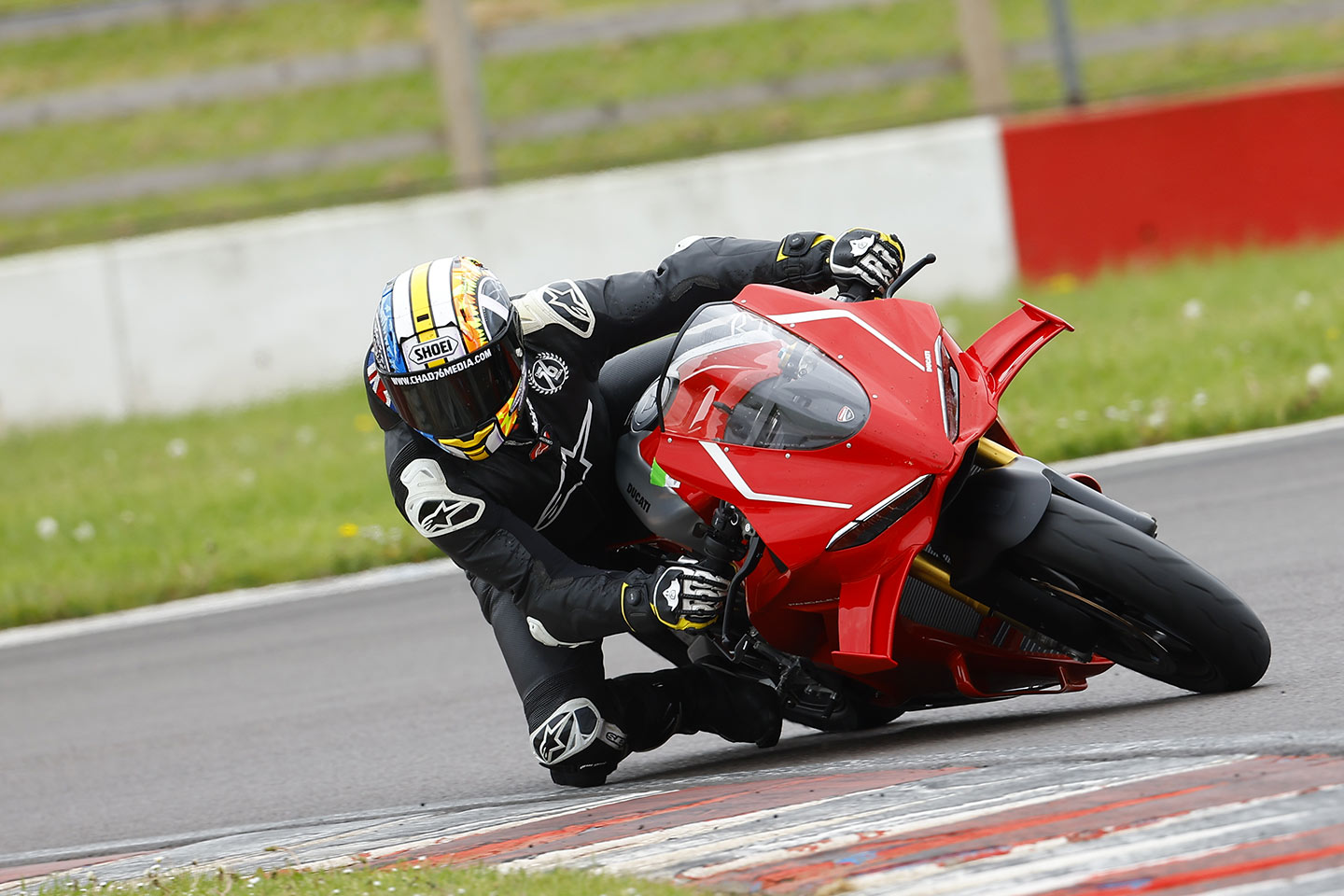
The 2026 Ducati Panigale V4 R is Ducati’s latest 998cc homologation superbike, developed with an unusually direct connection between MotoGP-derived technology and a road-legal production motorcycle. At the time of the riding account, the V4 R was described as dominating the 2026 World Superbike season. Its purpose, however, is not simply to produce a large headline figure: the update combines a high-revving engine with revised chassis flexibility, new aerodynamic devices, a racing-oriented gearbox and a detailed electronic package intended to make very high performance more usable on circuit.
The headline specifications require an important editorial caveat. The article gives 218 hp at 15,750 rpm for the road-legal motorcycle in its narrative, while its specifications table lists 208.4 hp at 13,250 rpm as the claimed output of the tested motorcycle. Those figures are not reconciled. Torque is similarly inconsistent: the narrative states 84 ft.-lb. at 12,000 rpm, the specifications table gives 84.4 ft.-lb., and the comparison section gives 84.5 ft.-lb., all at 12,000 rpm. The discrepancy should be resolved before publication of a definitive specification sheet.
A 998cc engine built for the top end
The liquid-cooled Desmosedici Stradale R is a 90-degree V4 with four desmodromic valves per cylinder. Its 998cc displacement comes from an 81.0mm bore and 48.4mm stroke, with a 14.0:1 compression ratio. Ducati retains the compact-liter-class capacity required by the homologation concept rather than using the larger engine found in the Panigale V4 S. The fuel system uses DFI, 56mm-equivalent oval throttle bodies and ride-by-wire, while power reaches the rear wheel through a six-speed transmission and chain final drive.
The riding account says the engine’s peak power arrives at 15,750 rpm and that it continues revving beyond 16,000 rpm. That powerband changes the way the motorcycle is ridden: the tester reported that upshifts had to come later than on many other superbikes. The 2026 update is also claimed to increase useful midrange torque by 7 percent at approximately 6,000 rpm, with a further 3 percent increase at peak torque. In practical terms, the aim is to make the engine less dependent on its extreme upper rev range without diluting its racing character.
With the full-race Akrapovič exhaust and Ducati Performance oil, the article reports a claimed 239 hp. That is a tested result associated with the race exhaust and special oil, not a standalone figure for the standard road-legal motorcycle. The special oil is listed at $38 per liter, and the engine’s 3.7-liter capacity means four one-liter containers are required for the oil change described. The article states that the oil-change interval for maximizing the stated power is every 620 miles. The 2026 engine is also said to comply with tighter Euro 5+ regulations.
Gearbox logic and MotoGP-derived aerodynamics
One of the V4 R’s most distinctive mechanical solutions is Ducati’s Racing Gearbox with a neutral-lock system. Neutral is positioned below first gear rather than between first and second. The arrangement is intended to eliminate accidental false neutrals between first and second under heavy braking and is described in the article as a first for a production motorcycle. The racing shift pattern runs sequentially from first through sixth when shifting up, with downshifts reversing that sequence.
Selecting neutral is less conventional. The rider must use the clutch together with the Ducati Neutral Lockout lever, mounted on the right handlebar beside the throttle. The auto-blipper and DQS 2.0 quickshifter reduce the need for the conventional clutch to starting and stopping, while the gear selector can reportedly be reversed relatively easily for a race-shift pattern. During the Donington Park test, the tester found the quickshifter effective even at half throttle.
The new Corner Sidepods are MotoGP-derived winglets integrated into the belly pan. Ducati claims they increase vertical downforce by 25 percent. Their intended function is different from simply adding stability in a straight line: at high speeds and lean angles, they are said to create additional cornering ground effect and draw the motorcycle toward the apex. The result is presented as part of a broader effort to use aerodynamic load where it can influence corner entry and mid-corner control.
The aluminum front frame is reported to be 17 percent lighter than the preceding design and to have 40 percent less lateral stiffness. At the rear, a hollow-center, double-sided swingarm is said to be 7.2 lb lighter and more flexible. These changes are intended to improve traction, feel and stability rather than pursue stiffness or low mass in isolation. The V4 R uses race-spec mechanical Öhlins suspension: a fully adjustable 43mm Öhlins NPX 25/30 fork with 4.9 inches of travel and a fully adjustable Öhlins TTX 36 rear unit with 5.1 inches of travel.
Braking hardware comprises Brembo Hypure radial-mount four-piston front calipers with 330mm discs and a two-piston rear caliper with a 245mm disc. Bosch Race eCBS and Ducati Race Brake Control form part of the braking strategy, while Ducati’s Vehicle Observer is used to refine and optimize the MotoGP-developed rider aids. Forged aluminum wheels measure 17 x 3.5 inches at the front and 17 x 6.0 inches at the rear. The listed road tire is the Pirelli Diablo Supercorsa V4 SP, sized 120/70-17 and 200/60-17.
What the electronics feel like on track
The test took place at Donington Park in the British Midlands during a Cycle World test day. The motorcycle used road-legal Diablo Supercorsa SP V4 tires rather than pre-warmed slicks. During warm-up, the tester reported clear feedback as the tires generated heat, pressures rose and grip increased. The motorcycle initially seemed intimidating, but that impression reportedly disappeared quickly once the laps began.
At approximately six-tenths pace, the tester described the V4 R as graceful and fluid through Donington’s sweepers. At high rpm, acceleration out of the Old Hairpin was described as very strong, with rapid and precise gear changes and no noticeable sliding or squirming under drive. In Slick A mode, the motorcycle delivers full power while reducing electronic intervention to near-minimum levels. The tester said this allowed greater feel for mechanical grip, more corner speed and increased confidence in the Öhlins suspension.
The account describes high speed and lean through Coppice, followed by strong third-gear acceleration after the turn. Slide, traction and wheelie controls helped manage mistakes while still allowing earlier throttle application. The tester also observed Ducati Slide Control activation out of Coppice and Ducati Wheelie Control activation when exiting both hairpins on worn tires. The 6.9-inch TFT display provides live rider-aid readouts, a lap timer with split times and a large gear-position indicator.
The braking system offers several different levels of electronic support. In ABS 1, intervention is minimized and Track Plus combined braking is selected for maximum braking performance. The system can apply rear braking automatically and can briefly add rear brake after front-brake release to help tighten the line. ABS 2 uses less automatic rear braking, while ABS 3 leaves full control to the rider. Mode 5 permits slide-by-brake behavior, which the tester characterized as more useful for spectacle than lap time.
The tester considered the V4 R’s braking unusually strong among road-legal motorcycles, while noting that the individual contribution of the aero, electronics and brakes could not be isolated. Importantly, the electronic assistance did not prevent feedback through the tires and suspension. After a day of lapping, the tester said the motorcycle produced faster Donington laps than ever before while leaving them tired but not exhausted. The conclusion was that lap times felt accessible rather than requiring constant pursuit, with substantial untapped electronic and mechanical setup potential remaining.
V4 R versus V4 S: different priorities
The brief comparison with the Panigale V4 S helps explain the V4 R’s role. The V4 S is described as a non-homologation superbike with an 1103cc V4, listed at 216 hp at 13,500 rpm and 89.2 ft.-lb. at 11,250 rpm. Against it, the 998cc V4 R has less torque but a higher-rpm power peak, while the two motorcycles are said to have very similar weight.
Their suspension philosophies also differ. The V4 R uses manually adjustable Öhlins components, whereas the V4 S has electronically adjustable suspension that continuously adapts to riding conditions. The tester considered the V4 S easier to set up and stronger in torque, but found the V4 R faster to steer, more precise and easier to change direction with through fast turns. The V4 R was ultimately judged to occupy a higher performance level, at least in that track comparison.
Price and the cost of the race approach
The U.S. MSRP is $49,995. The Complete Pro Akrapovič titanium exhaust system adds $9,870, while Ducati Corse Performance Oil is listed at $38 per liter. The 411-lb claimed wet weight is specified without fuel. Other listed dimensions include a 24.0-degree rake, 3.9-inch trail, 58.1-inch wheelbase, 33.7-inch seat height and 4.5-gallon fuel capacity.
The V4 R’s numbers and track impressions point to a motorcycle built around homologation logic: a smaller, high-revving engine; chassis flexibility intended to preserve feel and traction; aerodynamic load aimed at cornering; and electronic systems that let the rider choose how much assistance to retain. But the unresolved horsepower and torque discrepancies matter, particularly for a machine whose identity is defined by precise technical claims. A direct comparison with other road-legal liter-bikes is still needed before its relative showroom-spec performance can be established conclusively.
THE EVIDENCE BEHIND THE STORY
Sources
Spotted something that needs correcting? Contact the editorial team ↗