
Sepang 2015: the race that changed MotoGP’s finale
Rossi’s accusation, the fight with Marquez and the penalty that sent the title contender to the back of the Valencia grid.

6 min read
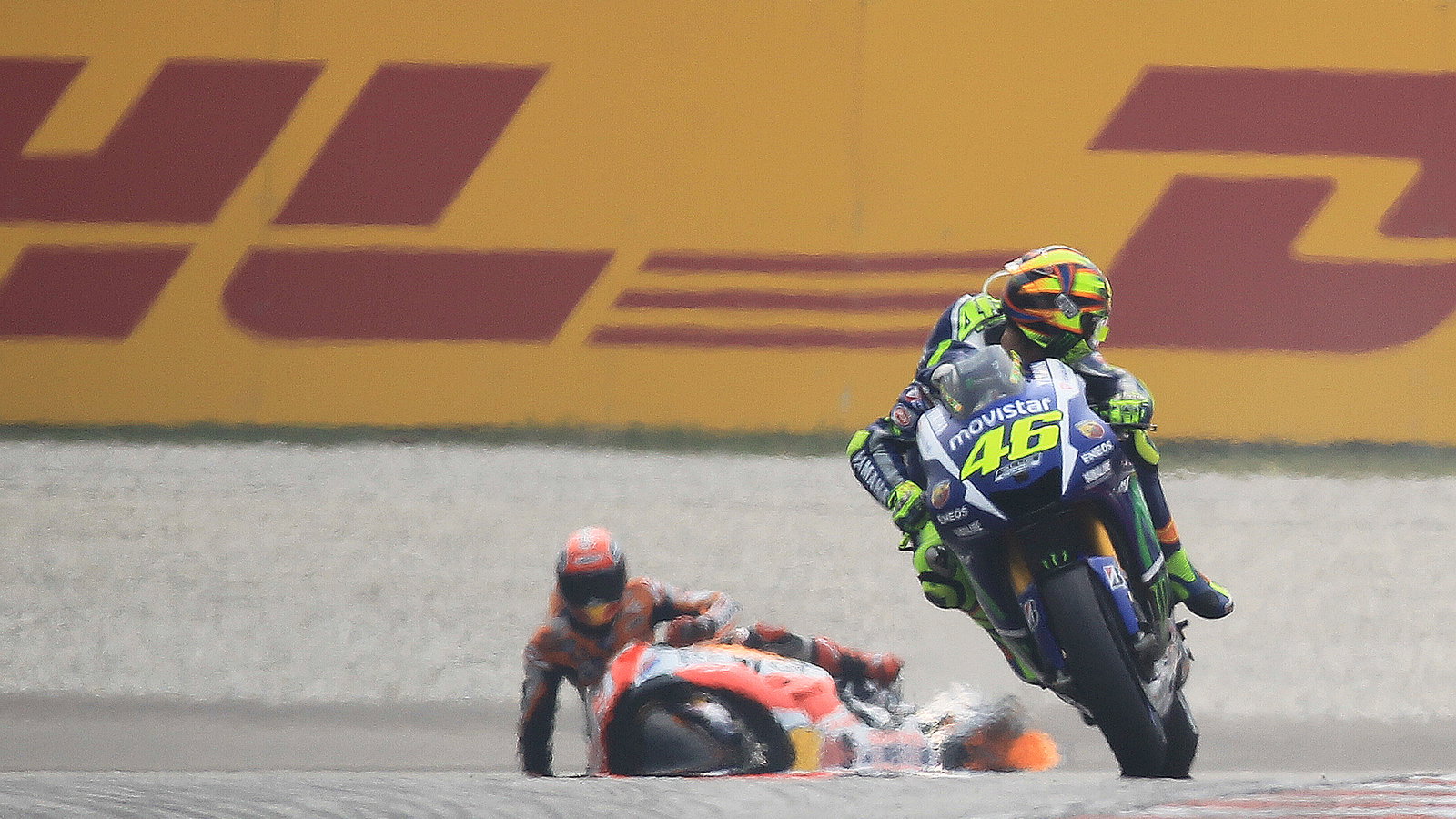
The Malaysian Grand Prix at Sepang on 25 October 2015 became far more than the penultimate round of the season. Valentino Rossi arrived with an 11-point lead over his Yamaha team-mate Jorge Lorenzo and his first mathematical chance to secure the championship. Lorenzo had increasingly looked like the faster of the two riders, while Marc Marquez was already out of title contention. That did not make Marquez irrelevant. Within days, he would become the central figure in the most bitter episode of the championship’s finale.
The weekend was tense before the bikes even took to the circuit. Sepang was surrounded by the South-East Asian haze created by wildfires in Indonesia. Visibility was restricted and the pollution raised health concerns. Javier Alonso said the Pollution Standards Index was below 100 PSI, a level at which activities could continue. Visibility at the circuit and hospital was monitored because the medical helicopter was part of the event’s safety plan. If flying became impossible, the road transfer was estimated at 30–35 minutes.
The accusation brought from Phillip Island
The dispute erupted during Thursday’s press conference. Rossi first described the pressure of fighting Lorenzo and compared the final two races with a football match played over two halves. The mood changed when the conversation turned to Phillip Island. Rossi argued that Marquez had not been racing solely for victory in Australia. In Rossi’s interpretation, the Honda rider had managed the pace in a way that helped Lorenzo take more points from him.
That suspicion grew from a real but ambiguous racing moment. Marquez could have stayed behind Lorenzo on the final lap at Phillip Island, but instead passed him and won the race. Lorenzo lost five points that would otherwise have left the championship entirely under his own control. The pass was not, however, a rules breach. Marquez said he had been racing for the win and explained that the Honda was placing heavy demands on its front tyre. He had needed to manage it for 27 laps without abandoning the fight for victory.
Andrea Iannone, who had passed Rossi for third in Australia, agreed that Marquez may have been “playing” with the other riders, but he did not assign a definite motive. Rossi went further. He linked Marquez’s attitude to their earlier confrontations in Argentina and at Assen and presented the disagreement as personal. Marquez rejected the claim. If he had wanted to help Lorenzo, he said, he would not have passed him on the final lap or pushed for the win.
Sepang turns the words into a fight
Lorenzo was faster than Dani Pedrosa and Marquez in Friday practice, while Rossi was eighth. In qualifying, Marquez took pole, Pedrosa was second and Rossi completed the front row. Lorenzo started further back but moved ahead of Rossi quickly. Pedrosa and Lorenzo began to pull away, leaving a fight behind them that soon became more than a conventional battle for position.
Rossi passed Marquez and the Honda rider answered at Turn 1. The pair exchanged positions through a series of attacks in corners where riders would normally hesitate, both machines moving around as the two men worked at the limit. At one point Rossi raised a hand, appearing to ask Marquez to end the fight as Pedrosa and Lorenzo escaped up the road. Marquez did not back off. The on-track confrontation now looked like an extension of the verbal exchange from the press conference.
The decisive moment came on lap seven at Turn 14. Rossi ran wide and took Marquez towards the edge of the circuit. Contact followed and Marquez crashed, while Rossi continued. Pedrosa won, Lorenzo finished second and Rossi took third. Television images showed movement from Rossi’s leg at the moment of the fall, but they do not provide a secure basis for calling the contact a deliberate kick. The key issue for the officials was the move that forced Marquez away from his line and caused the crash.
Race Direction draws the line
Race Direction did not announce an immediate penalty. Mike Webb explained that the officials needed to hear from both riders and study the replays. The final judgement separated the conduct of the two men. Webb said Marquez had probably been influencing Rossi’s pace, but that his passes were clean and had not breached the regulations. Rossi, by contrast, had responded in a way that caused contact and a fall.
The decision relied on Article 1.21.2, which requires riders to ride responsibly and not create danger for other competitors. Rossi received three penalty points because Race Direction judged that he had deliberately opened his line to force Marquez away and had caused the crash. A previous point from Misano brought his total to four and triggered a back-of-the-grid start for the Valencia finale.
The penalty did not settle the argument. It intensified claims from Rossi’s side and among his supporters that he had been treated unfairly. Valencia added a different piece of context: Lorenzo won the race and the championship, while Rossi fought back to fourth. He did not have the pace to reverse the result even with a better starting position, but the penalty had already changed the shape of the title decider.
The cost of taking the dispute public
Sepang cannot provide a definitive answer to whether Marquez wanted to help Lorenzo at Phillip Island. It does show the difference between suspicion and an offence. Marquez’s pass could be interpreted in different ways by Rossi, Iannone and the wider audience, but it remained within the rules. In Malaysia, Race Direction decided that Rossi crossed the line because his own move created danger and caused a crash.
Rossi’s garage had changed too. Jerry Burgess had left the previous season, and Rossi was working with Silvano Galbusera in 2015. There is no way to measure whether a different adviser would have changed Rossi’s decisions, but Burgess’s absence forms part of the context. The title fight demanded not only speed but also someone able to challenge the rider’s thinking when a rival outside the championship battle became the focus of his attention.
The aftermath reached beyond one penalty. MotoGP’s race-management structure was revised and an FIM stewards panel was created, allowing Race Direction to concentrate more closely on running the event. The personal dispute, however, lasted much longer. Rossi continued to defend his reading of Phillip Island, while Marquez went on to produce one of the sport’s great comebacks. Sepang 2015 remains a lesson in how quickly title pressure can turn a racing disagreement into a personal conflict — and how differently aggression and an offence are judged when contact sends a rider out of the race.
THE EVIDENCE BEHIND THE STORY
Sources
Spotted something that needs correcting? Contact the editorial team ↗