
MotoGP Phillip Island: Aprilia takes the early advantage
Bezzecchi led four Aprilias into the top five, while Marquez kept Ducati close ahead of the expected weather change.

4 min read
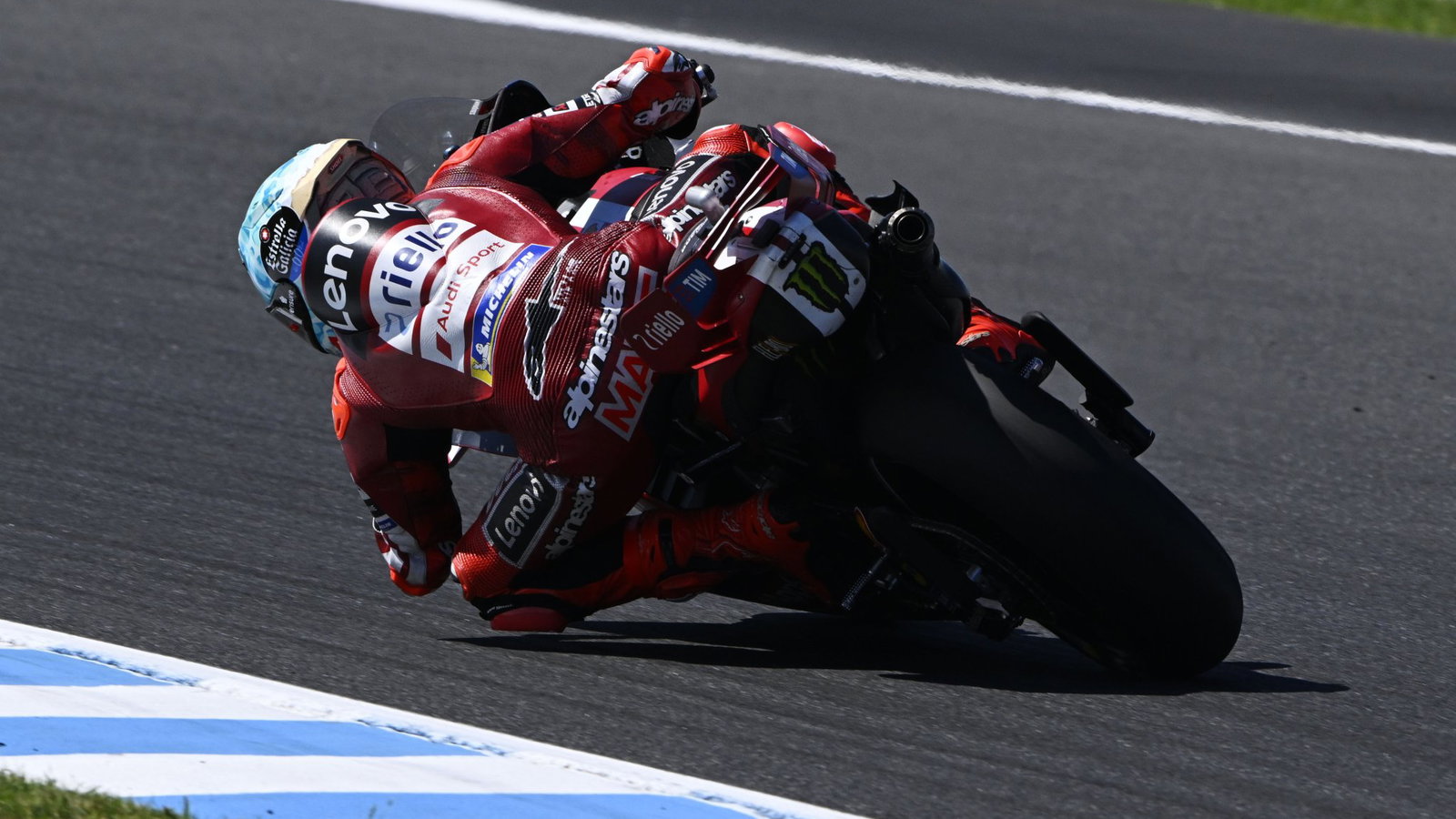
Aprilia controlled the opening day of the Australian Grand Prix at Phillip Island, placing all four RS-GPs inside the top five in Practice. Marco Bezzecchi set the pace with a 1m26.775s lap, but Marc Marquez kept Ducati within reach by finishing third. That result matters in a championship fight in which Marquez and Jorge Martin arrived in Australia separated by only two points.
Friday began in excellent conditions, yet the weather was expected to change sharply during the weekend. Wet tyres were considered highly likely to be needed at some stage. The schedule remained set for qualifying and the sprint on Saturday, followed by the main race on Sunday. Practice itself was interrupted twice by red flags, including one stoppage caused by a wallaby crossing the circuit.
Aprilia starts from the strongest position
Raul Fernandez followed Bezzecchi in second despite still carrying discomfort from the finger injury he suffered at Mandalika. Marquez was third, Ai Ogura fourth and championship leader Martin fifth. Bezzecchi began the weekend 46 points behind Martin, so the opening session gave him an immediate opportunity to reduce that deficit. For Aprilia, the result also suggested that the RS-GP is particularly well suited to Phillip Island’s fast, flowing layout.
That does not settle the race. Marquez remains a significant threat if the track stays dry, while wet conditions could reshape the order entirely. He was fastest in FP1 and spent much of the afternoon Practice session working on long runs, collecting information before the expected weather shift. Marquez won at Phillip Island with Ducati in 2024, and the circuit is one where a rider’s performance can narrow the gap between different machines.
Tyres and a new Ducati aerodynamic device
Marquez’s tyre work provided another indication of how open the dry-race picture remains. He completed 19 laps on the soft rear tyre, while Michelin considered both the medium and soft possible race choices if conditions stayed dry. His average pace was better than Martin’s, although the Aprilia rider was using the medium. Marquez’s immediate championship task is therefore clear: beat Martin without allowing the larger Aprilia group to control the fight.
Ducati also brought new wings for the swingarm, following a concept resembling a solution Aprilia had used at the British Grand Prix. The devices are expected to reduce drag and assist cornering by increasing the ground effect produced by modern aerodynamic fairings. They had been brought to Phillip Island quickly and did not yet have the carbon-fibre finish seen on Aprilia’s version. Marquez described that kind of development as a normal part of racing, arguing that engineers and riders must study rival solutions instead of treating technical progress as simple copying.
Aprilia’s team-order dilemma
Managing four competitive riders becomes increasingly important as the championship reaches its decisive phase. Bezzecchi and Fernandez collided at the start of the Indonesian sprint, while Martin finished third behind Fernandez in the grand prix. Martin’s points carried greater value for the title campaign, but Aprilia has not imposed team orders.
Team manager Paolo Bonora said the riders had been told to take care around one another, while remaining free to race. That approach leaves Bezzecchi free to attack a 46-point deficit and gives Fernandez the same opportunity to pursue a major result. It also means Martin must contend with three Aprilias that are not restricted by an internal order, as well as trying to stay ahead of Marquez.
Martin explained that he is entering corners with too much pressure, as if he were still riding a Ducati. The habit is compromising his turning and wearing the front tyre, echoing problems he had experienced at Aragon. Solving that issue will be important in the next sessions, particularly if the circuit remains dry and the race is decided by small differences in corner entry and tyre management.
The Qatar question gives riders a louder voice
Away from the track, the Qatar Grand Prix has reopened the question of how much influence MotoGP riders have over decisions that affect them. At a meeting in Phillip Island, roughly two-thirds of those present reportedly voted against travelling to Qatar, a region affected by armed conflict. The Grand Prix remained scheduled, while the situation was being monitored and preparations at Lusail were nearing completion.
The meeting was described as civil and organised, in contrast with the low attendance associated with the Safety Commission. Enea Bastianini said riders currently have limited power, while also acknowledging that without them there are no teams and no championship. Phillip Island is therefore hosting more than a close title contest: Aprilia is deciding how to manage four front-running riders, Ducati is responding technically, and the riders are testing whether collective pressure can give them a stronger role.
THE EVIDENCE BEHIND THE STORY
Sources
Spotted something that needs correcting? Contact the editorial team ↗