
King Snake: the Harley built by Alliance High School students
A donated 2020 Street Bob became a functioning custom motorcycle, built by students for The One Moto Show and linked to a proposed education initiative.

6 min read
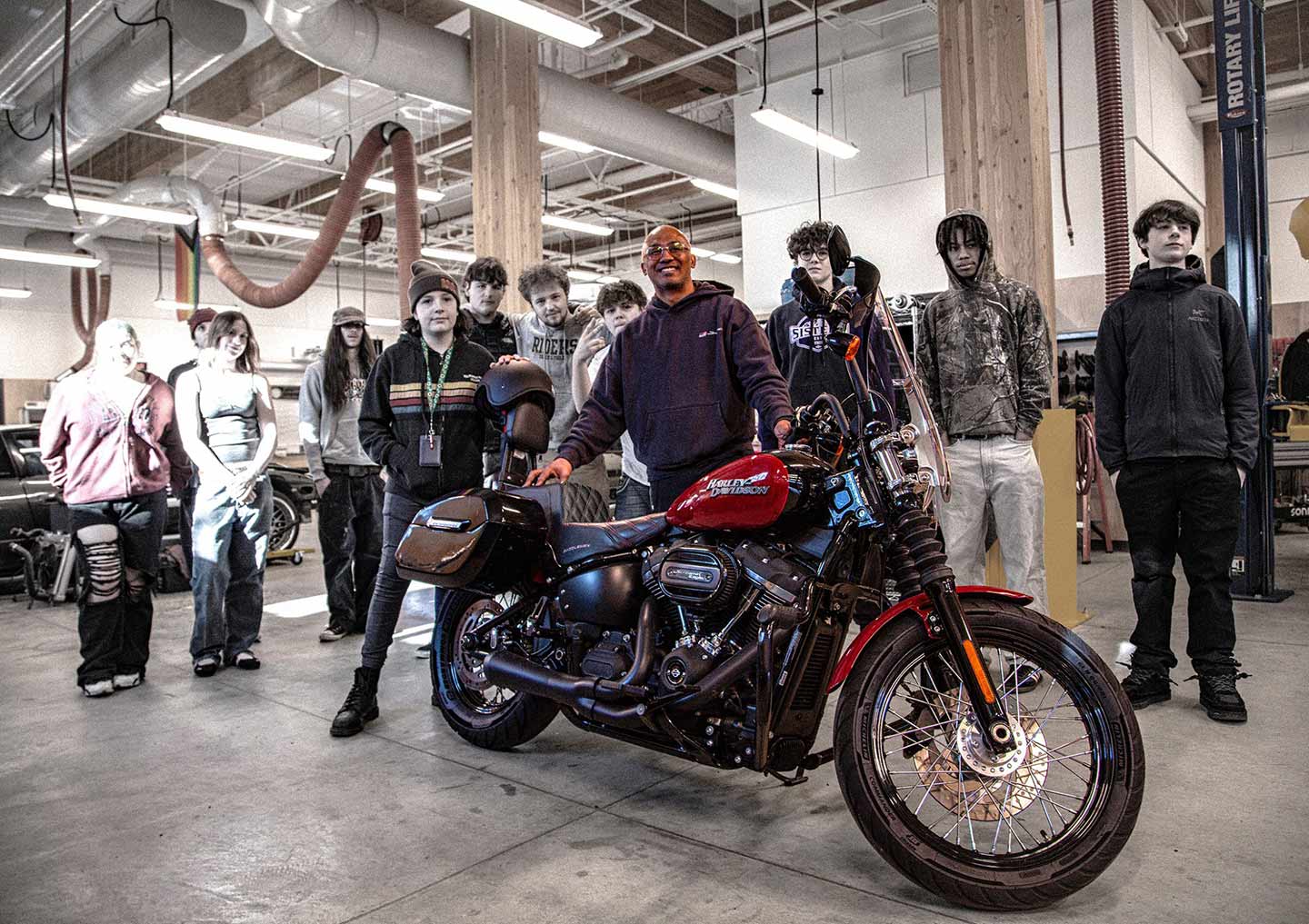
A functioning custom motorcycle built by students at Portland’s Alliance High School was among the prize-winning motorcycles at The One Moto Show, held inside the Zidell Yards Barge building. Called King Snake, the bike was created from a used 2020 Harley-Davidson Street Bob and displayed alongside approximately 300 other builds. The project also became the starting point for HighSchoolHarley, a proposed ongoing education program involving The One Motorcycle Show and Portland Public Schools.
The students attend Alliance High School, located across the river from the show venue. The project brought together the school, teacher Matt Kincaid, Harley-Davidson, mentor Shaun Guardado and show founder Thor Drake. Its purpose was not to produce a model or mock-up, but a working American V-twin motorcycle that the students would design, dismantle, fabricate and complete.
From industrial-arts class to working motorcycle
Kincaid teaches industrial arts at Alliance and builds and races cars. He believes teenagers should learn practical skills such as steel welding before they learn to project confidence they do not possess. Mitch Morse proposed that Kincaid’s students build a custom motorcycle as a class project, explaining that Drake supported the idea and might provide a venue for the finished work.
Kincaid then told his junior and senior students that they would build a custom motorcycle during the semester. Morse had previously worked for Harley-Davidson and used his contacts there to help secure a motorcycle. Harley-Davidson donated the used 2020 Street Bob, giving the class a recognizable base and allowing the students to say they had built a Harley at school.
Before taking the Street Bob apart, the students chose the name King Snake, a reference to the school mascot. They planned the paint scheme around Alliance’s black and blue colors. The project had no budget beyond the donated motorcycle and the support available to the team, so the work depended on the school’s facilities, outside help and the students’ own labor and creative direction.
Kincaid described the project as an opportunity to show students that teachers should also be willing to learn. The class learned how to dismantle a motorcycle, organize as a team and divide the work into one- to two-hour periods. The students already had most of the necessary skills from building cars in the school shop, but applying them to a motorcycle required a different project structure and new forms of problem-solving.
A fabrication course built around King Snake
Shaun Guardado of Suicide Machine Company joined the project as a mentor. The Long Beach, California, custom motorcycle operation is run by brothers Aaron and Shaun Guardado and is known for performance-oriented custom motorcycles. One recent Suicide Machine Company project involved purpose-built Harley-Davidson Pan America 1250 ST motorcycles for racing in the Super Hooligans series.
On the Alliance project, Guardado worked as both fabricator and customizer while leading an intensive introduction to motorcycle fabrication and metalworking. Under his guidance, the students studied design, fabrication, frame-jig geometry and methods for bending metal. They also learned to use different workshop tools, mock up bodywork, dismantle components, 3D-print parts, CNC-machine parts, weld and fabricate components themselves. The students spent months working through the motorcycle’s design, mechanics and fabrication.
Guardado praised Alliance’s workshop, its teachers and the school’s emphasis on recognizing students’ personalities, strengths and aptitudes. Some students were initially intimidated by working on the motorcycle. His approach was to prepare and assist them without doing the work in their place. When one student agreed to perform a task, that willingness encouraged others to participate. Guardado left before King Snake was finished, but the students had a foundation for completing the motorcycle and took responsibility for the remaining work.
The process included digital prototyping as well as conventional workshop skills. Students created components in 3D to check fit and operation before manufacturing them, then programmed the production of parts such as brackets. The headlight bracket began as a student prototype. The students also made the air-cleaner badge and produced a CNC-machined bracket beneath the seat to hold the nitrous bottle. These examples show the range of work covered by the project without establishing a complete list of the motorcycle’s final technical specifications.
From the school shop to The One Moto Show
When the partly finished Harley was shown to Thor Drake, he confirmed that it would be displayed at The One Show. King Snake arrived at the event approximately four months after the first welding began. Drake placed it among professional builds near the Harley-Davidson booth, where it stood alongside roughly 300 other motorcycles. The students worked to a firm deadline and then exposed the result of their work to a public audience.
Drake said that adding an educational element to The One Show was a first for the show team. He wanted young people to learn how to build motorcycles and hoped to help future generations enter the field. He also said that he had initially entered motorcycling without knowing how to perform the relevant work. The Alliance project therefore connected the show’s venue and motorcycle community with a classroom project in which students could develop practical skills and confidence by building a physical object with their own hands and suitable support.
Alliance is a public school structured around project-based career and technical education. In that setting, the motorcycle gave students a defined object to design and build, while the collaboration introduced them to fabrication, organization, teamwork, deadlines and public presentation. The project also challenged the view that school shop classes are obsolete.
The proposed HighSchoolHarley initiative
The Alliance project later developed into HighSchoolHarley, intended to become an ongoing, project-based education program operated by The One Motorcycle Show and Portland Public Schools. The proposed initiative aims to give local high school students practical experience in motorcycle fabrication and design. Those involved viewed expanding the idea as potentially beneficial to vocational schools and the motorcycle industry.
The available evidence does not establish a confirmed launch date or a final operating structure for HighSchoolHarley. It also does not provide King Snake’s full technical specifications, sale price or buyer’s identity. What is clear is the division of responsibility behind the first project: the students supplied the labor and creative direction, the school administration supported the work, Kincaid connected it to the classroom, Drake provided a place to show the motorcycle, Harley-Davidson supplied the Street Bob and Guardado materially influenced its custom character through his mentoring and fabrication expertise.
King Snake was sold to a local business owner on the day it arrived at the show, with the proceeds allocated to the educational program. The program indicated that it would probably use the money to acquire two motorcycle lifts, fabrication equipment and other tools for future builds. The evidence does not say that those purchases had already been made. It does, however, place the motorcycle’s sale within the same educational purpose as its construction: creating resources for students to continue working on real projects rather than treating the build as a one-off display.
THE EVIDENCE BEHIND THE STORY
Sources
Spotted something that needs correcting? Contact the editorial team ↗