
Honda to invest BRL 3.3bn in Brazil and add two Manaus plants
The 2026–2030 programme will raise Honda’s installed annual motorcycle capacity to 2.3 million units by 2029 and create 2,000 jobs.

4 min read
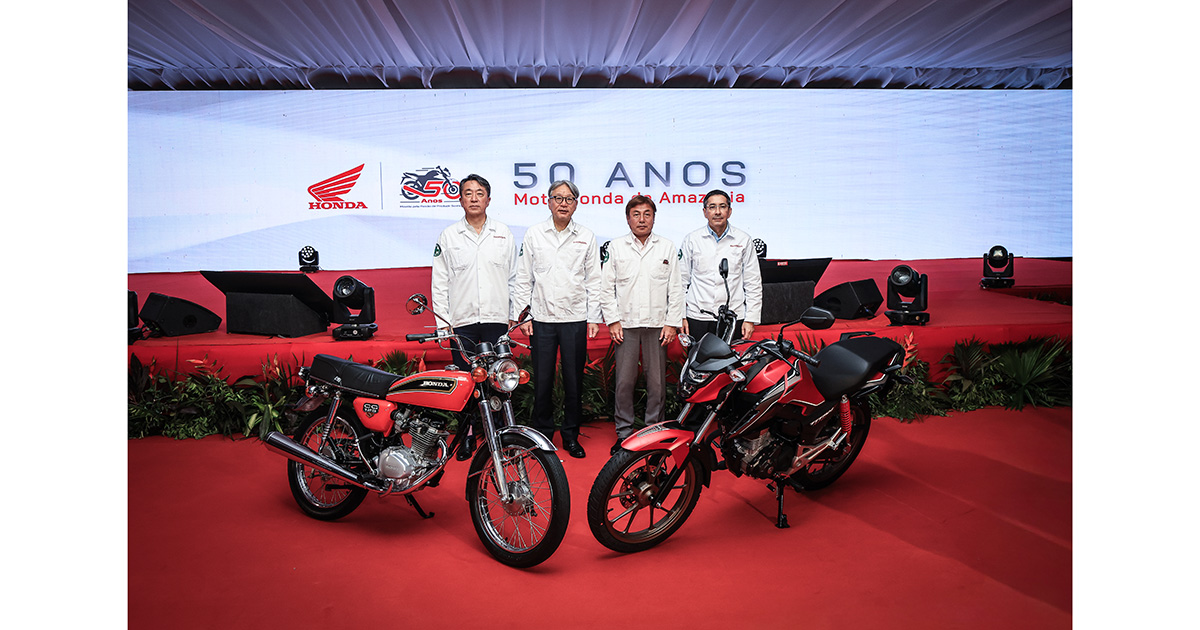
Honda is launching a BRL 3.3 billion investment programme for its Brazilian motorcycle operation, with two new plants planned inside the Manaus manufacturing complex. Running from 2026 to 2030, the programme is designed to lift installed annual production capacity to 2.3 million motorcycles by 2029 and create 2,000 jobs. The investment comes on top of the BRL 1.6 billion Honda announced the previous year.
Honda announced the plan on November 5, 2026, at a ceremony in Manaus, Amazonas state, held to mark 50 years of motorcycle production in Brazil. The expansion is intended to support the company’s response to demand in the Brazilian market while strengthening the competitiveness of its local manufacturing operation. Honda also presents the initiative as part of its longer-term contribution to mobility, employment and economic development in the country.
Two more plants in the Manaus complex
The project is more extensive than a simple increase in final assembly. Honda will construct two new plants within the existing manufacturing complex, and each will have its own assembly line together with the manufacturing processes needed to support production. The Manaus factory currently operates four assembly lines distributed across two production plants. Once the expansion is in place, the site’s installed annual capacity is expected to reach 2.3 million motorcycles by 2029.
The additional output will be supported by 2,000 new jobs, giving the investment a significant regional employment dimension. Honda’s Manaus operation already employs 9,200 people directly. The company says the project will reinforce the industrial base that has developed around the factory and help sustain activity across its wider Brazilian value chain.
A vertically integrated motorcycle operation
Honda began manufacturing motorcycles in Brazil in 1976, following its strategy of producing vehicles close to the markets where demand exists. During its first five decades, the Manaus plant produced more than 33 million motorcycles. It now turns out approximately 7,200 motorcycles per day and manufactures a range of 20 models, from 110cc to 1,100cc.
The facility is responsible for all Honda motorcycle production in Brazil. Honda describes it as the most vertically integrated motorcycle production facility within the Honda Group worldwide. In this context, vertical integration means that much of the final product is made internally rather than being limited to vehicle assembly. The Manaus site produces key components including frames, wheels, seats and engines, alongside assembling complete motorcycles.
Production serves the Brazilian market and also supports exports to 19 countries, among them the United States, Australia and Mexico. The operation includes a Development and Technology Center responsible for product, process and manufacturing-engineering activities. Honda’s Brazilian industrial network further includes more than 1,200 dealerships nationwide and over 120 direct suppliers, extending the plant’s economic impact beyond Amazonas.
Investment tied to the Amazon region
Honda established the factory in the Manaus Free Trade Zone, which the company associates with local industrialisation, the creation of qualified employment and the development of a skilled workforce. Over the past five decades, it says the operation has continued to receive investment in technology, innovation and professional development, and has gained recognition within Honda’s global organisation.
The company also links its Brazilian activities with environmental sustainability, community development and road safety. Its stated initiatives include industrial eco-efficiency measures, safety technologies for its products and rider education programmes delivered through Honda Traffic Education Centers, known as CETH. These activities sit alongside the production expansion rather than replacing its central manufacturing focus.
Toshihiro Mibe, president, CEO and representative director of Honda Motor Co., described the Manaus factory as one of the core facilities in Honda’s global motorcycle operations. He credited the site’s productivity, quality and manufacturing efficiency, as well as the contribution of customers, business partners and employees, and said Honda would continue investing in Brazil’s future, mobility and local economic development.
Keisuke Tsuruzono, president of Moto Honda da Amazônia Ltda., said the new investment reflects Honda’s confidence in the future of Brazil, the Amazon region and the company’s business. He connected the capacity expansion with the plant’s competitiveness and said Honda would continue working to provide products and services intended to exceed customer expectations. For Manaus, the result is a larger production platform built on an operation that already combines assembly, component manufacturing, engineering, exports and workforce development.
THE EVIDENCE BEHIND THE STORY
Sources
Spotted something that needs correcting? Contact the editorial team