
EICMA 2026: the market matures and technology moves downrange
Supersports remain the showcase, Chinese brands climb in capacity, A2-friendly models multiply and radar reaches more motorcycles.

4 min read
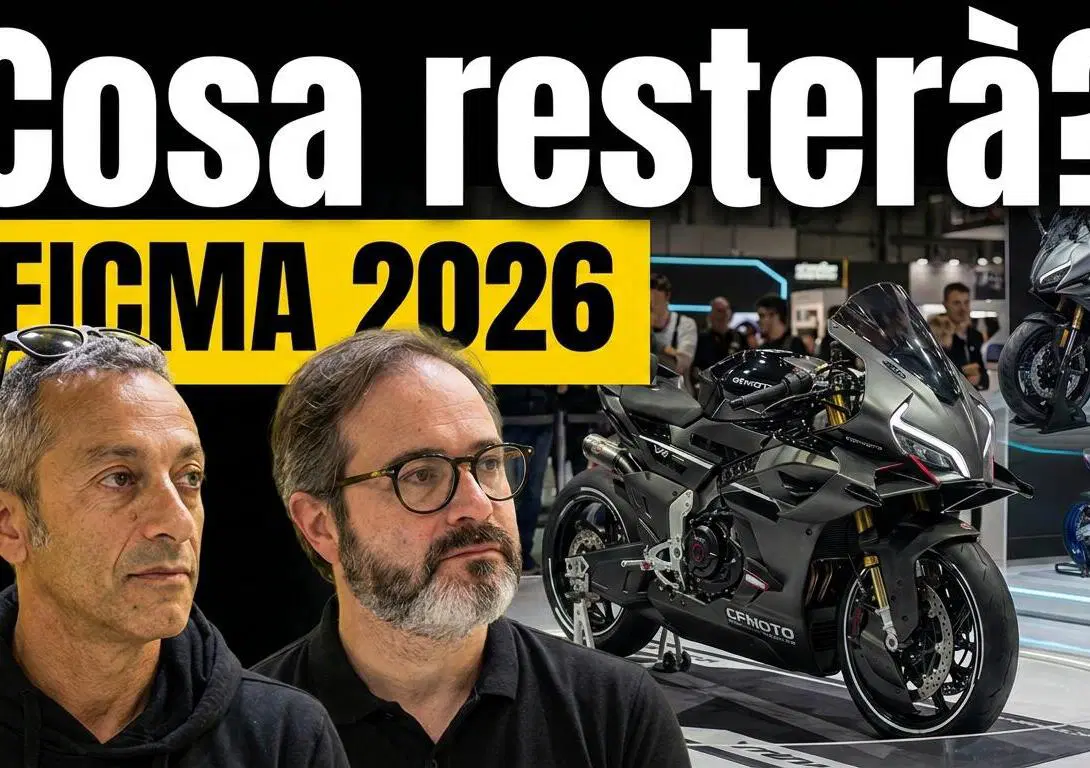
EICMA 2026 ended with record scale: ten halls at Fiera Milano Rho, more than 2,100 brands and over 300,000 square metres of exhibition space. The product story was less revolutionary. Instead, the show described a motorcycle market refining familiar ideas, widening their audience and moving advanced equipment into more accessible segments. After recent displays of increasingly varied engine layouts, manufacturers largely chose evolution over spectacle—but the resulting direction was still easy to read.
Supersports still carry the technology message
Supersport motorcycles are not major volume sellers, yet they remain the clearest place for a manufacturer to display its engineering ambition. Honda presented a deeply revised CBR1000RR-R Fireblade for 2027, developed with HRC and offered in three versions. The range now includes the new HRC Works Edition, giving the flagship an especially direct link to Honda’s racing expertise.
CFMOTO made a similarly important move with the V4SR-RR. The motorcycle has progressed from prototype to production form, producing 210 CV and using adaptive aerodynamic winglets. Dealership arrival is expected during 2027. Its importance is not limited to the specification sheet: Chinese manufacturers are now seeking visibility in the highest-performance part of the market, rather than concentrating only on smaller motorcycles.
China climbs in capacity as established brands lower the entry point
The show’s clearest industry-wide pattern was the contrast between these two directions. Chinese brands are moving beyond the familiar A2 territory and towards larger capacities, while established manufacturers are lowering the price barrier to attract new riders. BMW showed the F 450 R and F 450 RR at €6,690. Triumph extended the Bonneville name into its 400 family with the T40, while Harley-Davidson positioned the Sprint 440 below €6,000 and described it as the least expensive Harley-Davidson in decades.
China and India are not pursuing the same European strategy. Chinese companies are pushing upwards in engine capacity. Indian manufacturers, supported by strong domestic markets, are using Europe to establish themselves, seek margin or strengthen their image rather than simply chase volume. Royal Enfield is following its own route, while TVS and Hero appear closer in approach to the European market. Across these different strategies, value for money, robustness and reliability remain recurring advantages.
As the hardware converges, design has to speak louder
Parallel-twin engines and increasingly similar equipment packages make it easier for motorcycles to blur into one another. Design is becoming an important counterweight. The Morbidelli T802 family and the Moto Morini Camel stand out as adventure examples with a more recognisable visual identity. The Camel also brings a new 670 cc twin-cylinder engine to the formula.
Yamaha’s RW700 was one of the show’s most debated new motorcycles. It combines an adventure brief with strong scooter influences, the 689 cc CP2 twin and a Y-AMT transmission, while the smaller RW350 joins the range. The concept surprised visitors expecting another Ténéré, but it fits the growing idea of medium- and large-capacity scooters with touring ability. For riders coming from a TMAX, the RW700 is presented as a possible next step rather than a conventional adventure motorcycle.
Radar assistance reaches further into the range
Radar and ARAS technology are moving beyond the most expensive motorcycles. Honda’s Africa Twin Adventure Sports has Honda Sensing Ride, while the new Triumph Tiger 1200 adopts comparable assistance technology. Electric Ultraviolette motorcycles combine radar with a dual dashcam. The Voge R800 is another significant example: a mid-capacity Chinese motorcycle associated with this type of equipment. The broader direction is towards wider access to rider assistance, even though the technology has not become universal across the market.
Honda’s V3 remains unfinished business
The Honda V3R 900 E-Compressor appears closer to production, while its power output and prices are still pending. Alongside it, the sporting V3 concept without a compressor points to a different interpretation of the idea: performance motorcycles using more approachable capacities and performance targets, with the potential to reach a broader audience.
That combination defines EICMA 2026. The event was the biggest yet, but its manufacturers mostly worked through refinement, positioning and gradual technology transfer. Supersports continue to carry the image of technical ambition, Chinese brands are climbing in capacity, established names are seeking a lower entry point, and motorcycles such as the RW700 and Honda’s V3 show two very different ways of creating space in a crowded market.
THE EVIDENCE BEHIND THE STORY
Sources
Spotted something that needs correcting? Contact the editorial team