
AGV Pista GP R3 puts Sphera rotational-force system on the shell
The new track helmet uses more than 1,600 micro-spheres to address rotational forces in oblique impacts.

4 min read
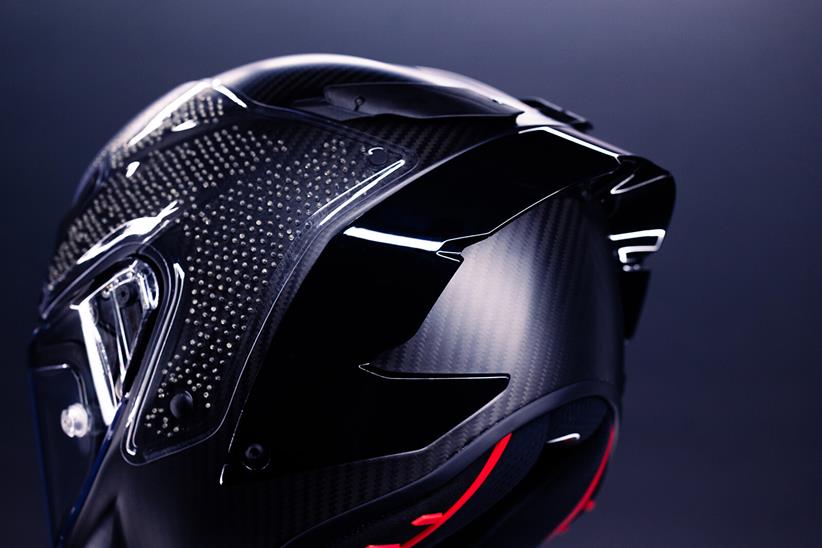
AGV has revealed the Pista GP R3, a new track-focused helmet that takes a different approach to rotational forces from systems usually placed inside a helmet. The model appeared at the San Marino MotoGP round on September 11–13 and represents the first major update to the Pista family since 2019. AGV has not announced when it will become available to the public.
The technology is called the Sphera AGV system. More than 1,600 plastic micro-spheres, each 2 mm in diameter, sit above the outer carbon-fibre shell. An additional polycarbonate shell holds them in place. During an oblique impact—one that is not delivered straight on—the secondary shell is designed to detach while the spheres roll. The aim is to reduce the rotational forces transmitted to the rider’s head.
The spheres are bonded in position to prevent high-speed rattling and to stop them spilling onto the circuit if a crash occurs. Sphera panels are positioned around the forehead and at the sides of the head, beside the visor mechanism. Massimo Varese, AGV’s Chief Research and Development Officer, says those areas account for roughly 75% of impacts. The rear is treated differently because it already has a spoiler designed to come away in a crash.
What Sphera is designed to do
AGV says the design can be up to six times more effective at managing rotational forces. The company also says laboratory tests by the Aragon Institute for Engineering Research at the University of Zaragoza showed up to a sixfold reduction in concussion risk. These are claims attributed to AGV, rather than independent findings presented here.
The principle concerns the different movement of the brain inside the skull. During an oblique impact, the helmet and skull can rotate faster than the brain, which is suspended in cerebrospinal fluid. That difference in movement increases strain and the risk of serious injury. Sphera is intended to limit this transfer of movement from the earliest stages of an impact.
RLS, the London-based company that worked with AGV, stresses that the panels do not detach in every crash. RLS Advisor Greg Shapleigh says activation occurs within a specific force range and requires a fair amount of mass behind the impact point. RLS had previously worked on bicycle helmets including the £159.99 Canyon Deflectr and £150 Hexr Miden. The technology was refined after its original creation at the University of Oxford.
Aerodynamics and helmet details
Putting the system on the outside of the helmet created aerodynamic requirements as well. AGV says it studied the cover’s behaviour at speeds up to 360 kph, along with the lateral forces generated when a rider is at a significant lean angle. The rear aerodynamic spoiler was redesigned and now has a series of jagged cut-outs. Development combined wind-tunnel work with on-track testing by MotoGP riders.
Development took around three years and more than 28,000 hours. AGV says the Pista GP R3 weighs no more than the Pista GP RR. The visor reaches 5 mm in thickness in some areas, while its opening mechanism has greater retention force intended to reduce the possibility of opening in a crash. The helmet meets the FIM FRHPhe-02 racing standard both with the Sphera system installed and without it.
AGV also says the new solution has not increased noise compared with the previous helmet. Work focused on the comfort padding, a small chin spoiler and ribbing at the base of the cheek pads. These measures accompany the aerodynamic development without changing the model’s fundamental track focus.
Testing through Project Apex
Before its appearance at the San Marino MotoGP round, the Pista GP R3 was shown at Misano on August 24 during Dainese’s Project Apex event. Riders from several classes, including Valentino Rossi and Marco Bezzecchi, tested the helmet alongside new leathers, gloves, boots and base layers. More than 95 equipment configurations were tested during the day, with feedback passed to a group of around 50 Dainese engineers.
The purpose of Project Apex is to let riders focus their attention on equipment. AGV notes that during official race events their attention is divided between the motorcycle and the competition, while a dedicated development day allows them to assess product details. Everything tested had already undergone up to 18 months of development in laboratories and on real circuits, although that does not mean every tested element will reach production.
The Pista GP R3 is therefore more than another change to a racing helmet’s padding. Sphera moves the proposed oblique-impact management to the outer surface, using a system that activates only under specific conditions. AGV is also seeking to retain the helmet’s weight, aerodynamic behaviour, noise control and FIM certification. Public availability and related commercial details have not yet been announced.
THE EVIDENCE BEHIND THE STORY
Sources
Spotted something that needs correcting? Contact the editorial team ↗