
Italy sells more helmets, but the market loses value
Helmet sales rose in the first half of 2026 while turnover declined. Jet, composite and modular categories show where the market is moving.

3 min read
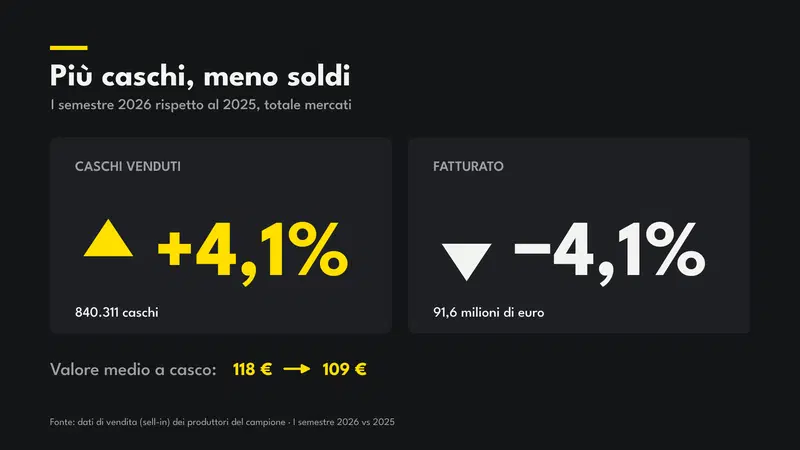
Italy’s helmet market grew in units but not in value. Manufacturers sold more than 840,000 helmets during the first half of 2026, up 4% on the same period of 2025. Over that period, however, turnover dropped by 4%. In practical terms, the average helmet leaving the factory was worth less than it had been a year earlier.
That does not make every budget helmet unsafe. It does point to a market in which price is carrying more weight, making approval, fit and intended use especially important when choosing protective equipment.
Jet helmets remain especially strong in Italy
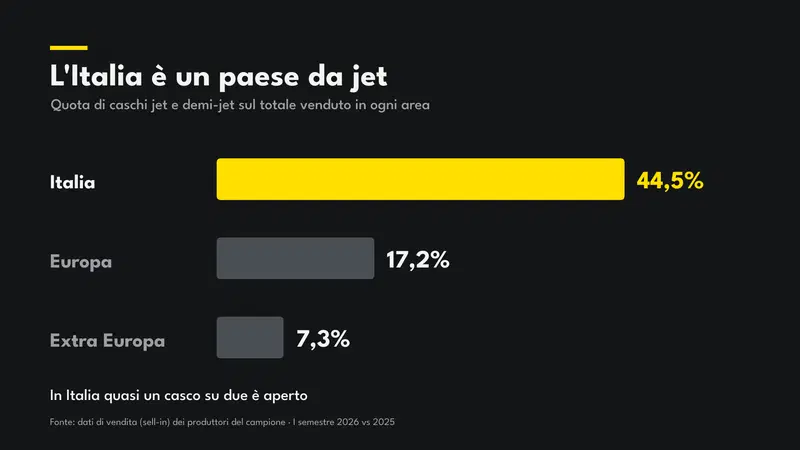
Roughly one in every two helmets sold in Italy is a jet helmet. Across Europe, the equivalent share remains below one in five. Convenience, ventilation and a lower price help explain the gap, particularly for urban travel and scooter use.
Popularity does not make every jet helmet the same, though. The category includes products selected largely for their appearance, while a sensible purchase should begin with the protection offered and the riding the helmet is meant to support.
Composite helmets diverge from the European trend
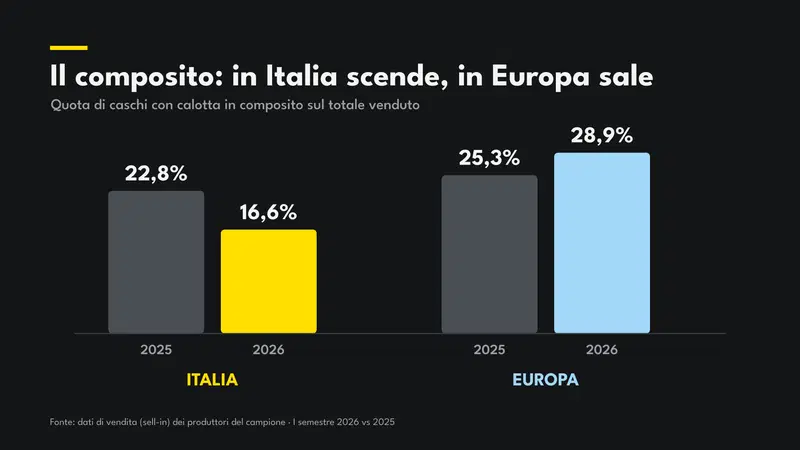
The clearest split concerns composite helmets, whose shells may use fibreglass, aramid or carbon fibre. Sales of composite full-face helmets in Italy fell close to half their level a year earlier. Europe moved in the opposite direction, with composite-helmet sales increasing over the same comparison.
That does not automatically make a thermoplastic helmet an inferior choice. A good thermoplastic helmet can pass the same ECE 22.06 approval tests as a composite one. The differences riders are most likely to notice concern weight, finish and service life.
Modulars are becoming an everyday option
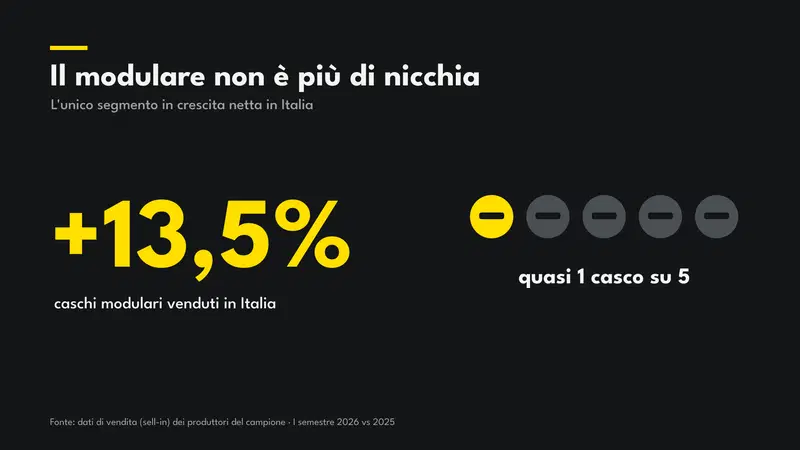
Modular helmets are the only category showing clear growth, approaching one in five helmets in the market. Once associated mainly with more mature touring riders, they are increasingly positioned as a practical compromise for everyday use. The P/J dual approval is not present on every modular, so it should be checked before purchase. A modular that is kept open all the time is, in effect, a heavier jet helmet.
The checks that matter before buying
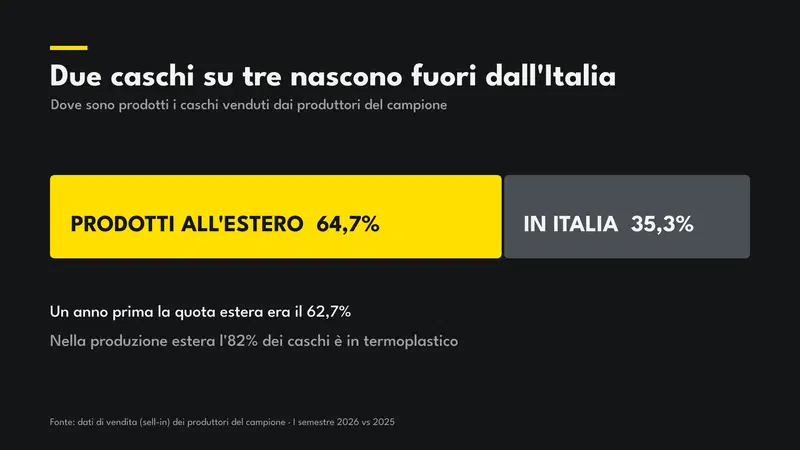
An “Italian” label is not enough to establish where a helmet was manufactured. Two out of three helmets from the manufacturers examined are made in factories outside Italy. For the buyer, more useful checks are the approval label on the strap, the correct size and the way the helmet fits the head. Replacement timing also matters, even when the outside still appears undamaged.
The market’s direction is therefore two-sided: unit sales are rising while value is falling. Jet helmets remain unusually prominent in Italy; composite full-face helmets are losing ground there while growing across Europe; and modulars are gaining space as an everyday solution. The purchase decision should start with approval, size and real-world use—not just price or graphics.
THE STORY IN PHOTOS
6 photos
THE EVIDENCE BEHIND THE STORY
Sources
Spotted something that needs correcting? Contact the editorial team