
Talan Skeels-Piggins breaks 200 mph on a turbocharged Hayabusa
The British paraplegic rider recorded 200.254 mph over a standing-start measured mile at Elvington after an 11-year project to build a bike around his needs.

5 min read
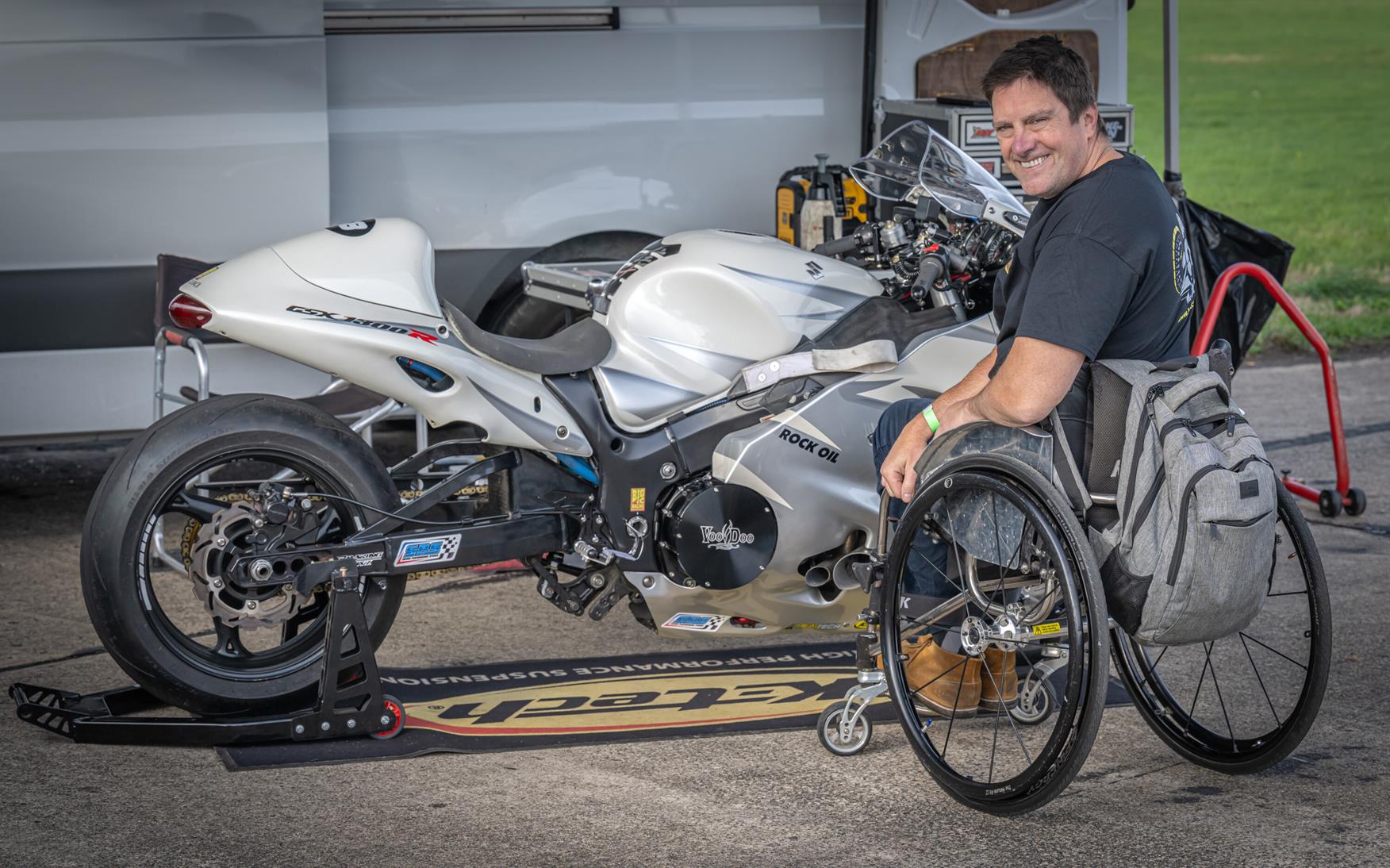
Talan Skeels-Piggins has become the first paraplegic rider to exceed 200 mph over a measured mile from a standing start. At Elvington Airfield, just outside York, the British rider reached a recorded 200.254 mph on his fifth and final run of the day, riding a turbocharged Suzuki Hayabusa. Rain and strong winds restricted the team to roughly four usable hours that afternoon, making the successful pass the culmination of an 11-year effort marked by setbacks, injuries and funding problems.
Skeels-Piggins was paralysed from the chest down after a motorcycle accident in 2003. He controls the Hayabusa with his upper body and arms, and said that decelerating the bike concerned him more than accelerating it. He ultimately decided to confront that fear and make the attempt, after years in which he felt the project had never had a motorcycle capable of giving the target a proper chance.
A Hayabusa built around the rider
The speed project began in 2015, when Skeels-Piggins was given a Hayabusa that needed repair. A modest engine tune, open exhausts and a thorough service were enough to produce 175.630 mph, which was a record at the time. Following a series of difficulties, the project was put on hold until early 2025. A conversation with motorcycle engineer and racer Lee Baxendale then restarted the plan, leading to a partnership involving Baxendale and his son Jay through Mainline Motorsports.
Lee Baxendale devoted more than 600 hours to developing the motorcycle. The chassis was lowered and lengthened, while the rear suspension received a Nitron shock and K-Tech prepared the forks. Specialist footpegs and Velcro straps held Skeels-Piggins’ legs in position during the run. An air shifter allowed him to change up by pressing the horn, reducing the number of additional controls he had to operate while accelerating.
The turbocharger was a late-stage decision rather than the foundation of the build. Baxendale initially developed a naturally aspirated configuration with an open intake and exhaust, while also considering nitrous oxide as a way to reach the required speed. The turbo route became possible when he bought a complete motorcycle from Sean Mills of Big CC Racing. He removed its turbo system, sold the donor bike and remaining parts, and also sold the nitrous components to help finance the conversion.
Baxendale described the result as close to a ground-up build, but not an especially expensive one. Before the turbocharger was fitted, the Hayabusa had already been set up for quarter-mile running in naturally aspirated form. That staged approach allowed the team to develop the chassis and riding arrangement before adding the power system intended for the 200 mph attempt.
Four hours to deliver the run
The weather turned the attempt into a race against the clock. Rain disrupted the programme at Elvington, leaving the team with an afternoon window of approximately four hours. The pressure had also increased a month earlier, on August 15, when South African rider Sampie Erasmus recorded 198.217 mph on a Suzuki GSX-R1000. That run moved the 200 mph target from an ambitious personal goal to an immediate benchmark for the Elvington team.
Lee and Jay Baxendale were present at the start line, along with Bike Experience instructor Daniel Elliott. The three helped keep Skeels-Piggins and the motorcycle upright before the launch. The final pass was completed despite the difficult conditions and a technical issue with the bike, according to Lee Baxendale. When the radio message began with the number two, Skeels-Piggins knew the target had been reached and burst into tears.
For Skeels-Piggins, the achievement was not primarily about public recognition. He said he would have been satisfied with any result beginning with 200, explaining that the goal was to reach the speed for himself rather than to claim a particular accolade. The emotional response reflected both the result and the years spent trying, running out of money, recovering from injuries and waiting for the right opportunity to make a serious attempt.
Those injuries have been a recurring part of his racing story. Skeels-Piggins has described shattered legs, a badly damaged left leg, a fractured pelvis and sternum, a lost finger and broken thumbs. Recovering from such injuries was especially difficult while also living with paraplegia and relying on his arms for everyday mobility. His concern about slowing the Hayabusa therefore formed part of a broader history of physical risk, rather than a minor detail of the record attempt.
A project with a wider purpose
The Elvington run adds another milestone to Skeels-Piggins’ sporting career. In 2012, he became the first paraplegic motorcycle racer to compete against non-disabled riders. Two years earlier, he had represented Great Britain as a skier at the Vancouver Paralympic Games; he had decided to learn to ski and pursue that objective only eight days after becoming paralysed.
He also founded The Bike Experience charity in 2011. Working with its team, he has helped more than 550 people with physical impairments experience motorcycle riding again. That work gives the Hayabusa project significance beyond its headline speed. The machine was not simply modified for more power: its chassis, suspension, controls and rider-retention system were progressively adapted around the person who had to operate it with his upper body.
The 200.254 mph pass therefore closes a long-running project on several levels. It delivered the standing-start measured-mile target, demonstrated the effectiveness of the specially arranged controls and turned a heavily delayed ambition into a completed run. For Skeels-Piggins and the Baxendale team, the number on the timing equipment was the visible result of a much longer process of rebuilding the motorcycle, finding the money to continue and creating the conditions in which the rider could finally give the attempt his best chance.
THE EVIDENCE BEHIND THE STORY
Sources
Spotted something that needs correcting? Contact the editorial team ↗