
Honda CB1000F brings CB750 and CB900F spirit into the present
Honda’s new naked bike combines F-series design cues with a Fireblade-family engine, a diamond frame and contemporary electronics.

4 min read
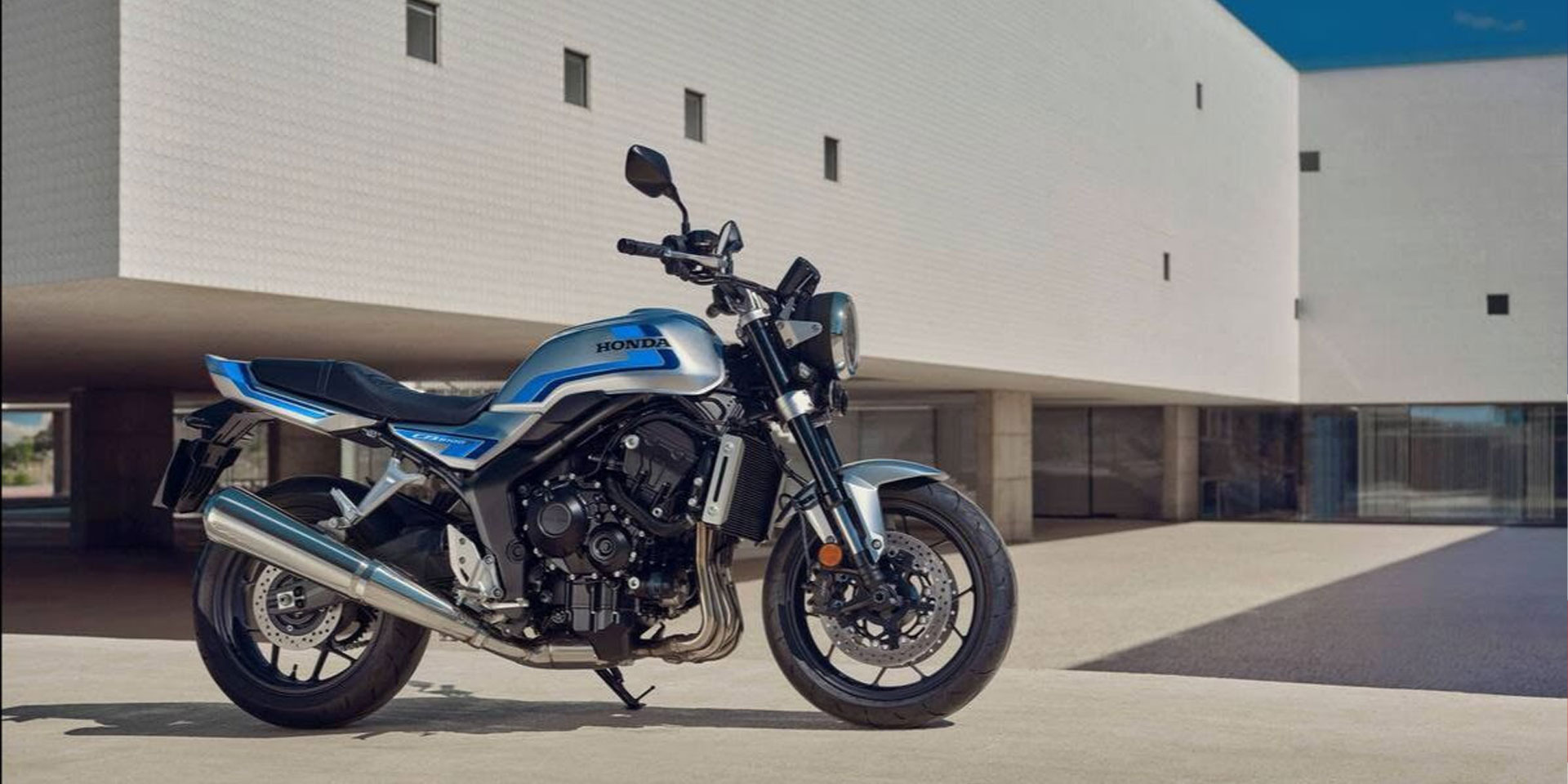
Honda is bringing the CB1000F to its dealerships across Europe, presenting the new naked motorcycle as a modern interpretation of the company’s CB750 and CB900F heritage. Its styling looks back to the 1970s and 1980s, but the mechanical package belongs firmly to the present, with an engine from the Fireblade family, a diamond-type frame, advanced suspension and an extended suite of electronic systems. Honda originally developed the bike as a versatile, everyday roadster for the Japanese market rather than as a literal recreation of either classic CB.
The project was overseen by Takayuki Haramoto, Honda’s Large Project Leader. He had previously worked on the 2023 CB750 Hornet and XL750 Transalp, and describes the CB1000F as an attempt to define what a simple, useful naked roadster for Japan should be. The historical starting point was not limited to showroom motorcycles: the design also draws from the Honda CB750 ridden by Freddie Spencer in AMA Superbike in 1981, when the racer known as “Fast Freddie” was competing with Honda.
A modern reading of the F-series
The CB1000F’s visual language belongs to the F-series and its association with Bol d’Or. The name recalls the FIM 24-hour endurance race, while the period CB750 and CB900F combined café-racer styling with strong engines and genuine competition influence. They were production motorcycles that incorporated technology from Honda’s RCB1000 endurance racer, giving their racing connection more substance than a simple retro styling exercise.
Honda’s designers treated the fuel tank and tail as one continuous composition, following the visual logic that made the older machines distinctive. Simple forms and clean surfaces shape a compact, forceful front section, while the rear is lighter and designed to remain practical. The intended balance is deliberate: the CB1000F should have the presence expected from a large motorcycle without sacrificing the approachable handling associated with the CB name.
That brief required more than transferring old shapes onto a new motorcycle. The CB models from the late 1970s and 1980s used double-cradle frames, horizontal air intakes and far less electrical equipment. The CB1000F instead uses a diamond frame, a down-draft intake and substantially more electronics. Haramoto says the difference in frame architecture made the characteristic fuel tank particularly difficult to develop around the modern platform. Even familiar-looking details therefore had to be reconsidered at an engineering level.
The engineer behind the project
Haramoto’s connection with motorcycles began before his Honda career. His first contact with one was his father’s Monkey, while the manga Baribari Densetsu strengthened his interest; its protagonist begins with a CB750F. He later explored mountain roads by motorcycle. At Honda, his work on the CB750 Hornet and XL750 Transalp brought him into contact with Masatoshi Sato, the Large Project Leader for those models and for the CBR1000RR Fireblade.
His influences are not confined to motorcycle designers. Haramoto cites Fender Stratocaster and Jazz Bass guitars, as well as the motorcycles shown in the 1988 animated film Akira. Outside work, he enjoys relaxed motorcycle rides, guitar and modular synthesizers, and he says he rides a Honda NM4. Those interests help explain why the CB1000F is intended to convey a period and an atmosphere rather than reproduce a historical motorcycle component by component.
Asked which older motorcycles he would choose to ride, Haramoto points to a Kawasaki Z1 or Z2, or a Honda CB750/900F, during the 1970s, when those machines were at the height of their racing development. His interest is not simply in operating an old model today; it is in experiencing the energy surrounding those motorcycles at that moment. The CB1000F follows the same idea in modern form, pairing the F-series identity and period-inspired proportions with current engineering, performance and technology.
THE EVIDENCE BEHIND THE STORY
Sources
Spotted something that needs correcting? Contact the editorial team ↗