
Why Márquez’s Qatar runner-up finish meant so much to Ducati
Marc Márquez won his 10th Sprint of the season before managing a difficult Grand Prix into second place, while Pecco Bagnaia suffered two right-foot fractures in the Sprint.

3 min read
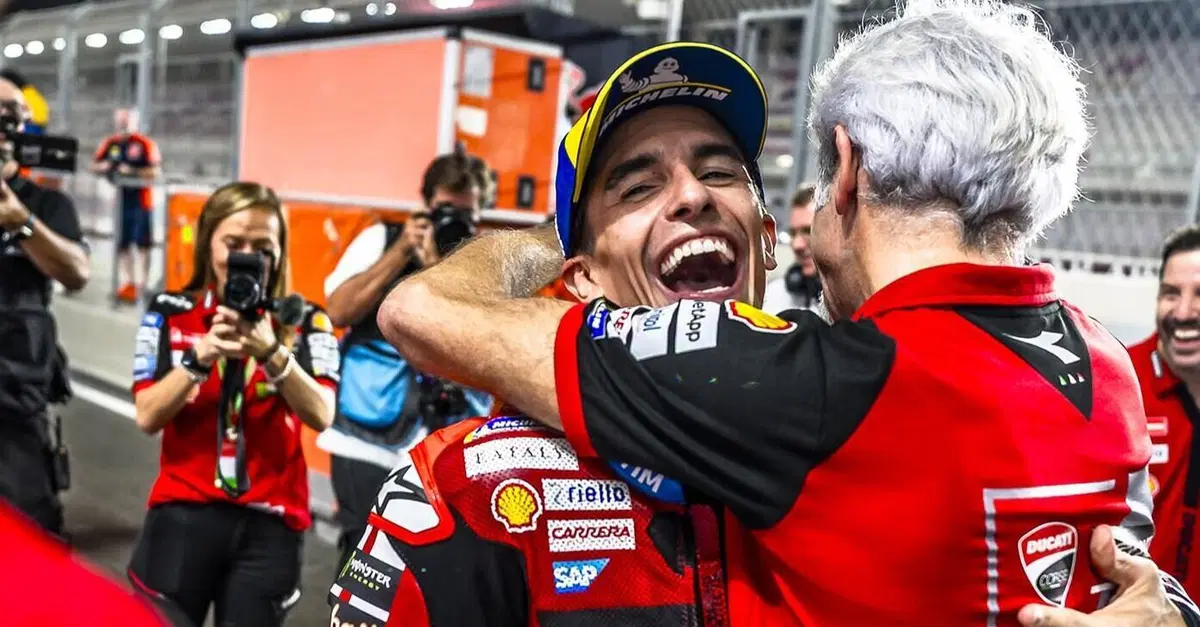
Marc Márquez’s Qatar weekend had two very different highlights: victory in the Sprint and second place in Sunday’s Grand Prix. The Sprint win was his 10th of the season, but Gigi Dall’Igna considered the runner-up finish in the longer race especially significant. In his assessment, Márquez produced a major result even though the circumstances were not initially the most favourable for him.
Dall’Igna, Ducati Corse’s general manager, focused on the way Márquez adapted his approach as the race unfolded. The Ducati rider did not rely exclusively on his usual attacking instincts. He spent the first half managing his pace and tyre wear, then increased the speed in the second half. That change brought a progressive recovery, the fastest lap and ultimately second place.
The performance mattered because it showed more than outright speed. Dall’Igna described Márquez as a rider capable of selecting the right tool for the situation: aggression and fighting instinct when those are needed, or a more calculated strategy when it offers the better route to the result. That ability to read the race in real time was, in Ducati’s view, the defining feature of his Qatar Grand Prix.
A strong start for Bagnaia ends in a costly crash
The Qatar Sprint also changed Ducati’s weekend for the worse. Pecco Bagnaia had looked fast, precise and competitive from the first free-practice sessions. Dall’Igna believed he had the pace to fight with the strongest riders in the leading group, but that possibility ended during the early stages of the Sprint after contact with another rider.
Bagnaia was thrown from his motorcycle in a crash that Dall’Igna described as violent and not the Italian rider’s fault. The injury was diagnosed as two fractures to his right foot. He subsequently underwent surgery in Turin, which was completed successfully. Dall’Igna’s comments about the injury had been made before the operation, so the timing of Bagnaia’s return to racing was not yet known in that assessment.
Dall’Igna nevertheless hoped to see Bagnaia back with the team for the final two events of the season. The injury therefore became the main negative element of a weekend in which Ducati had otherwise collected a Sprint victory and a Grand Prix podium finish through Márquez.
Ducati still has work to finish
For Dall’Igna, Márquez’s second place carried the character of a victory because it came from disciplined execution rather than a straightforward display of superiority. The race was less spectacular than the Sprint, but its importance was greater in the way Márquez managed the tyres, waited for the right moment and then converted his pace into a decisive recovery.
The result also came at a crucial point in the championship. Ducati still has two events to complete, and the Constructors’ Championship will be decided across those final appointments. Márquez’s double result in Qatar gives the team substantial momentum, but Dall’Igna stressed that the job is not finished. Ducati’s final objective remains to complete the campaign strongly while respecting the work of its team, its rivals and its supporters.
THE EVIDENCE BEHIND THE STORY
Sources
Spotted something that needs correcting? Contact the editorial team