
Imola 1983: Roberts won the race, Spencer won the title
Kenny Roberts needed victory and help from Eddie Lawson. He got the first, but Freddie Spencer held on to become the youngest 500cc champion.

5 min read
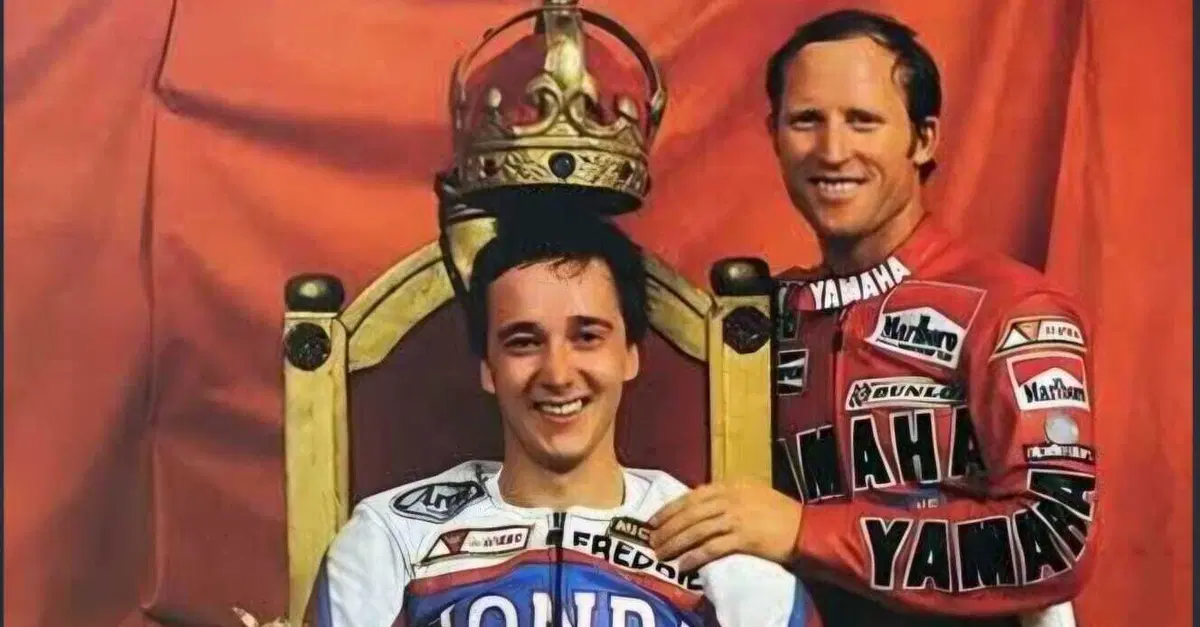
The 1983 500cc World Championship went down to its final afternoon at Imola, where Kenny Roberts achieved the result he needed for himself but not the one required for the title. Roberts won the San Marino Grand Prix on 4 September, yet Freddie Spencer finished second and retained the championship by two points. At 21 years and 258 days, the Honda rider became the youngest 500cc champion.
Imola was the twelfth and final round of a shortened season. Only twelve races were held: the South African Grand Prix at Kyalami had been added, while Argentina was cancelled for financial reasons and Finland and Czechoslovakia were dropped because of the danger associated with their circuits. After eleven races, Spencer arrived with six victories and a five-point lead over Roberts, who had won five times. The two Americans had dominated the season on a Honda NS 500 and Yamaha OW70 respectively.
Roberts therefore needed to win and push Spencer down to third place or lower. The points available were 15 for victory, 12 for second and 10 for third. Eddie Lawson, Roberts’ Yamaha team-mate and a 500cc rookie in his first season in the class, also needed to finish ahead of Spencer. Lawson was riding in the same team associated with Giacomo Agostini, and his result could determine whether Roberts’ final championship challenge succeeded.
The stakes were personal as well as sporting. Roberts had already decided to retire from Grand Prix racing and had brought his sons, Kenny Jr and Kurtis, to Imola for what he regarded as his last European race. He explained that the boys lived with his former wife in California and that continuing in the World Championship would leave him too little time for them. Their presence gave the finale the character of a farewell even before the title was decided.
A race shaped by the start
Roberts took pole position ahead of Spencer, but starts in that period were made by riders pushing their motorcycles into motion. The two Hondas reacted more effectively and moved ahead, while Marco Lucchinelli also launched quickly. Roberts needed until the fourth lap to get past Lucchinelli. On lap eight he made his decisive move on Spencer under braking for the Tosa, taking control of the battle in front of roughly 80,000 spectators.
The pass did not end the contest. Over the next nine laps, Roberts and Spencer exchanged positions four more times. Roberts deliberately varied his pace at the Tosa, through the chicanes and on the approach to Acque Minerali, slowing enough to give Lawson a chance to close the gap. The tactic was clear: a Yamaha rider in front of Spencer could have transformed Roberts’ race win into a championship win.
Lawson, however, could not reach the position Roberts needed. He made a poor start and initially remained behind Lucchinelli. Although he later raised his pace and recovered some ground, he stayed too far back to challenge Spencer. Roberts crossed the line 1.23 seconds ahead of his title rival. Spencer was second, while Lawson finished third, more than seven seconds behind the winner. Lucchinelli took fourth, over 19 seconds behind Roberts, with Randy Mamola behind him.
The result gave Roberts the race victory and recovered three of the five points separating the Americans. It was not enough. Spencer’s second place secured the championship with a final advantage of two points, despite Roberts having done everything the race result itself demanded. The outcome also meant Roberts and Spencer ended the season level on six victories each.
A title handover in a staged photograph
Roberts was visibly frustrated after the finish. A remark attributed to him about Lawson’s failure to finish second circulated around the podium, but the more lasting image from Imola was less confrontational. Photographer Franco Villani arranged a special session near the podium with the two protagonists, a gold throne and red velvet. The scene presented the young champion and the outgoing 500cc star together, turning the end of the championship into a symbolic handover.
The photograph had been carefully conceived rather than captured by chance. Villani arranged for the riders to be taken away for the session while people waiting for their interviews wondered where they had gone. French Formula 1 photographer Bernard Cahier was also present and made a version of the image; Honda later distributed his photograph through its press material. The same idea had reportedly occurred to two Spanish photographers as well, but Villani’s version came first.
Other premier-class titles decided by tiny margins
The two-point gap at Imola was part of a longer history of close finishes in the premier class. In 1967, Giacomo Agostini and Mike Hailwood ended the season on 46 points each. The championship was decided by the number of second-place finishes: both riders had five victories, but Agostini collected more second places. The final round in Canada was won by Hailwood, while the title went to Agostini.
One-point championship margins occurred in 1949, when Leslie Graham finished on 30 points against Nello Pagani’s 29, and in 1950, when Umberto Masetti scored 28 against Duke’s 27. The same gap separated Wayne Rainey and Mick Doohan in 1991, when Rainey finished on 240 points to Doohan’s 239. That was the last season in which two results were discarded; before the discarded scores were removed, the totals were 233 and 224.
Rainey and Doohan were separated by four points again in 1992, when Rainey won his second consecutive title. Marc Márquez defeated Jorge Lorenzo by the same margin in 2013, taking the MotoGP crown in his first season in the class on a Honda. Five-point gaps decided the 2006 title, won by Nicky Hayden over Valentino Rossi, and the 2015 championship, won by Jorge Lorenzo over Rossi. Imola remains unusual because the challenger won the final race, the champion’s margin was only two points, and the result closed Roberts’ European Grand Prix career at the same time.
THE EVIDENCE BEHIND THE STORY
Sources
Spotted something that needs correcting? Contact the editorial team