
Bulega: Márquez apologised before his MotoGP transition
The Superbike champion discusses the 2024 WDW contact, his rear-brake system and the differences between MotoGP’s 850 and 1000 machines.

6 min read
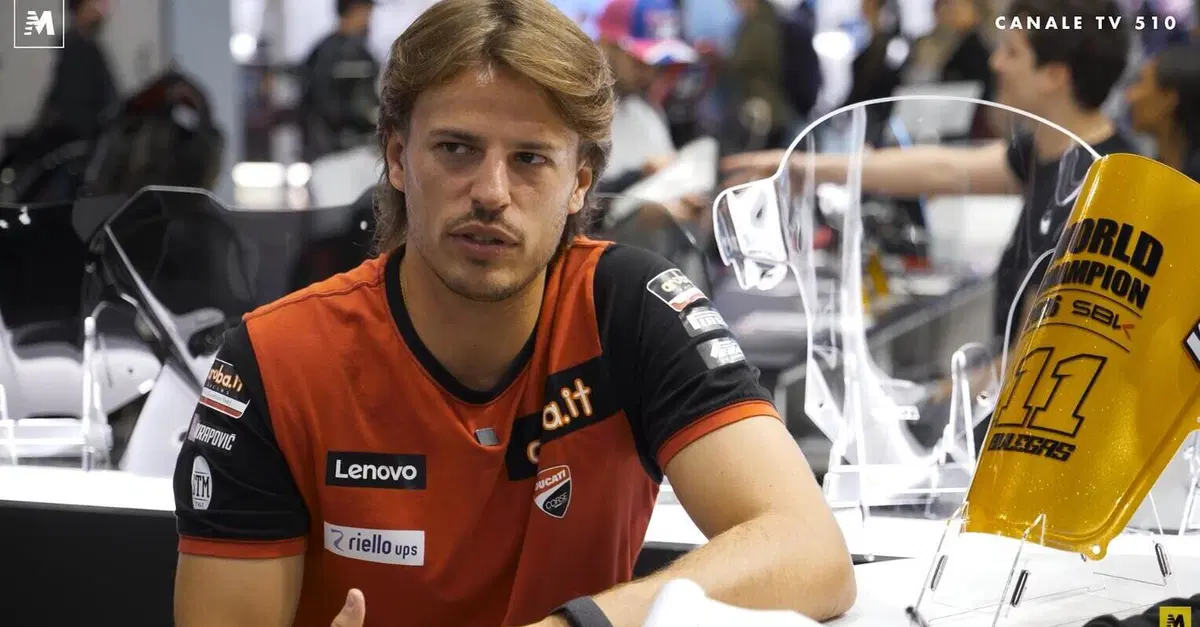
Nicolò Bulega finished 2026 as Superbike champion, but the next challenge is already taking shape: a move into MotoGP. The Italian has ridden both the 850 and 1000 machines, while his latest Superbike campaign brought 32 wins — described as a single-season record — and 52 victories in the category, matching Troy Bayliss. At EICMA, Bulega discussed the demands of the next step, how a MotoGP rider reads the bike at 340 km/h and a private episode involving Marc Márquez.
The championship has particular significance in Italy because the Superbike crown returned there 14 years after Max Biaggi’s 2012 title. Bulega did not necessarily place the championship itself at the top of his personal list. Asked to rank the achievements of his season, he put the single-season wins record first and the 52 victories matching Bayliss second. That comparison means a great deal to him: Bayliss was one of the riders he admired as a child, when his father’s Supersport team gave him an early life in the paddock.
The pressure on the other side of the garage
Bulega singled out Iker Lecuona as an exceptionally strong teammate. He pointed to Lecuona’s speed after moving from Honda to Ducati, which he described as the best motorcycle of the year. The challenge, however, was not only outright pace. With the same machinery, the same team and a direct comparison every time they went on track, a fast teammate can make a rider lose direction and start chasing countless setup changes.
Bulega believes Lecuona avoided that trap and remained strong throughout the season. For that reason, he expects Lecuona to be the rider everyone must beat next year. The conversation also turned to Francesco Bagnaia’s partnership with Márquez, but Bulega did not claim to know what happened inside that garage. He drew instead on his own experience: the pressure is different when a rider is fighting for first and second place than when the battle is for 15th or 20th.
His assessment of Bagnaia was clear and positive. Bulega considers him a very strong rider who can return to the front if he recovers the necessary confidence. He was similarly cautious when discussing Toprak Razgatlıoğlu. The expectations around the Turkish rider had been enormous, but Bulega argued that Yamaha is a difficult motorcycle. He cited Fabio Quartararo, a world champion who also often struggles and finds himself near the back. His view is that Razgatlıoğlu should first be placed on a motorcycle capable of winning before his season is judged properly.
What the rider can read at 340 km/h
Bulega’s account of riding fully tucked shows how little time there is for each decision. With his helmet close to the tank and his eyes looking ahead, he feels heavy vibration through the motorcycle and a strong flow of air over his shoulders and along his back. At 340 km/h, the sensation is almost like flying. There is no opportunity to switch off, however, because the rider remains fully responsible for controlling the machine.
The dashboard cannot be studied continuously. Bulega mainly checks the lap time on the start-finish straight, usually just before the line. He then combines the information agreed with his mechanics, the messages on the board and the sector times displayed on the dashboard. The comparison is with his best lap of the weekend, giving him a quick indication of where he is gaining or losing time.
A rival closing in is not always detected visually. The motorcycles make enough noise for Bulega to distinguish the engine, braking and engine-braking sounds. In terms of his own preferences, he wants confidence from the front end but uses the rear brake heavily. In right-hand corners he operates a rear-brake control with his index finger, positioned beneath the clutch lever; in left-handers he uses his right foot. The same arrangement applies to his Superbike and MotoGP riding, and he has used it for long enough that he no longer wants to ride without it.
The apology after WDW 2024
The most personal revelation concerned the Race of Champions at WDW in 2024. Bulega said Márquez called him on the evening after the race and apologised for their contact. The exchange had not become public because Bulega preferred to keep it private rather than add more controversy around the incident. Márquez also gave him his helmet, writing on the visor that Bulega was a very fast rider with a beautiful riding style.
Bulega also reacted warmly to Márquez’s prediction that he would be the surprise of the following year. For a rider preparing to enter MotoGP, that recognition is an additional source of motivation. The episode is therefore more than a story about contact on track: it shows how an uncomfortable moment can be handled away from the cameras without becoming a public dispute.
850 versus 1000
Bulega has ridden both versions. He tested the 1000 the previous year and completed two Grand Prix, while also working as a test rider with the 850 intended for the following season. He identifies the engine as the main difference: the 850 is noticeably slower. Much of the rest of the concept remains similar. The absence of ride-height devices removes one task from the rider’s workload and makes the motorcycle more straightforward, closer to what Bulega calls a normal bike.
He expects more wheelies off the line compared with the 1000, although that does not mean the front will rise without control. Electronics and winglets will continue to limit the effect. The training programme, meanwhile, does not need a radical overhaul. Superbike is already extremely fast and, in Bulega’s description, heavier than MotoGP. MotoGP’s greater aerodynamic load pushes the machine towards the ground and increases the physical demand, but Bulega still trains every day from Monday to Saturday. He considers the step from Supersport to Superbike larger than the move from Superbike to MotoGP.
If he could combine qualities from great riders, Bulega would take Márquez’s ability to adapt to every condition. From Valentino Rossi he would choose the speed of finding a fast rhythm, from Jorge Lorenzo the corner speed and riding style, and from Casey Stoner the outright pace. To sum up his own 2026 season, he needed one word: “unrepeatable.”
The interview ended with a more private detail. Bulega said he often dreams about crashing as he is falling asleep, as if the front of the motorcycle has folded and his body reacts suddenly. When his partner asks what is happening, he tells her that he has just crashed at Arrabbiata 1. Racing intensity, it seems, does not always end when the rider leaves the circuit.
THE EVIDENCE BEHIND THE STORY
Sources
Spotted something that needs correcting? Contact the editorial team