
Aprilia sweeps the Portimao podium as Marquez seals 10th title
Marco Bezzecchi wins ahead of Jorge Martin and Raul Fernandez, while Marc Marquez secures the 10th world championship of his career.

6 min read
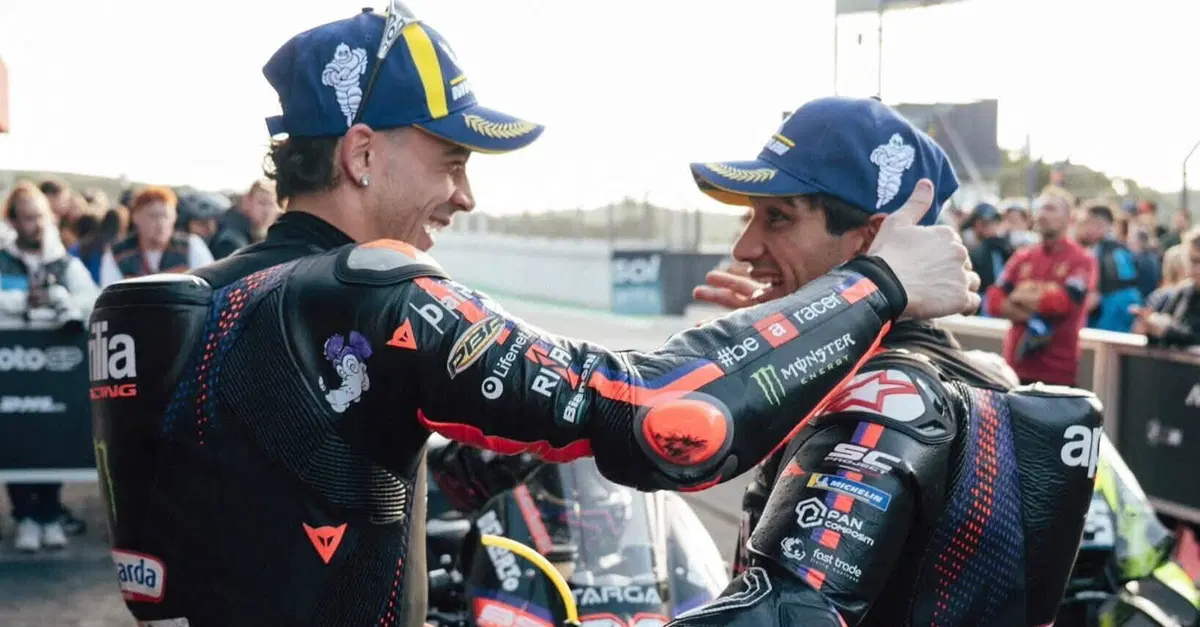
Aprilia produced a perfect race result at Portimao, with Marco Bezzecchi winning ahead of Jorge Martin and Raul Fernandez to create an all-RS-GP podium. The wider championship picture belonged to Marc Marquez, who secured the 10th world title of his career. Aprilia still has work to do in the manufacturers’ championship, but its nine-point advantage over Ducati gives the Italian marque a strong position in that fight.
The result gave the Portuguese weekend two distinct storylines. Bezzecchi converted Aprilia’s strength into victory, Martin delivered a second-place finish after a season shaped by injury and adaptation, and Fernandez completed the manufacturer’s clean sweep. At the same time, Marquez completed the riders’ championship campaign. The combination made Portimao a major moment for Aprilia even though the individual title went elsewhere.
Bezzecchi: a season built on progress
Bezzecchi described the season as his best so far in MotoGP. The victory was his 13th in the premier class, and his wins have come with both Ducati and Aprilia machinery. He also entered the weekend with a first double victory at this circuit among the milestones being discussed around his campaign. Rather than presenting the Portimao result as the product of a single decisive session, Bezzecchi credited the team for finally putting together a complete weekend.
His assessment of the weekend was straightforward: he felt he had done everything possible on the previous day, on race day and across the event as a whole. That satisfaction was mixed with the awareness that the season was not yet finished. Bezzecchi immediately turned his attention to Valencia, saying that the team’s work would continue there before the focus moved to the following season.
Bezzecchi also treated the title battle with Marquez as an important part of his development. He considered it especially satisfying to fight a rider who had been performing at an exceptionally high level. In his view, Marquez’s victory was earned by that strength rather than by circumstance. Spending most of the season near the front gave Bezzecchi a clearer sense of what he had achieved, while also showing him that there were areas where he could still improve.
The season changed Bezzecchi’s relationship with Martin as well. The two Aprilia riders repeatedly fought for the same objective, yet that rivalry brought them closer rather than creating a lasting distance between them. Bezzecchi said their connection had become stronger during the year, building on a relationship that had already developed during the previous season. For Aprilia, having two riders capable of challenging near the front while maintaining that level of cooperation became one of the campaign’s defining features.
Bezzecchi’s comments also carried a note of self-criticism. He said there were things he could do more effectively and areas in which he needed to grow, even while recognising the many positive parts of the season. His approach was to take the confidence from the victories and the championship fight, then return stronger rather than treating the Portimao result as an endpoint.
Martin sees a missed year behind the title loss
Martin regarded second place as a significant result because of the circumstances in which he had reached it. Injuries had kept him away from Aprilia during the previous year, meaning he did not have the time required to establish a technical and working base with the team. He described the current season as a year of construction rather than a campaign that began with everything already in place for a title challenge.
In Martin’s view, one additional full year with Aprilia would have left him much better prepared. He pointed to the difficulty of fighting for a championship when a rider can finish a Friday in 12th, 15th or 10th place. Those starting points make it harder to build the consistent platform required over an entire season, even when the race pace is strong enough to challenge the leading riders.
Despite that frustration, Martin said he was proud of the work completed and of the way he had returned from injury. He placed particular importance on the fact that he reached the podium four weeks after fracturing a radius. The achievement was not simply a result on the Portimao timing sheet for him; it represented a recovery that had once seemed difficult to imagine and a return to the front of the field after a period when his season appeared to be in serious danger.
Martin said the championship opportunity had escaped him over a period of three or four races. He felt that the title had been within reach, even if he had not been the strongest rider throughout the campaign, but the accumulated difficulties eventually narrowed that opportunity. His target at Portimao was to finish first or second and keep pushing until the end. Second place could not reverse the championship result, but it gave him a strong finish and preserved the pride he took from the season.
The Spaniard’s perspective on the final result was shaped more by the journey than by the position itself. He said that finishing second, third or fifth would not change the value of coming back from a broken arm and returning to the front. For Martin, the experience and the lessons gained were more important than the precise championship ranking. He regarded being back in this position as a victory in its own right.
Marquez sets the standard
Martin spoke of Marquez as the best rider in MotoGP history and said that beating him requires complete preparation. He has managed to beat Marquez in individual races, but argued that a rider must be at 100 per cent to fight him over a full championship. Martin added that he had not been at that level consistently, citing limitations with the motorcycle as well as the physical effects of his injuries.
His conclusion was that Marquez is the one rival against whom even a single mistake can prove decisive. That assessment also explains why Martin placed such value on remaining close to the champion’s level. He said that every battle with Marquez gave him something to learn and made him stronger for the future, turning the championship defeat into a reference point for his next challenge.
Martin also argued that Marquez’s 10th title gains significance from the quality of the opposition. A championship would not carry the same weight if the other riders had failed to make the fight difficult, he said. In that sense, the close contest reflected not only Marquez’s achievement but also the level reached by the riders who pushed him throughout the season.
Portimao therefore closed with Aprilia at the centre of the sporting picture. Bezzecchi won, Martin finished second and Fernandez completed the all-Aprilia podium, giving the RS-GP a clean sweep while the manufacturer retained a nine-point lead over Ducati in the constructors’ fight. Marquez, meanwhile, added a 10th world championship to his career. The result captured both sides of the season: a champion who completed the decisive task and an Aprilia group that turned a strong challenge into its clearest race result yet.
THE EVIDENCE BEHIND THE STORY
Sources
Spotted something that needs correcting? Contact the editorial team