
Marc Márquez: 2028 will decide whether there is still a reason to continue
Márquez puts the odds of retirement at 70 percent, but Emilio Pérez de Rosas believes a new challenge could change the decision.

5 min read
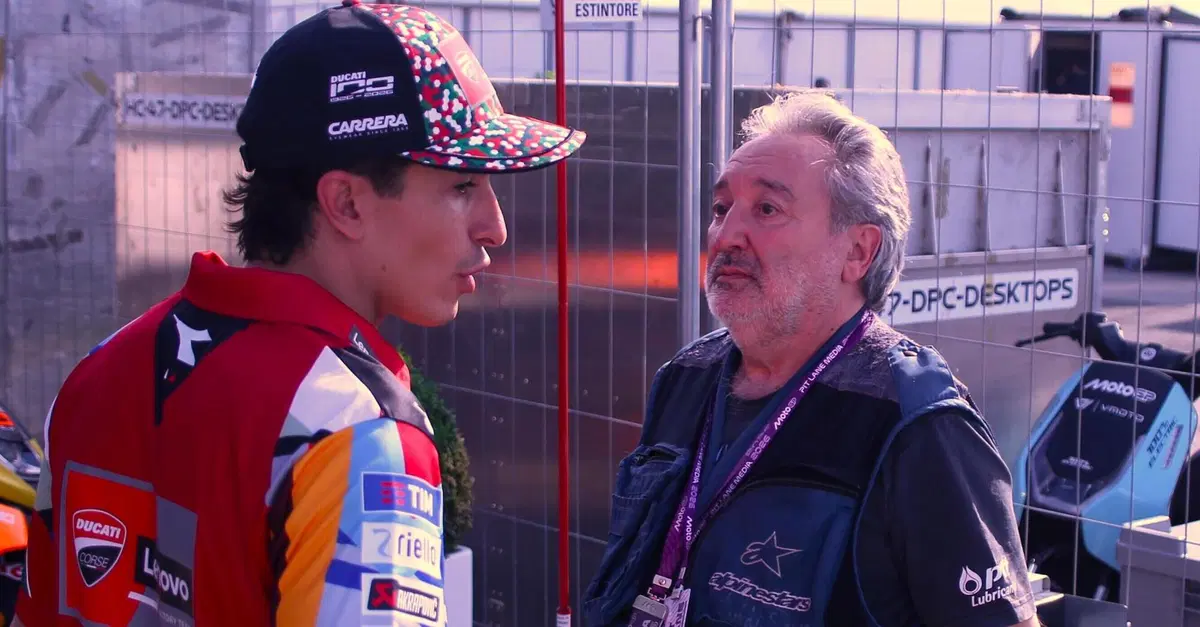
2028 is the milestone Marc Márquez has set for the next major question of his career. When the two years of his Ducati contract are complete, Márquez has said he will decide what comes next. His current personal balance leans 70 percent towards retirement and 30 percent towards racing on. This is not a retirement announcement. It is a view of the future that leaves the next chapter deliberately open.
Emilio Pérez de Rosas, who has known Márquez for years through Emilio Alzamora, does not regard the matter as settled. The case for stopping is easy to understand: Márquez has won his tenth World Championship, endured major periods of injury and rehabilitation, and knows that every additional season demands considerable risk. Pérez de Rosas, however, separates the rational argument made by an outside observer from the way a champion of Márquez’s level is likely to frame the decision.
Retirement depends on the next challenge
Pérez de Rosas’s central point is that Márquez has never operated without a distinctive target. Every year, he believes, the rider finds a new “reto” — a challenge strong enough to justify the intensity, preparation and risk of MotoGP. If another such challenge appears, the current 70 percent leaning towards retirement may shift. If it does not, leaving after 2028 would be a completely coherent choice.
Pedro Acosta is mentioned as one possible example, not as a confirmed future rival. Pérez de Rosas sees a potential source of motivation in a new generation of riders and in a technical environment that rewards different qualities. The conversation also touches on changes to the motorcycle and tyres, as well as the interest surrounding Nicolò Bulega. A new leading rider does not guarantee a particular duel, but it can create the kind of uncertainty that often re-engages a top competitor.
What Pérez de Rosas does regard as clear is what will not keep Márquez in MotoGP: simply filling a place on the grid. He does not see Márquez continuing merely to finish third, fourth or fifth. Competitiveness on its own is not enough. The rider needs a goal that forces him to adapt, take risks and prove again that he can turn a difficult situation into an advantage.
Rossi as motivation and historical measure
Overtaking Valentino Rossi was, in Pérez de Rosas’s view, one important component of Márquez’s career drive. It was not the only reason he pursued his titles with such intensity. Márquez’s return after difficult seasons and his eventual ninth and tenth championships gave a new dimension to a comparison that had begun much earlier.
His assessment of the two riders deliberately avoids a simple comparison of numbers: Márquez is, in his opinion, the greatest, while Rossi is the most important. The former stands out for racecraft, adaptation and intensity on the motorcycle. The latter had a deeper influence on MotoGP’s identity, popularity and relationship with its audience. These are two different ways of leaving a mark, rather than a single ranking table.
In his reading of 2015, Pérez de Rosas places the Márquez-Rossi confrontation at the centre, rather than a strategy designed to help Jorge Lorenzo. Lorenzo was part of the championship context, but Pérez de Rosas believes Márquez’s actions were driven more by the rivalry and direct duel with Rossi. He also considers a future substantive conversation between the two riders positive for both of them and for the sport.
Why 2013 still matters
Márquez had already announced his potential in his first MotoGP season, when he won the 2013 World Championship. It was a competitive campaign: the discussion cites 334 points for Márquez, 330 for Lorenzo and 300 for Dani Pedrosa. Those figures are recalled with some hesitation in the conversation, but the broader point is clear: Márquez took the title in a season in which three leading riders accumulated substantial scores.
Pérez de Rosas also attributes to Márquez the records for youngest rider to reach the podium, set the fastest lap, win and take the title. Those achievements explain why his arrival in the premier class was viewed as more than a strong rookie season. It was the emergence of a rider who combined speed with an unusual ability to understand immediately what was happening around him.
Even so, Pérez de Rosas identifies the previous season’s World Championship as Márquez’s greatest achievement. Its importance, as he describes it, lies not only in the result or the machinery involved, but also in what came before it: pain, rehabilitation, gym work and operations. That path gave the title a weight beyond another addition to Márquez’s record.
Speed was never the whole story
The conversation places particular emphasis on Márquez’s wins with machinery that was not always the best on the grid. The comparison with Honda’s difficulties against other technical packages is used to show what an exceptional rider can add when the equipment does not hold the advantage. It is not only outright speed. It is understanding what the motorcycle needs and extracting more from it than its theoretical potential suggests.
Santi Hernández has compared Márquez with Lionel Messi on a motorcycle. Guim Roda, meanwhile, reduced the rider’s special quality to an observation from his childhood: the other children were fast, but Márquez understood why he was fast. That distinction matters more than raw talent, because it helps explain his adaptation to different motorcycles, rivals and circumstances.
This is what makes 2028 a genuine dilemma. Márquez has reached the historic objective of moving beyond Rossi and now has ten World Championships. To continue, he will need more than the ability to remain quick: an opponent such as Acosta, a technical change or a target capable of recreating the feeling of discovery. If he finds one, the 30 percent assigned to continuation may be enough. If he does not, retirement will be the conscious decision of a rider who has no interest in simply occupying a place on the grid.
THE EVIDENCE BEHIND THE STORY
Sources
Spotted something that needs correcting? Contact the editorial team