
The Half-Bike Margin That Can Decide an Inside Pass
A photograph of Mike Hailwood attacking Phil Read illustrates why reaching the inside is not enough when two racing lines are about to meet.

5 min read
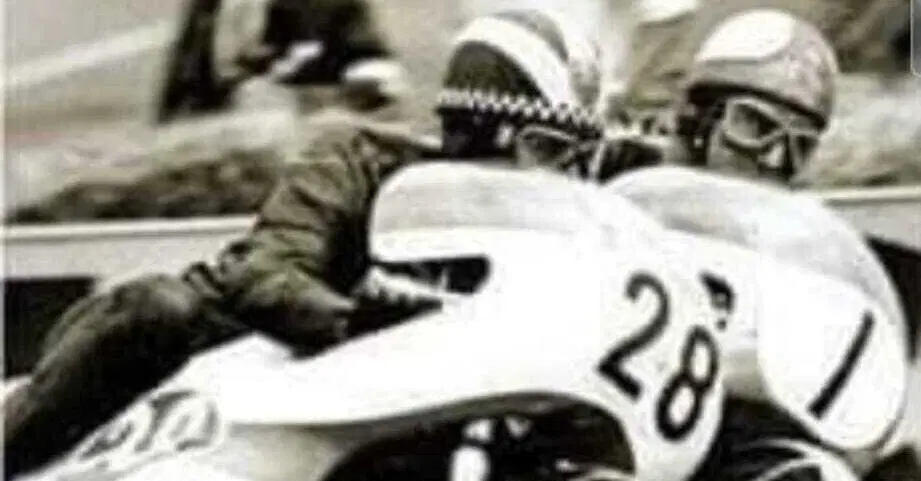
A single racing photograph can show the whole problem with an inside attack without revealing how the move ended. The rider carrying number 1 is attempting to pass number 28 through a corner, arriving on the inside while the other motorcycle follows the outside line. The two riders are Mike Hailwood and Phil Read, whose combined achievements included 16 world titles and 22 TT victories. The historical setting matters less than the situation frozen in the frame: the attack has begun, but the pass is not yet secure.
The geometry of the attack
The inside rider has evidently committed to a later braking point and an earlier turn-in. By taking the tighter route, he travels less distance and aims to arrive at the apex before the motorcycle on the outside. If that happens, the rider who has attacked can place the rival behind him on corner exit. The price is lower speed at the apex, because the tighter trajectory does not allow the same cornering speed as the wider line.
That is the logic behind an inside pass on corner entry: trade some entry and apex speed for position on the shorter path. But the geometry only works if the attacking motorcycle has created enough of a lead before the two paths come together. Reaching the inside first, by itself, does not guarantee that the pass has been completed. The rider on the outside may still be alongside, committed to a line that is about to intersect with the attacker’s route.
In the photograph, number 1 is captured at precisely that uncomfortable point. The machines are running alongside each other and are very close, while the apex is approaching rapidly. The rider making the move appears to be considering whether the other competitor has seen the attack. There is no clear separation that would make the result predictable, and only a fraction of a second remains to decide what happens next.
Why half a motorcycle matters
The practical threshold described in the commentary is at least half a motorcycle ahead before the lines converge. With that margin, the outside rider has a reasonable opportunity to recognise that the inside line is occupied, raise the motorcycle slightly and run wider to avoid contact. It is not a formal measurement of every racing incident, but it explains the difference between a pass that has been established and an attempt that still depends on the other rider reacting perfectly.
The image shows no such margin. The two motorcycles are nearly level, leaving number 1 with two unattractive options. The first is to abandon the attack and slow down, assuming there is still enough room and time to do so. The second is to continue towards the apex and accept the risk of a collision. That decision is made after the braking and turn-in choices have already limited the available escape routes.
This is also why the responsibility of the attacking rider is different from the responsibility of the rider already occupying the outside line. Hailwood, as the rider initiating the move in the photograph, had been watching Read from the beginning of the braking phase and had assessed where the other motorcycle was. Even if he needed to look away briefly to pick up the circuit’s braking and cornering references, the attack remained his decision. The rider who starts the manoeuvre must have a realistic way to complete it rather than leaving the outcome entirely to the other motorcycle’s awareness and cooperation.
What the photograph cannot settle
The frame cannot establish whether Read had already seen Hailwood. It is possible to interpret the outside rider’s position as deliberate refusal to yield, but the photograph does not reveal his awareness or his intention at that instant. A reputation for aggressive or unfair riding may shape a viewer’s first judgment, yet it cannot prove what a rider noticed while approaching the apex.
Nico Cereghini writes that he would prefer to believe Read had seen Hailwood and was choosing not to react, but he also acknowledges that this cannot be known from the image. Cereghini recalls that several riders regarded Read as unfair and says Yamaha shared that view, removing him from its list. Those judgments form part of the historical context around the scene, not a reliable answer to the immediate question of whether Read saw the inside motorcycle.
The same caution applies to the opposite conclusion. The picture does not prove that Read failed to notice the attack, nor does it prove that he deliberately maintained his line to create contact. It shows only the relative positions, the closing distance to the apex and the lack of a decisive gap. That is enough to explain the danger, but not enough to assign every detail of the incident with certainty.
The lesson for a corner-entry pass
An inside pass can be the most secure option at corner entry because the attacking rider controls the shorter trajectory. Its security ends where the two trajectories coincide. At that point, being alongside is not the same as being ahead. The attacking rider needs to have gained sufficient ground—at least the half-bike margin described here—so the outside rider has a visible and physically possible way to avoid the overlap.
The Hailwood–Read photograph therefore works as more than a historical image of two famous riders. It is a study in timing, spatial judgment and responsibility. Braking later and turning earlier may put a motorcycle on the preferred line, but the pass is not complete until the attacker has secured that line before the apex. If the motorcycles remain almost level, the move has transferred its risk to a rider who was already committed to the corner, and the final outcome can depend on a reaction neither competitor has time to guarantee.
THE EVIDENCE BEHIND THE STORY
Sources
Spotted something that needs correcting? Contact the editorial team